For centuries, Western historiography propagated a narrative framing the medieval era—commonly known as the Dark Ages—as a millennium of intellectual stagnation, wedged between the fall of the Roman Empire and the cultural rebirth of the Renaissance. This Eurocentric perspective largely ignored concurrent advancements in the Islamic world, where the courts of Baghdad, Cairo, Córdoba, and Isfahan sustained a flourishing era of scientific, mathematical, and technological inquiry. Among the most remarkable figures of this epoch was the 12th-century polymath Badi al-Zaman Abu al-Izz Ismail ibn al-Razzaz al-Jazari, whose foundational contributions to mechanical engineering prefigured modern automation, hydraulics, and software architecture by centuries.
Al-Jazari’s life and work unfolded against the backdrop of the Artuqid dynasty, a Turkoman principal ruling in the region of Diyar Bakr, centered in the city of Amid (modern-day Diyarbakır, Turkey). During the 12th century, while the European continent experienced the tumult of the Crusades, the Artuqid court fostered an environment of immense cultural patronage and scientific curiosity. Rulers of the dynasty sought to display political legitimacy and economic prosperity through the commission of magnificent public works, monumental architecture, and sophisticated automata. It was within this climate of technological ambition that al-Jazari emerged, eventually rising to the position of chief engineer (Ra’is al-A’mal) at the Artuqid court, a role he maintained for more than three decades until his death in 1206.
Chronology of an Engineering Legacy
The trajectory of al-Jazari’s career is marked by decades of meticulous experimentation, culminating in a defining publication at the close of his life:
- 1136 CE: Badi al-Zaman al-Jazari is born in the Jazira region of upper Mesopotamia, son of a master craftsman.
- c. 1174 CE: Assumes the position of chief engineer for the Artuqid court in Amid, beginning a prolific period of invention focused on hydraulic devices and automata.
- 1180–1200 CE: Develops and refines his masterworks, including complex water-raising pumps, sophisticated water clocks, and automated musical performers displayed within royal palaces.
- 1206 CE: Completes his masterwork, The Book of Knowledge of Ingenious Mechanical Devices (Kitab fi ma’rifat al-hiyal al-handasiyya), shortly before his death.
The Masterwork: The Book of Knowledge of Ingenious Mechanical Devices
Completed in 1206 CE, al-Jazari’s seminal treatise stands as a watershed document in the history of technology. The manuscript meticulously details over one hundred mechanical devices across multiple categories, including water clocks, fountains, automated musical instruments, and advanced water-raising mechanisms. Crucially, unlike many of his contemporaries who guarded trade secrets, al-Jazari provided comprehensive structural diagrams, material specifications, and step-by-step assembly instructions.
Historians of science frequently note that al-Jazari’s methodology anticipated modern open-source documentation. By detailing gear ratios, valve dimensions, and calibration techniques for varying seasonal conditions, he ensured that his inventions were replicable. This commitment to transparent technical communication transformed mechanical design from an occult or isolated craft into a cumulative, shareable discipline.
The Castle Clock: A Monument to Hydraulic Precision
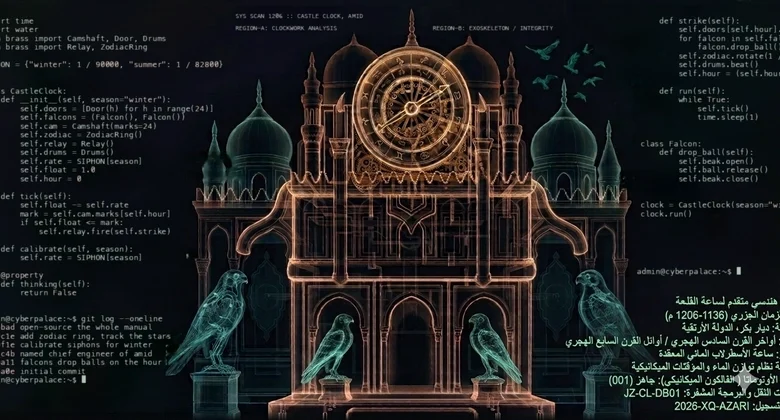
The crowning achievement of al-Jazari’s engineering portfolio was the Castle Clock, a monumental timekeeping device standing approximately eleven feet (over three meters) tall. Installed in the royal courtyard, the structure functioned simultaneously as an astronomical calendar, a public spectacle, and an administrative timekeeper.
The engineering sophistication of the Castle Clock lay in its hidden mechanics. At its core was a continuous-flow hydraulic system driven by a regulated water tank. As water evacuated the primary reservoir through calibrated siphons and flow regulators—principles of fluid dynamics that predated European formalization by centuries—a weighted float descended at a strictly uniform rate. This continuous downward motion served as the mechanical heartbeat of the apparatus.
As the float descended, it triggered a series of physical relays, camshafts, levers, and pulleys. These components acted as a physical program, executing a sequence of automated events on the hour: doors opened, musicians moved, celestial rings rotated, and brass balls dropped into the open beaks of decorative falcons, producing acoustic signals. This deterministic execution of a pre-arranged script using physical hardware closely mirrors the logical processing cycles of modern computing.
Supporting Data and Technical Context
Al-Jazari’s designs incorporated advanced mechanical concepts that would take centuries to be formally theorized and categorized in Western science:
- Hydraulic Regulation: Al-Jazari utilized feedback loops and constant-level tanks to counteract pressure drops, anticipating fluid dynamic principles later described by Daniel Bernoulli in the 18th century.
- Crankshaft Mechanics: While single-throw crankshafts existed previously, al-Jazari was the first to implement a crankshaft-connecting rod mechanism in a multi-cylinder pump, enabling the conversion of rotary motion to linear reciprocating motion—a foundational component of modern internal combustion engines and industrial machinery.
- Segmental Gears: He successfully employed segmental gears to translate rotational power between intersecting axes, optimizing torque transmission in heavy automata.
- Mechanical Programming: Through pegged cylinders and cams, al-Jazari created programmable automata, predating the punch-card systems of the 19th-century Industrial Revolution by over six hundred years.
Scholarly Analysis and Broader Implications
Historians of science and technology argue that the underrepresentation of al-Jazari and his contemporaries in mainstream educational curricula has distorted the historical timeline of human innovation. Academic assessments emphasize that the transmission of engineering knowledge from the Islamic Golden Age to Renaissance Europe—facilitated by trade, translations, and diplomatic exchanges—laid the vital groundwork for the European scientific revolution.
Furthermore, contemporary technology theorists draw direct parallels between al-Jazari’s mechanical logic and modern computer science. By demonstrating that complex, life-like behaviors could be generated through deterministic physical systems—gears, water, and gravity—al-Jazari established the conceptual framework of automation.
The legacy of Badi al-Zaman al-Jazari demonstrates that the evolution of technology is not a sudden, isolated miracle of the modern West, but a continuous, global chain of ingenuity. His work challenges modern observers to reevaluate the medieval period, revealing an era not of darkness, but of precision, clarity, and foundational mechanical brilliance.