The SaaSpocalypse Narrative Faces A Reality Check As Industry Titans Reaffirm The Future Of Software At Dreamforce 2026

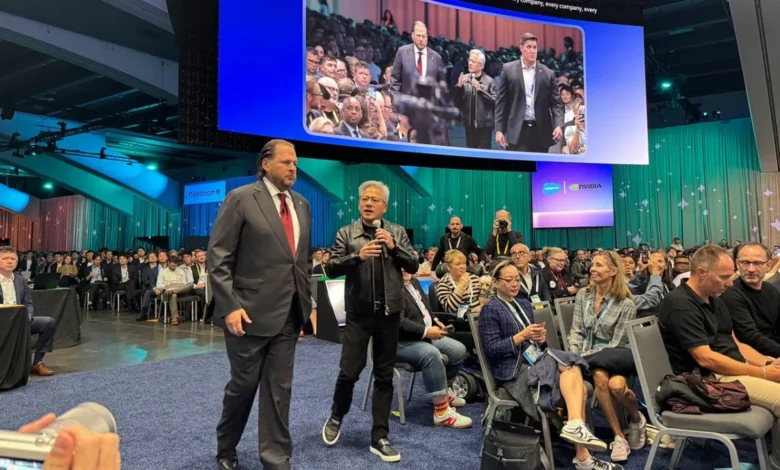
The narrative of an impending "SaaSpocalypse"—the theory that generative artificial intelligence would render traditional Software-as-a-Service (SaaS) business models obsolete—has been the defining debate of the 2026 technology landscape. As enterprises pivoted toward agentic AI workflows, Wall Street analysts and market observers questioned whether the long-standing subscription-based software model was approaching its twilight. However, at the opening day of Dreamforce 2026, two of the industry’s most influential figures—Salesforce CEO Marc Benioff and Nvidia CEO Jensen Huang—directly confronted these anxieties, characterizing the doom-laden predictions as fundamentally misunderstood.
The skepticism surrounding the software industry reached a fever pitch earlier this year, particularly following the launch of Anthropic’s Claude Cowork. This agentic platform, designed to execute complex, multi-step tasks within enterprise environments, triggered a seismic shift in investor sentiment. In February, the S&P 500 Software and Services index experienced a sharp contraction, shedding nearly 5% of its value and erasing approximately $830 billion in market capitalization within a single week. Investors, spooked by the prospect of autonomous agents replacing human-interfaced software, scrambled to divest from traditional cloud-based platforms, fearing that the utility of SaaS had been fundamentally disrupted.
A Chronology of the SaaS Debate
The timeline of this industry turbulence began in late 2025, as large language models (LLMs) transitioned from creative tools into functional, task-oriented agents. By January 2026, venture capital firms began signaling a pivot away from traditional "SaaS-for-everything" models toward companies building native agentic infrastructures.
The turning point occurred in February 2026, when the release of high-performance enterprise agents coincided with weak quarterly outlooks from several secondary software players. This created a "perfect storm" of market volatility. Throughout the spring and summer, industry analysts—including those from major consultancies like Gartner—began publishing reports on "agentic arbitrage," a phenomenon where AI agents automate away the need for traditional software dashboards, effectively bypassing the seat-based licensing models that have underpinned the SaaS industry for two decades.
By August 2026, however, the narrative began to shift as major incumbents reported record-breaking earnings. Salesforce’s Q2 financial results, which highlighted a 210% year-over-year surge in revenue from AI-centric products like Agentforce and Data 360, provided the first major empirical evidence that the "SaaSpocalypse" might be a misnomer.
The Perspective from the Top: Benioff and Huang
During their keynote dialogue at Dreamforce 2026, Jensen Huang addressed the audience with a stark rejection of the software-death narrative. Huang, whose hardware remains the bedrock of the current AI boom, argued that the perception of software as a dying industry stems from a misunderstanding of how AI integrates with existing architectures.
"I was the first CEO to come out—not in the software industry—to say the end of software is nonsense," Huang stated. "This is going to be a layer on top of software. This new layer on top of software is going to be agentic. It’s going to make software so much better."
Huang’s thesis is that agents do not replace software; rather, they transform software from a passive tool into an active collaborator. Instead of humans navigating menus and inputting data, the agentic layer interprets the user’s intent and executes the necessary processes across existing SaaS backends.
Marc Benioff, reinforcing this view, labeled the market’s panic as "crazy nonsense." Benioff noted that while the era of static, human-labor-intensive software is certainly coming to an end, the need for robust, data-rich enterprise platforms has never been higher. "We realize that the SaaSpocalypse isn’t about the end of software, but it may be about the end of software that makes humans do all the work," Benioff explained.
Market Implications and the Rise of AIforce
The strategic response from Salesforce, exemplified by the launch of "AIforce," illustrates how major players are adapting to this new paradigm. AIforce serves as a "live interface layer" that abstracts the traditional dashboard. By allowing users to interact with enterprise data via agents like Claude or proprietary models, Salesforce is essentially decoupling the user interface from the backend infrastructure.
This is a critical evolution for the industry. Gartner’s research in June 2026 identified that roughly $234 billion in application spending is currently exposed to "agentic arbitrage." As users move toward single-agent interfaces that can perform tasks across multiple silos, the traditional "seat" model—where every employee pays for a license to a specific tool—faces structural pressure.
However, as Benioff’s recent earnings performance suggests, the transition is not necessarily a zero-sum game. If a software company can successfully pivot to become the "agentic backbone" for an enterprise, it can capture even higher value by providing the secure data and integration points that these agents require to function effectively.
Broader Industry Impacts and Future Outlook
The broader implications for the IT sector are profound. AWS CEO Matt Garman, speaking on the state of the industry earlier this year, echoed the sentiments expressed at Dreamforce, suggesting that while the fear was overblown, the industry is entering a period of forced evolution.
- Increased Competition: Existing software vendors must now compete not just on features, but on the ability to provide an API-rich environment that is "agent-friendly."
- Licensing Shifts: The industry is likely to move away from rigid per-user pricing toward consumption-based models, where the cost is tied to the volume of work an agent performs.
- Infrastructure Consolidation: Enterprises will likely favor platforms that offer centralized data governance (such as Data 360) because agents require high-quality, real-time data to execute tasks accurately.
While the "SaaSpocalypse" served as a useful wake-up call for an industry that had become overly reliant on legacy interfaces and incremental feature updates, the consensus among industry leaders is that the future is not "no software," but rather "invisible software."
The success of companies that can successfully bridge this gap—maintaining the stability of enterprise SaaS while embracing the fluidity of agentic AI—will likely define the next decade of corporate technology spending. The panic of early 2026 appears to be yielding to a more nuanced understanding: AI is not the executioner of SaaS, but its most significant upgrade.
As IT decision-makers look toward the end of the year and into 2027, the focus is shifting from "how do we replace our software" to "how do we integrate agentic capabilities to increase the ROI of our existing software investments." This shift suggests that while the industry is undergoing its most significant transformation since the rise of cloud computing, the foundational role of software remains firmly intact, albeit significantly more autonomous than it was even eighteen months ago.