Unlocking Advanced Enterprise Search: Native BM25 and Hybrid Capabilities Arrive in Google Cloud AlloyDB and Cloud SQL for PostgreSQL 17+

The landscape of modern artificial intelligence and enterprise data management is undergoing a fundamental shift, moving beyond simple keyword lookups and isolated semantic searches into a unified architecture known as hybrid search. As generative AI, retrieval-augmented generation (RAG), and autonomous data agents become core components of enterprise software, the limitations of relying on a single search paradigm have grown increasingly apparent. Vector embeddings, while revolutionary in their ability to capture conceptual meanings, semantic intent, and contextual nuances, routinely falter when tasked with locating precise alphanumeric strings, product SKUs, serial numbers, and strict geographic identifiers. Conversely, traditional full-text search excels at exact matches but lacks the cognitive flexibility required to understand broader thematic queries.
To bridge this operational divide, Google Cloud has announced the public preview of native BM25 indexing in AlloyDB and Cloud SQL for PostgreSQL 17+. Powered by the open-source pg_textsearch extension originally developed by Tiger Data, this native integration allows developers to combine semantic vector search with gold-standard keyword retrieval directly within their operational databases. By eliminating the necessity of maintaining, provisioning, and synchronizing separate external search engines, the new capability addresses long-standing challenges in database architecture, including data silos, network latency, synchronization lags, and escalated infrastructure expenditures.
The Evolution of Information Retrieval and the Limitations of Legacy Postgres
For years, developers seeking to implement full-text search natively within PostgreSQL environments relied on built-in functions such as ts_rank. While adequate for basic applications, standard PostgreSQL ranking mechanisms degrade significantly as document corpora expand to enterprise scales. Traditional built-in functions lack native support for inverse document frequency (IDF), meaning common words carry the same weight as statistically rare, high-value terms. Furthermore, they lack term-frequency saturation, an essential mathematical safeguard that prevents a document from being artificially inflated in the rankings simply because a non-relevant keyword is repeated dozens of times.

To resolve these architectural shortcomings, the industry has long relied on the Best Matching 25 (BM25) algorithm as the gold standard for text retrieval. BM25 incorporates term frequency saturation, inverse document frequency weighting, and document length normalization to accurately score how relevant a given document is to a specific search query. Historically, implementing BM25 ranking within managed database services like AlloyDB or Cloud SQL required provisioning an external search backend—such as Elasticsearch or OpenSearch—and building complex synchronization pipelines to keep operational data updated across separate systems.
The integration of the pg_textsearch extension fundamentally alters this paradigm. By building a high-performance BM25 search engine directly on PostgreSQL data pages, Google Cloud enables relational databases to handle complex keyword retrieval with the speed, accuracy, and reliability previously reserved for dedicated search clusters.
Technical Architecture: Unifying Vector and Keyword Search
The introduction of native BM25 indexing in AlloyDB and Cloud SQL for PostgreSQL 17+ empowers developers to construct comprehensive hybrid search architectures entirely inside their operational data stores. The underlying workflow relies on the orchestration of two distinct indexing mechanisms on a single table: a vector index (such as ScaNN in AlloyDB or HNSW in Cloud SQL) for semantic understanding, and a native BM25 index for exact lexical matching.
To illustrate the implementation, consider a representative retail dataset, such as a cymbal_products table containing unique identifiers (uniq_id), product names, detailed textual descriptions (product_description), and generated vector embeddings (product_embedding). By enabling the pg_textsearch extension, database administrators can instantly create a BM25 index directly on the text description column using specialized operators.
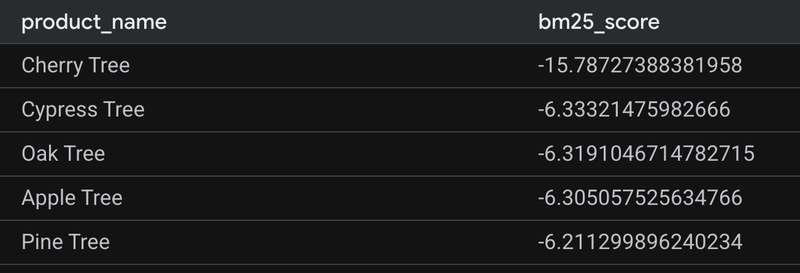
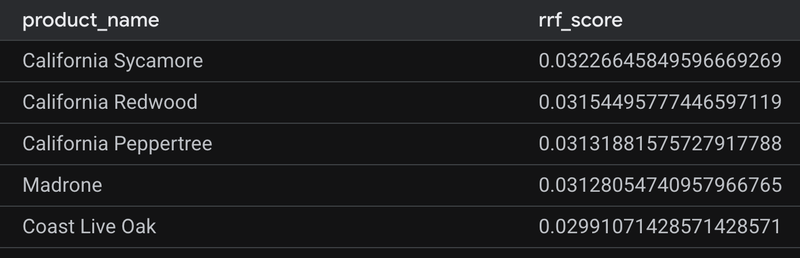
When executing a search query, the database evaluates both dimensions of the user’s intent. For instance, a query such as "trees that grow taller than houses" leverages semantic vector embeddings to capture the conceptual meaning of height and arboreal growth. Simultaneously, a targeted keyword constraint for "California" utilizes the BM25 index to guarantee that strict geographic or proper-noun requirements are rigorously enforced.
To merge these disparate scoring systems into a single, cohesive result set, both AlloyDB and Cloud SQL utilize the Reciprocal Rank Fusion (RRF) algorithm. AlloyDB simplifies this process further by providing an out-of-the-box hybrid search user-defined function (UDF), while Cloud SQL achieves the same architectural outcome through standard Common Table Expressions (CTEs) and score coalescing. The resulting output presents users with a single, highly relevant ranked list where conceptual intuition and absolute keyword precision intersect seamlessly.
Operational Implications and Industry Impact
The release of native hybrid search capabilities within managed PostgreSQL services carries profound implications for enterprise software architecture and cloud cost management. Maintaining disparate infrastructure for operational data and search indices has historically introduced significant friction, including increased vulnerability windows, operational overhead, and recurring software licensing or cloud provisioning expenses.
By consolidating these workloads into a unified PostgreSQL environment, enterprises can achieve substantial reductions in total cost of ownership (TCO). Data remains strictly within the primary database, eliminating the synchronization delays that frequently plague decoupled microservices architectures. This ensures that real-time transactional updates, inventory adjustments, and catalog modifications are immediately reflected in both vector and full-text search results without batch-processing delays.
Furthermore, the integration addresses the growing demand for deterministic reliability in generative AI applications. While large language models and vector search engines are exceptional at generating creative or conceptually aligned recommendations, they are notoriously susceptible to hallucinations or misinterpretations when handling exact constraints. By anchoring semantic search results with deterministic BM25 keyword matching, developers can build RAG pipelines and enterprise data agents that deliver both contextual depth and absolute factual accuracy.
Future Outlook and Availability
The preview availability of native BM25 indexing in AlloyDB and Cloud SQL for PostgreSQL 17+ marks a major milestone in Google Cloud’s broader strategy to optimize relational databases for modern AI workloads. As organizations increasingly transition experimental generative AI applications into production-grade enterprise environments, the demand for robust, low-latency, and economically viable database infrastructure will only accelerate.
Industry analysts note that extensions like pg_textsearch represent a growing trend toward database extensibility, where relational engines absorb specialized functionalities that previously required external third-party software. By leveraging open-source innovations and integrating them directly into fully managed, enterprise-grade cloud services, Google Cloud is positioning PostgreSQL as an increasingly versatile foundational layer for the next generation of intelligent applications. Developers and database administrators can begin testing native BM25 and hybrid search workflows immediately within AlloyDB and Cloud SQL instances running PostgreSQL 17 or higher.
Related posts: