The advent of semantic layers fundamentally reshaped the landscape of business intelligence (BI), offering a standardized and governed view of data across disparate tools and dashboards. This innovation promised a unified understanding of metrics, aligning departmental definitions and empowering analysts to query complex schemas without deep technical expertise, all while enforcing robust access controls for sensitive information. For a period, these solutions effectively met the demands of a human-centric data consumption model. However, as the enterprise increasingly embraces artificial intelligence (AI), particularly autonomous agents, the limitations of these traditional semantic layers have become starkly apparent. The core assumption that a human was always the end-user of the data is no longer sufficient in an era where AI agents are tasked with understanding and reasoning over enterprise data. The critical question now is whether these established semantic layers can provide the robust foundation that AI agents require to operate with accuracy, control, and cost efficiency as AI transitions from experimental phases to operational deployment across organizations.
The Inherent Limitations of Traditional Semantic Layers for AI
Understanding why traditional semantic layers falter in the current AI paradigm necessitates a closer examination of how AI interacts with enterprise data. Large Language Models (LLMs) and AI agents are designed to query data autonomously. Crucially, they need to grasp the meaning of the data, not merely its location within a database schema. When an AI agent is presented with raw schema information, it can readily discern the structure. The challenge arises when it encounters terms like "revenue" or "margin." Without explicit, context-rich definitions, the agent may struggle to differentiate between, for example, gross revenue and net revenue, or a re-defined financial metric from a previous quarter. This ambiguity forces the AI to infer and speculate, often producing outputs that appear plausible on the surface but are fundamentally flawed in their underlying logic.
The issue is not a lack of structural understanding but a deficit in nuanced business context. An AI agent might correctly identify the relevant table and column for "revenue." However, it lacks the critical understanding of how different departments, such as finance and sales, define and utilize this metric. It also fails to grasp its position within the broader business ontology of revenue recognition. While a simple metric definition might prevent the AI from inventing its own meaning of "revenue," a correct label for a single field is insufficient for answering complex enterprise questions, which rarely revolve around isolated data points. These traditional semantic layers were not engineered to bridge this gap. Their design was optimized for human analysts and BI tools, failing to expose the intricate relationships, organizational knowledge, and governed business logic that AI systems need for consistent and accurate reasoning across vast datasets. As AI agents are increasingly delegated decision-making authority, a dedicated layer to govern these autonomous machines has become an urgent necessity.
The Architecture of an AI-Ready Semantic Layer
To achieve reliable operation at enterprise scale, AI systems demand a unified semantic foundation that delivers trusted business context, optimizes token efficiency, ensures consistent governance, and provides enterprise-grade performance. Examining these non-negotiable components reveals the blueprint for an AI-ready semantic layer.
Beyond Metric Definitions: Rich Business Context
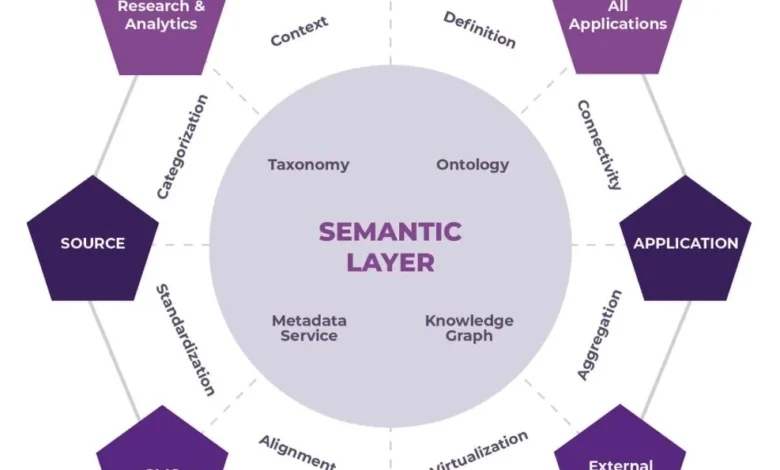
While a certified metric definition, such as the precise meaning of "margin" or "revenue," is essential to prevent AI from fabricating its own interpretations, it represents only a partial solution. Enterprise-level inquiries are inherently multi-faceted. For instance, answering a question like, "Why did margin fall in the Northeast last quarter?" requires the AI to intricately connect data points across products, regions, sales channels, and specific timeframes. It must also apply relevant business rules, including fiscal calendars, currency conversions, and the appropriate aggregation levels. Even if an AI retrieves individual metrics accurately, it can still reach an incorrect conclusion if data is joined at an inappropriate level, a business rule is misapplied, or data is inadvertently counted multiple times. In essence, correct metric definitions are a prerequisite, but without a profound understanding of business semantics—the relationships that bind data and the ontologies that structure this knowledge—AI can still arrive at erroneous conclusions. An AI-ready semantic layer addresses this by providing this high-fidelity business context directly to AI systems.
Integrated Governance for Trust and Compliance
Governance must be an intrinsic element of the business context delivered to AI. All AI operations should adhere to the same governance framework that governs human enterprise users. This includes the consistent enforcement of governed business logic, access controls, data lineage, and audit trails across every interaction. Such integration ensures that AI-generated outputs remain traceable, explainable, and compliant with regulatory requirements. This proactive approach to governance mitigates risks associated with autonomous decision-making and builds essential trust in AI-driven insights.

Optimizing Token Economics for Scalability
Token efficiency is a critical consideration as AI adoption scales. In the absence of an AI-ready semantic layer, agents are compelled to reconstruct business context from scratch for every query, starting with raw metadata and rudimentary prompt instructions. This repetitive process leads to significant inefficiencies, with organizations effectively paying to recreate the same logic repeatedly. A well-designed semantic layer circumvents this by pre-providing essential context. This not only enhances first-response accuracy but also dramatically reduces token consumption, a crucial factor in controlling costs as AI usage proliferates across the enterprise. For example, a study by a leading AI research firm indicated that by pre-caching and structuring contextual data, organizations could reduce LLM API calls for analytical queries by up to 60%, translating directly into substantial cost savings.
Enterprise-Scale Performance and Cloud Efficiency
AI agents fundamentally alter how enterprise data is consumed, introducing continuous, high-volume, and highly concurrent workloads. An AI-ready semantic layer must not only support accurate reasoning but also sustain enterprise-scale performance under these demanding conditions. Furthermore, it must maintain cloud efficiency as adoption grows. Traditional BI tools, while effective, often generated periodic reports or ad-hoc analyses. AI agents, conversely, can generate a constant stream of queries, placing a strain on underlying data infrastructure if not properly managed. Solutions that decouple query processing from the data warehouse can offer significant advantages in terms of latency and cost, especially as AI workloads expand.
A Unified, Interoperable Foundation
In the BI era, the ability of different tools to maintain their own metric definitions and business logic was manageable because human analysts could manually reconcile inconsistencies. AI agents, however, lack this critical discernment. They do not question conflicting definitions; instead, they often select one arbitrarily and proceed. This can lead to inconsistent reasoning and compounding errors across an organization deploying multiple AI applications. As organizations embrace AI, maintaining separate semantic models for each consumer becomes an untenable strategy. AI systems necessitate a single, unified semantic foundation that acts as an intermediary between enterprise data and all consumers, including AI agents, LLMs, BI tools, applications, and APIs. This unified approach also facilitates adaptability. As AI technology evolves with new models and frameworks emerging regularly, the underlying business logic should remain stable. An AI-ready semantic layer provides this foundational stability, enabling organizations to adopt new AI technologies without the need for constant stack rebuilds.
Beyond Traditional Solutions: The AI-Centric Semantic Layer
It is crucial to recognize that not all semantic layers are engineered to meet the demands of enterprise AI. Many traditional vendors have focused on solving specific problems within their historical contexts. For instance, platforms like AtScale excel at federated query capabilities, while Cube offers a developer-friendly API layer. dbt Labs is recognized for its strong metric consistency across data pipelines. However, these specialized strengths do not inherently equip them to cater comprehensively to the multifaceted requirements of enterprise AI.
These existing solutions often provide varying degrees of business context. Nevertheless, AI systems frequently find themselves needing to reconstruct business understanding from raw metadata and schemas, a process that contributes to higher token usage and diminished efficiency. The execution architecture of these semantic layers also plays a significant role in enterprise AI performance. Many rely heavily on the cloud warehouse to process every query. As AI usage expands across users and applications, this creates contention for warehouse resources, increases response latency, and drives up cloud compute costs.
The most effective AI-ready semantic layer adopts a fundamentally different approach. It must seamlessly integrate business context, enterprise-scale performance, and AI token efficiency onto a single, cohesive semantic foundation. This holistic design ensures that AI agents can operate with the accuracy, speed, and cost-effectiveness required for widespread adoption.
The enterprises poised to thrive in the next wave of AI innovation will not be distinguished solely by their speed in adopting new tools. Their success will be measured by the trustworthiness of the data that powers those tools. This foundational trust, critical for reliable AI operations, begins with a robust and intelligently designed semantic layer. The shift from BI to AI necessitates a paradigm shift in how we conceptualize and implement data governance and context, making the evolution of the semantic layer a central pillar of modern enterprise data strategy. The implications extend beyond mere data access; they touch upon the very integrity and reliability of AI-driven business processes and decision-making.
Related posts: