Researchers Uncover DDRop: A Novel Hardware Attack Exploiting Freshness Vulnerabilities in Intel and AMD Confidential Computing

A collaborative team of academic researchers and security engineers has disclosed details regarding a sophisticated hardware attack dubbed "DDRop," which fundamentally undermines memory protection mechanisms across modern enterprise server architectures. The vulnerability targets confidential computing environments—specifically Intel TDX, Intel Scalable SGX, and AMD SEV-SNP—by silently dropping memory writes, thereby tricking processors into reading stale encrypted data.
The discovery exposes a fundamental design compromise inherent in contemporary cloud server memory encryption: while data is encrypted while traversing buses and residing in dynamic random-access memory (DRAM), hardware implementations frequently omit "freshness" guarantees. Consequently, servers can mathematically verify that data is encrypted, but they cannot verify whether it represents the most recently written iteration.
The research was conducted by scientists from KU Leuven, ETH Zurich, Durham University, and Google. The findings are scheduled to be formally presented in November at the ACM Conference on Computer and Communications Security (CCS 2026). To foster transparency and further scientific evaluation, the research collective has made the interposer board designs, controller firmware, and proof-of-concept attack code publicly available on GitHub, alongside their comprehensive academic paper.
Mechanics of the DDRop Attack: Hardware Interposers and Stale Data
Modern cloud architectures heavily rely on confidential computing to insulate multi-tenant workloads from unauthorized observation, ensuring that even hypervisors, cloud administrators, and physical infrastructure operators cannot inspect tenant memory in plaintext. To scale efficiently across the massive memory footprints demanded by enterprise cloud environments, hardware designers enforce encryption without implementing a complete hardware integrity and freshness tree.
DDRop exploits this exact architectural gap through the deployment of an "interposer"—a custom-built, low-profile circuit board costing less than $200 in raw components. Measuring the physical dimensions of standard memory channels, the interposer is slotted directly between the host processor and a DDR5 memory module.

Operating at full DDR5 speeds, the interposer consists of high-speed digital logic switches capable of monitoring and manipulating the memory bus in real-time. When a write command is issued by the processor to update data in memory, the interposer deliberately forces a command error on the bus. Simultaneously, it severs the specific physical trace wire that the memory module uses to report errors back to the controller. As a result, the memory module quietly discards the write instruction entirely, while the processor remains oblivious, proceeding under the assumption that the memory update completed successfully.
When the processor later requests the data, the memory returns the older, pre-existing encrypted value. Because the cryptographic engine evaluates the ciphertext using standard validation checks and finds it mathematically consistent with the encryption key, it decrypts the stale data without triggering security exceptions.
Evolution from Passive Monitoring to Active Manipulation
DDRop represents a notable milestone in hardware security research as the first active interposer attack capable of operating at full speed on modern DDR5 memory architectures deployed in contemporary cloud datacenters.
Previous attempts to probe or manipulate DDR5 memory buses—such as the TEE.fail side-channel attack disclosed in late 2025—were strictly passive. Those methodologies relied on listening to memory bus traffic, often requiring researchers to artificially throttle memory speeds and utilize specialized, secondary laboratory equipment to capture leakage.
Conversely, earlier active attacks capable of altering memory states, such as the "Battering RAM" exploit, were restricted exclusively to older DDR4 memory modules. Those attacks relied on an address-swapping technique that has since been rendered obsolete by the redesigned, robust command and signaling formats introduced with DDR5 specifications. DDRop bypasses these structural fortifications not by attempting to remap or alter addresses, but by executing a targeted, silent write-dropping sequence.
Target Analysis: Breaking Intel TDX and AMD SEV-SNP
The research team successfully demonstrated that DDRop can be leveraged to achieve arbitrary control over virtual machines running on Intel Trusted Domain Extensions (TDX) architectures.

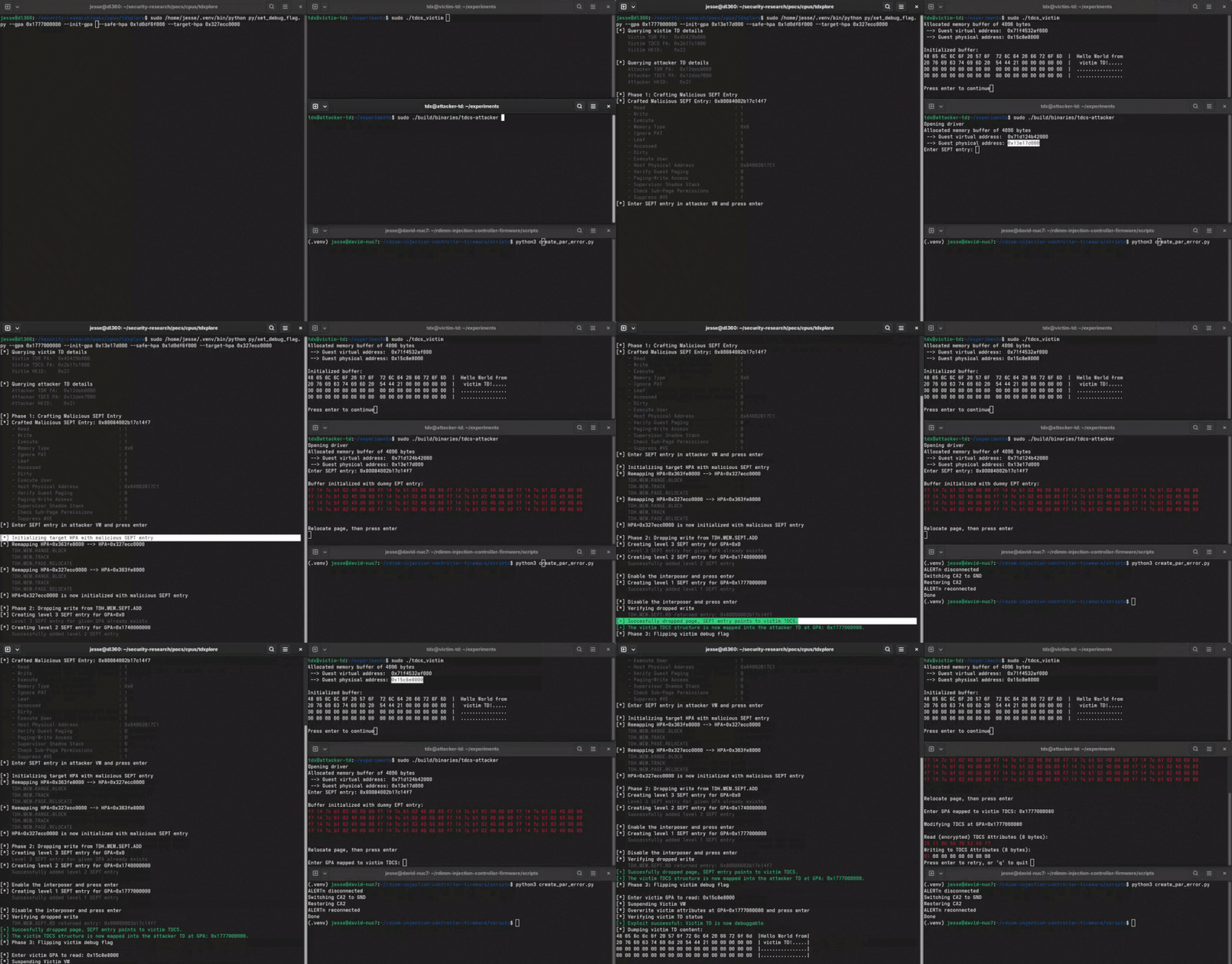
Under normal operational parameters, Intel TDX utilizes trusted firmware to maintain isolated, encrypted page tables for individual virtual machines. When this firmware attempts to write empty memory entries to establish a new page table during initialization, the DDRop interposer drops the write instructions. This forces the system to retain attacker-controlled data previously planted in that specific physical memory segment. Consequently, an untrusted virtual machine managed by an attacker can map its own memory allocations onto arbitrary physical addresses, granting read-and-write access to protected memory spaces belonging to co-hosted victim workloads.
By securing this level of foundational access, the researchers executed three distinct attack vectors under Intel TDX’s default logical integrity mode:
- Memory Inspection: Reading sensitive cryptographic materials and private data from a victim virtual machine.
- Debug Mode Toggling: Forcing a victim virtual machine into a diagnostic debug state, allowing plaintext memory extraction before restoring the original data configurations to eliminate visible artifacts of tampering.
- Attestation Forgery: Overwriting the foundational launch measurement—a cryptographic hash utilized by remote clients to verify that a virtual machine booted from a pristine, trusted software image. By altering this measurement, malicious workloads can impersonate legitimate enterprise instances during remote attestation procedures.
The researchers noted that two of these vectors—direct memory reading and unauthorized debugging—would be successfully mitigated by Intel TDX’s optional, stronger cryptographic integrity mode, which enforces stricter cross-VM protections. However, they argue that attestation forgery would likely persist even under cryptographic integrity, because the write operations occur internally within the attacker’s isolated virtual machine space under its own assigned key, marking the generated data as structurally valid to the hardware engine.
When evaluated against AMD Secure Encrypted Virtualization-Secure Nested Paging (SEV-SNP), the scope of the exploit was comparatively narrower. Utilizing the interposer to drop writes during AMD’s specialized page-relocation processes enabled researchers to duplicate the contents of a victim memory page into another location. However, the advanced debug-mode manipulation and attestation-forggeries demonstrated on Intel systems were specific to the TDX architecture.
Industry and Vendor Responses
Coordinated disclosure protocols were initiated prior to public dissemination, alerting both Intel and AMD to the structural vulnerabilities associated with DDRop. Both corporations acknowledged the research findings, but neither issued immediate mitigation guidelines or software patches, citing the inherent limitations of their published threat models.
Representatives from AMD communicated that because the attack necessitates direct physical access to enterprise hardware, it falls strictly outside the defined threat model governing SEV-SNP deployments. Intel adopted an identical stance regarding physical attacks targeting server-grade memory channels, confirming via its product security channels that physical interposer exploits do not warrant the assignment of Common Vulnerabilities and Exposures (CVE) identifiers.

Furthermore, Intel officially stated that physical interposer attacks reside entirely outside the boundary of protections guaranteed by its memory encryption frameworks. While Intel’s newer Xeon processors support optional cryptographic-integrity modes that partially mitigate certain classes of interposer manipulation, the corporation has characterized this domain of physical hardware research as "out of scope, but not out of mind," indicating that future silicon generations will incorporate enhanced bus-level safeguards.
Broader Implications for Cloud Computing and Security
DDRop underscores the continuous tension between performance scalability and exhaustive physical security in enterprise infrastructure. Cloud service providers—including Amazon Web Services, Microsoft Azure, and Google Cloud Platform—depend heavily on confidential computing guarantees to market secure cloud environments for sensitive financial, governmental, and healthcare applications.
The researchers emphasize that DDRop does not demonstrate any active breaches or compromises of live cloud infrastructure in the wild. Rather, the vulnerability highlights a latent physical security risk: an adversary with brief, localized hardware access can install an inexpensive circuit board in a matter of minutes. Such physical access could theoretically be achieved via compromised supply chain logistics, legally compelled hardware seizures, or rogue datacenter personnel.
Because the underlying vulnerability stems from hardware architecture rather than software implementation, security analysts agree that conventional operating system patches or hypervisor updates cannot fully remediate the issue. Safeguarding against interposer-based attacks will ultimately require future generations of server silicon to integrate comprehensive memory freshness verification—such as advanced cache-line versioning mechanisms—directly into the memory controller and bus architectures without incurring prohibitive performance penalties.