F5, a leading application security and delivery company, has released critical patches for a severe vulnerability in NGINX, identified as CVE-2026-42533. This flaw, described as a heap buffer overflow, could allow a remote, unauthenticated attacker to trigger a denial of service (DoS) and potentially achieve remote code execution (RCE) by sending specially crafted HTTP requests to vulnerable NGINX worker processes. The fixes were rolled out on July 15, impacting NGINX versions 1.30.4 (stable) and 1.31.3 (mainline), as well as NGINX Plus 37.0.3.1. System administrators operating on any earlier builds are strongly advised to upgrade immediately to safeguard their infrastructure against potential exploitation.
The discovery of CVE-2026-42533 sends a significant ripple through the cybersecurity community, given NGINX’s pervasive presence across the internet. NGINX, an open-source web server, reverse proxy, and load balancer, powers an estimated one-third of all active websites, including many high-traffic platforms and critical enterprise applications. Its role as a fundamental building block for modern web infrastructure means that any significant vulnerability in its core functionality carries widespread implications for global internet security. The flaw’s ability to be triggered remotely and without authentication underscores its severity, making prompt patching an absolute imperative for organizations worldwide.
The Heart of the Matter: Unpacking CVE-2026-42533
At its core, CVE-2026-42533 is a heap buffer overflow residing within NGINX’s script engine. This engine is responsible for dynamically assembling strings from various directives at request time, a critical function in how NGINX processes and responds to incoming web traffic. A heap buffer overflow occurs when a program attempts to write more data into a fixed-size memory buffer than it was allocated, overwriting adjacent memory regions. This can lead to various unpredictable outcomes, ranging from application crashes (denial of service) to the execution of arbitrary code, granting attackers full control over the compromised system.
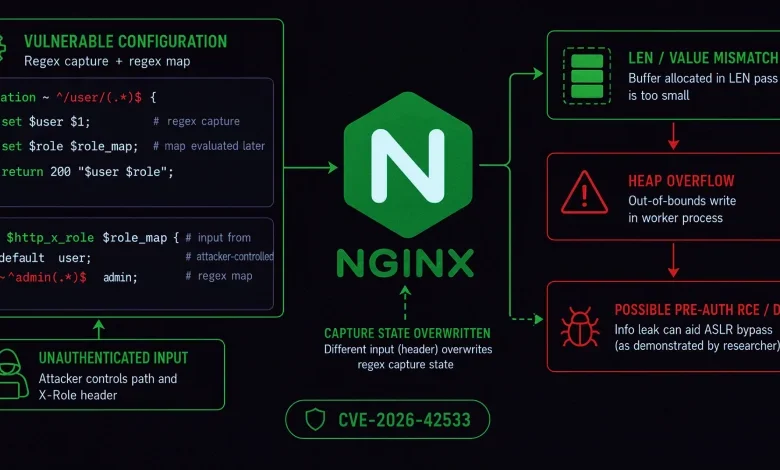
The vulnerability specifically manifests under a very particular NGINX configuration. It requires the presence of a regex-based map directive whose output variable is subsequently referenced in a string expression. Crucially, this reference must occur after a capture from an earlier regular expression match has been made and referenced. This specific confluence of configuration elements creates the conditions necessary for the flaw to surface, highlighting the intricate nature of modern software vulnerabilities that often depend on complex interactions between different code paths and user configurations.
The Flawed Two-Pass Evaluation
The technical root of the problem lies in NGINX’s two-pass evaluation mechanism within its script engine. When processing string expressions that involve variables and regex captures, NGINX typically performs two distinct passes:
- First Pass (Measurement): The engine calculates the exact number of bytes required for the final result string and allocates a buffer of that precise size in memory.
- Second Pass (Writing): The engine then proceeds to write the actual bytes of the result string into the previously allocated buffer.
The critical breakdown occurs because both passes rely on a shared capture state. In the vulnerable configuration, evaluating the map directive’s regex between these two passes causes a crucial overwrite of this shared capture state. Consequently, the first pass, which determines the buffer size, uses the original capture (e.g., $1 from a location match). However, by the time the second pass begins to write data, the shared capture state has been modified by the map‘s regex evaluation, effectively replacing the original capture with a different, attacker-controlled value.

This desynchronization means the buffer is sized for the original, potentially smaller, capture, while the writing pass attempts to fill it with data from the new, attacker-controlled, and potentially much larger, capture. The result is an undersized buffer being overrun, with both the length and the content of the overflow directly controlled by elements within the attacker’s HTTP request. This direct control over the overflow makes the vulnerability particularly dangerous, as it can be leveraged not just for crashing the worker process but also for more sophisticated memory manipulation leading to RCE.
Assessing the Broad Scope of Exposure
While the technical conditions for exploitation are specific, the sheer age and widespread adoption of NGINX mean that the potential attack surface is vast. F5’s advisory confirms that the flaw affects every NGINX version from 0.9.6 through 1.31.2, a staggering range that dates back to 2011. This timeline is significant because it coincides with the year the map directive gained regex support, indicating that the vulnerability has been lurking in the codebase for over a decade. This long dormancy period for such a critical flaw underscores the challenges of maintaining large, complex software projects and the difficulties in identifying subtle logical errors that only emerge under specific operational contexts.
Widespread Vulnerability Across Versions
The broad scope of affected versions implies that many legacy NGINX deployments, which might not be regularly updated, are critically exposed. Organizations often struggle to keep all software components fully patched, especially for foundational infrastructure like web servers, due to concerns about compatibility, downtime, or resource constraints. This vulnerability highlights the significant risk associated with delayed patching and the importance of a robust patch management strategy.
F5’s Role and Product Specifics
F5, as the company behind NGINX, also noted that the vulnerability impacts several of its commercial products that integrate NGINX, including NGINX Ingress Controller, NGINX Gateway Fabric, NGINX App Protect WAF, and NGINX Instance Manager. At the time of the initial publication, while fixes were available for the core NGINX server and NGINX Plus, F5 had not yet listed fixed builds for these specific downstream products. This lag can be a point of concern for enterprises heavily reliant on these integrated solutions, as it means a complete patching strategy might involve waiting for additional updates, leaving a temporary window of vulnerability.
CVSS Scores: A Measure of Severity
F5 has assigned CVE-2026-42533 a high severity score on industry-standard vulnerability metrics. On CVSS v4, the vulnerability scores 9.2, and on the older CVSS v3.1 scale, it scores 8.1. Both scores categorize the flaw as "critical" or "high," reflecting its potential for significant impact. While F5 initially rated the attack complexity as "high," further analysis by independent researchers, as detailed below, suggests that the practical complexity for achieving remote code execution might be lower than initially assessed, increasing the overall risk profile. These high scores are a clear signal to system administrators that this is not a vulnerability to be underestimated or deferred.
Unveiling Deeper Exploitation Potential: Researcher Insights
The disclosure of CVE-2026-42533 was not the result of a single discovery but rather a testament to collaborative security research, with F5 thanking over a dozen researchers who independently brought the issue to their attention. The NGINX changelog specifically credits Mufeed VH of Winfunc Research and NGINX maintainer Maxim Dounin for their contributions to the fix.

Among the reporters, Stan Shaw, publishing under the pseudonym cyberstan, released a highly detailed write-up that goes significantly beyond F5’s initial advisory. Shaw’s analysis sheds crucial light on the true exploitation potential of the flaw, particularly concerning remote code execution.
Stan Shaw’s Critical Contribution: RCE Beyond F5’s Initial Assessment
F5’s initial advisory stated that remote code execution might be possible if Address Space Layout Randomization (ASLR) is disabled or can be bypassed. ASLR is a memory protection technique used by operating systems to randomly arrange the address space positions of key data areas, preventing attackers from reliably predicting the location of malicious code. Shaw’s research, however, makes a stronger claim: he argues that the vulnerability itself provides a bypass for ASLR. This significantly escalates the threat, as it means RCE is potentially achievable on default systems where ASLR is typically enabled, contradicting the initial assessment that might lead some administrators to believe the RCE risk is minimal.
The ASLR Bypass and Information Disclosure Vector
Shaw further elaborated on a critical aspect of the overflow that contributes to ASLR bypass. He explained that the capture clobbering mechanism works in reverse as well: when the clobbered capture is smaller than the original capture, the oversized buffer hands back uninitialized heap data. On a default Ubuntu 24.04 build, Shaw found that a single unauthenticated GET request could be leveraged to recover the memory addresses needed to construct a reliable RCE payload. This information disclosure bypasses ASLR by providing the attacker with precise memory layout details, paving the way for consistent code execution.
"A reader of the F5 advisory could reasonably conclude this is DoS-only on default systems. It is not," Shaw emphasized to The Hacker News, underscoring the discrepancy between his findings and the initial public statement. His testing demonstrated RCE in 10 out of 10 attempts on default configurations, a highly reliable exploitation vector. For now, Shaw has responsibly chosen to withhold specific exploitation details and a proof-of-concept, giving system administrators a critical window to patch before exploit code potentially surfaces in the public domain.
Responsible Disclosure and Withholding PoC
Shaw’s decision to hold back a proof-of-concept (PoC) for 21 days after the patch release is a common practice in responsible disclosure. It aims to provide defenders with sufficient time to apply patches before attackers can leverage publicly available exploit tools. However, the cybersecurity community understands that such a window is often a race against time, as other malicious actors or researchers may independently discover and weaponize the vulnerability.
Navigating Mitigations and Incomplete Solutions
The primary and most effective solution to CVE-2026-42533 is to upgrade NGINX to a patched version: 1.30.4 (stable), 1.31.3 (mainline), or NGINX Plus 37.0.3.1. This directly addresses the underlying flaw in the script engine.

F5’s Interim Guidance: Named Captures
For organizations unable to immediately apply the full patch, F5’s advisory suggested a temporary mitigation: switching affected regex maps to named captures. Named captures (e.g., (?<name>...)) are an alternative to numbered captures (e.g., $1, $2) and, in most configurations, can circumvent the specific flaw by altering how capture states are managed and referenced.
Shaw’s Warning: A Remaining Attack Vector
However, Stan Shaw’s in-depth analysis revealed a crucial limitation to this temporary mitigation. He found that if a map directive defines the same named group as a location regex, a second, narrower code path to the same heap overflow remains open. This means that simply converting to named captures does not provide a complete defense in all scenarios. Shaw confirmed this variant with AddressSanitizer, a memory error detector, and noted that F5’s advisory does not mention this specific edge case. "Upgrading to 1.30.4 / 1.31.3 is the only complete fix," he stated, reinforcing the urgency of a full patch.
The specific configuration to identify as vulnerable is narrow: a regex-based map whose variable appears in a string expression alongside a numbered capture ($1, $2) from an earlier regex, with the capture written ahead of the map variable. To assist administrators in identifying such configurations, Shaw has released a CVE-2026-42533-Config-Scanner tool on GitHub. This scanner automates the check across NGINX configurations, follows include directives, and flags only the exploitable orderings. It’s designed as a diagnostic tool, not an exploit, providing valuable assistance for rapid risk assessment.
A Recurring Pattern: NGINX’s Script Engine Vulnerabilities
The discovery of CVE-2026-42533 is particularly concerning as it marks the third heap overflow vulnerability disclosed in NGINX’s expression-evaluation code within approximately two months. This recent series of flaws points towards a potential systemic weakness in how NGINX handles string and regex processing.
A Series of Heap Overflows
The previous vulnerabilities include:
- Rift (CVE-2026-42945): Discovered in May, this flaw was also a heap overflow related to a stale flag in the script engine. It gained notoriety for being actively exploited in the wild shortly after its public disclosure.
- Overlapping-Captures Bug (CVE-2026-9256): Disclosed days after Rift, this bug in the rewrite module similarly involved a heap overflow stemming from issues with overlapping captures during regex processing.
Architectural Weaknesses and Design Implications
All three vulnerabilities share a common architectural weakness: NGINX’s two-pass script engine design, where a buffer is sized in one pass and written into in another. In each instance, a specific trigger (a stale flag, overlapping captures, or clobbered capture state) causes the write operation to outrun the size initially measured, leading to a buffer overflow. This recurring pattern suggests that while the immediate triggers differ, the underlying design paradigm—trusting its own measurement without robust re-validation or atomic operations—is prone to subtle errors that can have critical security implications.

This series of flaws warrants a deeper architectural review of NGINX’s script engine and expression evaluation logic. Addressing these vulnerabilities individually is crucial, but a more comprehensive solution might require rethinking parts of the engine’s design to prevent similar issues from emerging in the future. The implications extend beyond NGINX itself, serving as a cautionary tale for developers of other critical infrastructure software regarding the complexities of memory management and the potential for subtle timing or state-management errors to lead to severe vulnerabilities.
The Broader Cybersecurity Landscape and Supply Chain Risk
The constant emergence of critical vulnerabilities in foundational software like NGINX underscores the ongoing challenges in maintaining secure digital infrastructure. NGINX is a critical component in the software supply chain, meaning a flaw in it can affect countless downstream applications and services. This highlights the importance of open-source security, continuous auditing, and robust vulnerability disclosure processes. Organizations need to invest in supply chain security practices to quickly assess and mitigate risks stemming from components embedded deep within their technology stacks.
Urgency for Action: Preventing Exploitation
As of July 20, CVE-2026-42533 had not yet been added to CISA’s Known Exploited Vulnerabilities catalog, and no public exploit code had appeared. However, this window of opportunity for defenders is likely to be short-lived. Stan Shaw’s stated intention to publish his proof-of-concept 21 days after the patch release means that weaponized exploit code will likely become publicly available in the near future.
Lessons from Past Incidents
The case of Rift (CVE-2026-42945) serves as a stark reminder of the rapid transition from vulnerability disclosure to active exploitation. Its exploit went public within days, leading to widespread active exploitation soon after. This rapid weaponization cycle is a common trend for critical vulnerabilities, especially those affecting widely deployed software like NGINX.
Recommendations for System Administrators
Given the high severity of CVE-2026-42533, its potential for remote code execution, and the looming threat of public exploit code, system administrators must prioritize patching NGINX servers immediately.
- Immediate Upgrade: The most complete and recommended action is to upgrade to NGINX 1.30.4 (stable), 1.31.3 (mainline), or NGINX Plus 37.0.3.1.
- Configuration Review: Utilize tools like Stan Shaw’s
CVE-2026-42533-Config-Scannerto identify potentially vulnerable configurations even after applying temporary mitigations. - Stay Informed: Continuously monitor F5’s security advisories and NGINX changelogs for updates, especially regarding fixed builds for NGINX Ingress Controller, Gateway Fabric, App Protect WAF, and Instance Manager.
- Layered Security: While patching is paramount, organizations should also maintain layered security defenses, including robust intrusion detection/prevention systems, Web Application Firewalls (WAFs), and regular security audits, to detect and potentially mitigate exploitation attempts.
The cybersecurity community remains vigilant, underscoring that proactive patching is the strongest defense against this critical and complex NGINX vulnerability.