Mastering Scikit-LLM Estimators: Bridging Traditional Machine Learning and Large Language Models for Scalable AI Engineering

The intersection of traditional machine learning frameworks and modern generative artificial intelligence has long presented data scientists with a frustrating architectural dilemma. For years, practitioners working within structured pipelines—utilizing libraries such as scikit-learn for cross-validation, metric tracking, and systematic evaluation—found themselves hitting a technological wall whenever they attempted to incorporate Large Language Models (LLMs). The conventional integration method required writing bespoke, brittle Python scripts filled with nested loops, explicit API calls, manual string parsing, and extensive try-except blocks designed to catch anomalies where a model returned unstructured prose instead of a clean categorical label. While these custom scripts managed to accomplish basic classification tasks, they lacked the modularity, reproducibility, and architectural elegance required for enterprise-grade production environments.
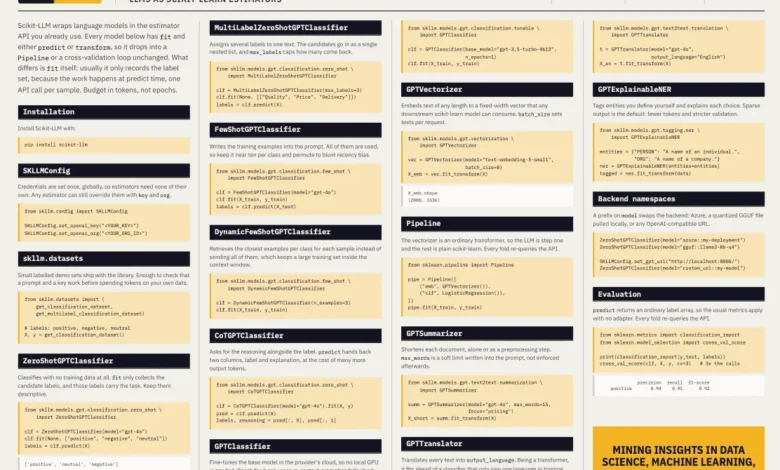
The introduction and maturation of Scikit-LLM have fundamentally reshaped this landscape by seamlessly wrapping state-of-the-art language models directly into the familiar scikit-learn estimator application programming interface. By adopting the standard architectural contracts of machine learning pipelines—where every model features native fit, predict, and transform methods—Scikit-LLM eliminates the friction between probabilistic generative models and deterministic statistical workflows. To help practitioners navigate this powerful integration, technical resources such as the newly released KDnuggets Scikit-LLM Estimators Cheat Sheet have emerged, providing developers with a structured reference guide for deploying these hybrid systems effectively. Understanding the mechanics, operational nuances, and economic implications of this library is becoming an essential competency for modern AI engineers seeking to bridge the gap between classical predictive modeling and generative intelligence.
Background Context and the Evolution of Hybrid Machine Learning Architectures
To understand the significance of Scikit-LLM, one must examine the broader evolution of software tooling within the artificial intelligence sector. Throughout the early and mid-2010s, scikit-learn cemented its status as the undisputed industry standard for classical machine learning. Its unified API design allowed developers to swap out algorithms—moving from a Support Vector Machine to a Random Forest—with a single line of code change. However, the generative AI boom of 2022 and 2023 shifted the paradigm away from structured tabular data toward unstructured text, embeddings, and prompt-driven interactions.
Initially, the machine learning community bifurcated into two distinct camps. On one side were data engineers and classical practitioners who relied on scikit-learn, XGBoost, and lightGBM for structured numerical data classification and regression. On the other side were application developers writing bespoke orchestration layers using tools like LangChain and LlamaIndex to query proprietary foundational models via cloud APIs. This separation created immense friction for data science teams attempting to build comprehensive data pipelines that ingested raw text, performed sophisticated semantic preprocessing, classified intents, and ultimately fed structured outputs into downstream statistical models.
Scikit-LLM was developed to solve this exact architectural disconnect. By inheriting the core design principles of scikit-learn, the library allows large language models to participate as standard components within a multi-step data processing pipeline. In this ecosystem, the traditional role of the fit method is cleverly re-engineered. Because models like GPT-4 or open-source alternatives do not necessarily require traditional gradient descent training when utilized via prompt-based inference, the fit function typically serves to register the label set, configure hyperparameters, or establish contextual baselines, deferring the heavy lifting to the predict phase where individual samples are evaluated against the language model.
Core Components of the Scikit-LLM Ecosystem
The Scikit-LLM library provides a robust suite of estimators designed to handle diverse natural language processing tasks without forcing developers to abandon their preferred structural workflows. Among these, the ZeroShotGPTClassifier has rapidly emerged as the most frequently deployed tool for rapid prototyping and baseline establishment. Utilizing a zero-shot classifier requires a shift in cognitive perspective for developers accustomed to traditional supervised learning. When calling fit(None, [...]) with only a predefined list of candidate labels, the engineer is essentially passing the task specification directly into the model’s operational context.
Because the language model relies entirely on semantic understanding rather than learned numerical weights from a training corpus, vague or ambiguously defined labels invariably yield suboptimal or erratic results. Consequently, best practices dictate that engineers must treat these candidate labels not as terse categorical tags, but as rich, descriptive semantic definitions. For instance, classifying customer support tickets with labels such as "Billing" yields inferior performance compared to using descriptive specifications like "Customer inquiry regarding invoice discrepancies, charges, or payment processing failures."
When zero-shot classification proves insufficient for nuanced domain-specific tasks, developers can transition to the DynamicFewShotGPTClassifier. Unlike standard few-shot prompting techniques—which inject a static, often bloated set of examples into every single API prompt regardless of context—the dynamic variant employs intelligent semantic retrieval. For every individual sample processed, the estimator dynamically fetches the most relevant and contextually appropriate training examples from the reference set, optimizing prompt token length while maximizing contextual relevance.
Beyond classification, the library offers specialized transformers such as the GPTVectorizer. This utility transforms text strings of arbitrary length into fixed-width numerical vector embeddings. By positioning the GPTVectorizer as the initial step in a scikit-learn Pipeline, developers can leverage an LLM to extract rich semantic representations from raw text, and subsequently route those vectors into traditional, high-speed algorithms such as logistic regression or ridge classifiers. This hybrid approach drastically reduces operational latency and inference costs for downstream tasks by decoupling deep semantic extraction from final decision-making.
Furthermore, the GPTTranslator acts as a specialized transformer capable of standardizing multilingual inputs before they reach a downstream classifier. By placing a translator at the front of a pipeline, systems trained exclusively on English-language corpora can seamlessly ingest, translate, and classify text originating from diverse global markets without requiring the costly retraining of core predictive models on multilingual datasets.
Economic Implications and Token Cost Considerations
While the architectural integration offered by Scikit-LLM provides unprecedented development velocity and code cleanliness, practitioners must remain acutely aware of the underlying economic realities. Traditional scikit-learn workflows operate almost entirely locally on the developer’s workstation or cluster compute infrastructure, meaning that running computational loops, cross-validation splits, and grid searches incurs zero marginal financial cost beyond baseline electricity and compute leasing.
In contrast, Scikit-LLM routes computational requests through external application programming interfaces tied to token-based billing models. This fundamental shift introduces severe financial multipliers that can easily catch engineering teams off guard. For example, executing a standard cross_val_score evaluation with a strict three-fold cross-validation configuration (cv=3) instantly triples the volume of API calls required to evaluate a model. If that evaluation is subsequently nested within an automated hyperparameter grid search (GridSearchCV)—a standard, unconscious habit in classical machine learning experimentation—the resulting explosion in API requests can generate prohibitive financial expenses and rapidly exhaust rate limits.
Industry analysts and senior data architects stress that engineering habits forged in the era of zero-marginal-cost local computing must be deliberately audited when transitioning to LLM-backed pipelines. Developers must adopt rigorous token-budgeting strategies, implement aggressive caching mechanisms for repetitive inference tasks, and rely on validation subsets rather than full-scale cross-validation sweeps during early-stage exploratory data analysis.
Broader Industry Impact and Future Outlook
The rise of interoperable libraries like Scikit-LLM signals a maturing phase in the broader artificial intelligence engineering landscape. As organizations move past the initial wave of standalone chatbot development and experimental prompt engineering, the industry is increasingly focused on production-grade system reliability, software maintainability, and operational governance.
By anchoring generative AI capabilities within established, battle-tested software frameworks like scikit-learn, developers can leverage decades of established software engineering patterns—including unit testing, automated pipeline validation, and standardized performance metrics reporting. This harmonization bridges the cultural and technical divide between software engineers, classical data scientists, and prompt architects, fostering multidisciplinary collaboration within enterprise technical teams.
Educational resources, such as specialized technical cheat sheets and community documentation, continue to play a vital role in accelerating this adoption curve. By providing clear, concise visual and textual references for complex estimator behaviors, these tools lower the barrier to entry for practitioners looking to modernize their workflows. Ultimately, Scikit-LLM represents a pragmatic, highly effective stepping stone for engineers seeking to harness the transformative power of large language models without sacrificing the rigorous structure and predictability of traditional machine learning engineering.