How Optimizing Data Payloads with Markdown Can Significantly Reduce AI Token Consumption and Operational Costs

The rapid integration of autonomous AI agents into enterprise workflows has introduced a hidden but profound fiscal challenge: the "token tax." As these agents increasingly rely on search results, file retrievals, and external API data to perform reasoning tasks, the sheer volume of data being fed into Large Language Models (LLMs) has become a primary driver of operational overhead. Because current token-based billing models charge for every character processed—regardless of whether that information is essential for the model’s reasoning process—organizations are inadvertently paying a premium for "data noise."
Recent technical advancements have brought this issue to the forefront, specifically regarding the inefficiency of traditional JavaScript Object Notation (JSON) when used as an input format for generative AI. SerpApi, a prominent provider of search engine data, has pioneered a shift toward Markdown-based output as a solution to this structural inefficiency. This development signals a broader trend in AI engineering: the transition from raw data delivery to "model-optimized" data ingestion.
The Anatomy of Token Bloat in AI Agents
To understand why token consumption has ballooned, one must examine how AI agents interact with search APIs. A standard API request, such as searching for local services or technical documentation, typically returns a JSON object. While JSON is the industry standard for software-to-software communication, it is inherently verbose. It includes extensive metadata, tracking parameters, nested arrays, and redundant key-value pairs that are essential for web applications but extraneous for an LLM trying to synthesize a summary.
When an AI agent executes a recursive search—where the agent performs a query, reads the results, and then launches a secondary query based on those findings—the token count compounds exponentially. A single search query that might seem trivial can result in a payload containing thousands of tokens of metadata, including internal tracking links and formatting characters like braces, quotes, and commas. If an agent is designed to iterate through ten search results, the total token consumption can easily reach six figures, leading to significant latency and inflated cloud compute bills.
Chronology of the Shift Toward Model-Optimized Data
The evolution of data delivery for LLMs has occurred in three distinct phases over the past 24 months:
- The JSON Dominance Era (2022–2023): As LLMs gained popularity, developers relied on existing REST APIs. JSON was the default, and engineers focused on integration rather than payload efficiency. Token costs were relatively manageable as agents were primarily used for single-turn tasks.
- The Emergence of Agentic Systems (Early 2024): The rise of autonomous agents (such as AutoGPT, BabyAGI, and custom LangChain implementations) changed the landscape. Agents began performing multi-step reasoning, leading to the discovery that token consumption was the primary bottleneck for scalability.
- The Efficiency Pivot (Mid-2024 to Present): Developers began implementing server-side filtering, custom prompt engineering, and, most recently, the adoption of lightweight output formats like Markdown. The introduction of Markdown-native API outputs marks a departure from forcing LLMs to parse structured code formats.
Comparative Token Analysis: A Quantitative Review
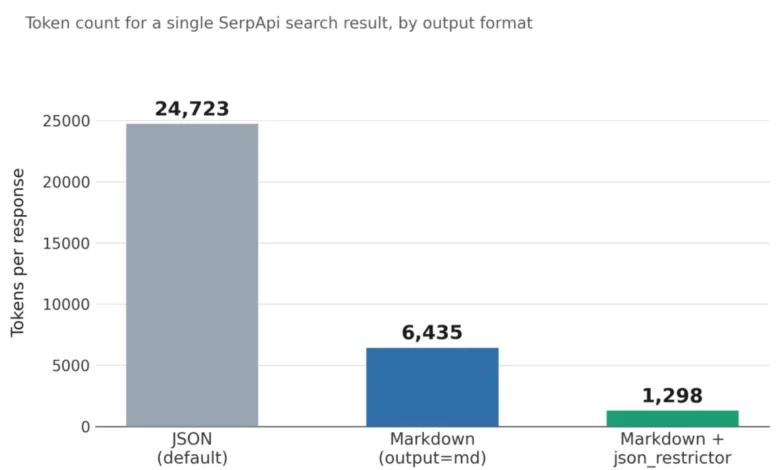
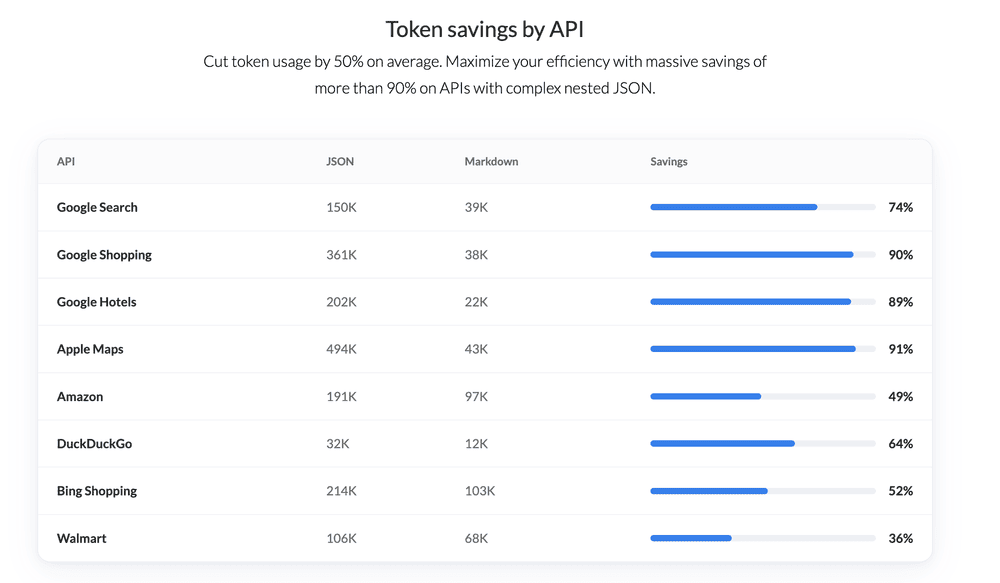
The shift from JSON to Markdown provides quantifiable relief for compute-heavy workflows. In controlled tests conducted by data providers, a standard search query for "coffee" yielded 24,723 tokens when delivered in a standard JSON format. By contrast, the same data, when re-encoded into a structured Markdown format, required only 6,435 tokens.
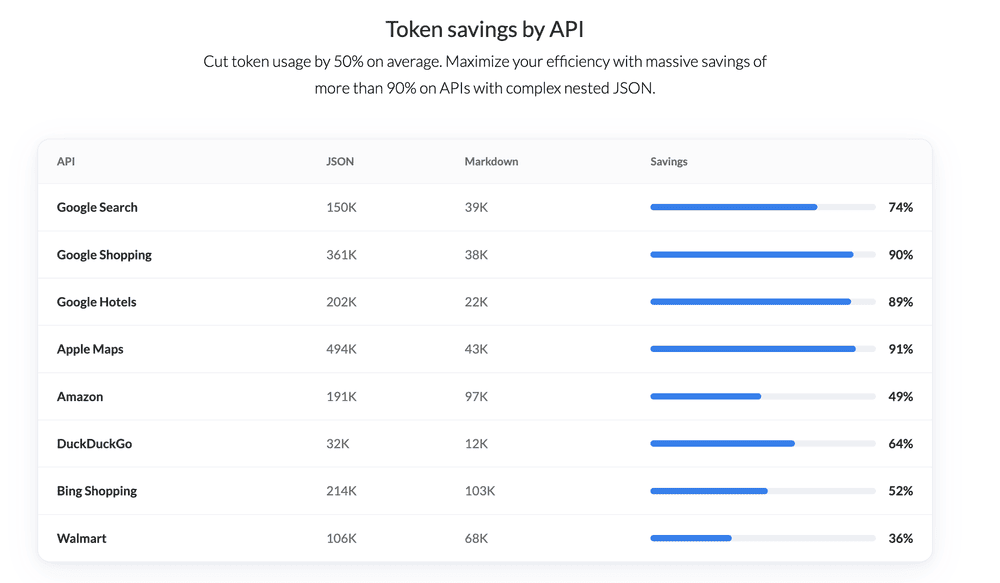
This represents a 74% reduction in data volume. Further refinement—specifically using field-level restriction to remove non-essential information like historical coupon pricing or secondary store metadata—allowed the same query to be processed with as few as 1,298 tokens. For a high-frequency application performing thousands of queries per day, this reduction represents the difference between a functional, cost-effective prototype and an unscalable, prohibitive expenditure.
Strategic Implications for Data Architecture
The decision to transition from JSON to Markdown is not merely a cost-cutting measure; it is a fundamental shift in how data is architected for machine cognition. JSON is built for machines that require rigid, programmatic consistency. Markdown, conversely, is a human-readable, lightweight markup language that aligns more closely with the natural language processing (NLP) capabilities of modern LLMs.
Industry experts note that LLMs perform better when the input data is "denoised." When a model is tasked with parsing a JSON file, it must allocate "attention" to brackets, quotes, and property keys. By stripping away these syntactic markers, the model can dedicate more of its internal context window to the actual substance of the search results. This reduces the risk of "hallucinations" that can occur when a model is overwhelmed by excessive or irrelevant metadata.
Limitations and Use-Case Suitability
While Markdown is highly effective for summarization, research, and agentic reasoning, it is not a universal replacement for JSON. In scenarios where downstream processing requires strict data types—such as financial calculation engines, inventory management systems, or coordinate-based mapping applications—JSON remains the necessary standard.
If an application requires high-precision float values for currency, specific array structures for integration with a database, or boolean values for logical branching, the rigid structure of JSON is non-negotiable. The current consensus among software architects is a "hybrid strategy": using Markdown-formatted outputs for the reasoning and research stages of an agent’s lifecycle, and utilizing JSON for the transactional stages where data integrity and type safety are paramount.
Implementation and Future Outlook
The industry is currently moving toward a standard of "Server-Side Payload Management." Providers are increasingly offering tools such as json_restrictor or specific headers that allow developers to dictate exactly which fields should be returned. This server-side filtering is crucial because it reduces the amount of data transferred over the network before it ever reaches the LLM context window.
As AI models continue to expand their context windows, the temptation to feed them "everything" will grow. However, seasoned engineers are cautioning against this "brute force" approach. Efficient token management is likely to become a core competency for AI developers, similar to how memory management was treated during the early days of personal computing.
The adoption of these practices is expected to accelerate as more APIs follow the lead of early innovators. By automating the trimming of internal tracking noise and duplicate fields, providers are essentially lowering the barrier to entry for complex, autonomous AI applications. For enterprises, this means that the threshold for deploying sophisticated AI agents is moving from the realm of "theoretical possibility" to "economic feasibility."
Conclusion: The New Standard for AI-Ready Data
The transition to Markdown is emblematic of a maturing AI ecosystem that is shifting its focus from raw capability to operational efficiency. As organizations move beyond the initial phase of AI experimentation, the focus must inevitably turn to the long-term sustainability of agentic systems. By minimizing token waste, optimizing data shapes, and reducing the computational load of every API request, companies can ensure that their AI systems are not only intelligent but also economically viable.
For developers tasked with building the next generation of autonomous agents, the message is clear: the data that is easiest for a machine to parse is not always the best for an AI to reason with. By carefully managing the "shape" of information, developers can unlock higher performance, lower costs, and more reliable outcomes from their LLM integrations. The future of AI is not just about having more data; it is about having the right data, in the right format, at the right time.