Amazon Web Services Launches Enhanced Custom Event Bus for EventBridge to Simplify Multi-Account Serverless Architectures

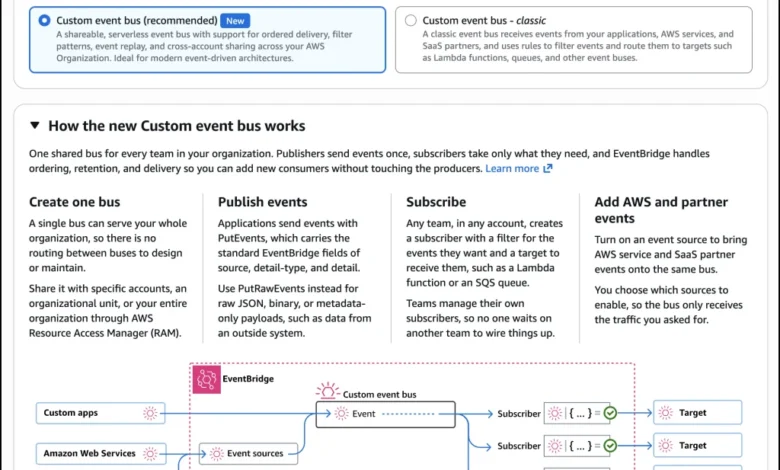
Amazon Web Services (AWS) has officially announced the launch of an enhanced custom event bus for Amazon EventBridge, a release designed to fundamentally transform how enterprise organizations manage event-driven serverless architectures across complex, multi-account environments. The newly introduced feature addresses longstanding architectural friction points by providing a single, centralized, organization-wide event bus equipped with native event ordering guarantees, simplified subscriber resource models, and an improved throughput-based pricing structure.
Main Facts and Technological Overview
For years, organizations building event-driven applications on Amazon EventBridge typically initiated development with a single custom event bus located within a solitary AWS account. While this approach functions smoothly for smaller projects managed by individual teams, it encounters significant scaling hurdles as organizational adoption broadens. Enterprise security and governance standards strongly mandate multi-account AWS structures, requiring distinct teams to operate within isolated accounts.
To bridge communication gaps between these isolated domains, developers previously had to establish multiple event buses connected via intricate cross-account rules or complex bus-to-bus configurations. This operational workaround inadvertently reintroduced the exact administrative complexity that serverless computing was originally engineered to eliminate. Furthermore, platform engineering teams routinely lost real-time visibility regarding event subscriptions, while cross-account routing charges compounded rapidly. Additionally, workloads requiring strict event sequencing were forced to construct convoluted workarounds or rely on entirely separate third-party technologies.
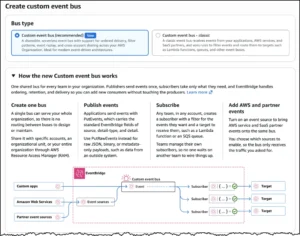
The newly launched enhanced custom event bus resolves these challenges by enabling enterprises to deploy a singular, unified event backbone that spans all AWS accounts under an organizational umbrella. By leveraging native AWS Resource Access Manager (AWS RAM) integrations, platform administrators can provision a shared bus with a default quota of up to 10,000 subscribers per bus, thereby drastically reducing the architectural fragmentation historically caused by arbitrary subscriber limits.

Chronology and Development Background
The evolution of Amazon EventBridge reflects the broader maturity of serverless architectures within cloud computing. Originally derived from Amazon CloudWatch Events, EventBridge evolved into a serverless event bus service designed to connect applications using data from AWS services, integrated SaaS applications, and custom application data. As microservices architectures proliferated throughout the late 2010s and early 2020s, developers increasingly demanded tighter controls over cross-account governance, event filtering, and delivery guarantees.
Throughout the development cycle of the enhanced custom event bus, AWS engineering teams solicited extensive feedback from enterprise platform administrators who struggled with the operational overhead of managing sprawling networks of inter-account event rules. The resulting solution, rolled out in phases through the AWS Management Console, establishes a clear dichotomy between legacy implementations and modern infrastructure. Existing configurations will remain fully operational under the designation of "Custom event bus – classic," ensuring zero disruption to legacy workloads, while the new resource is made available for progressive enterprise adoption at the discretion of platform engineering teams.
Core Architectural Advancements
The enhanced custom event bus introduces several critical engineering capabilities designed to streamline modern distributed systems:
Native Event Ordering and Synchronous Delivery
While asynchronous processing patterns represent the gold standard of scalable event-driven design, specific operational use cases—such as real-time logistics tracking or financial transaction processing—demand strict chronological sequencing. Out-of-sequence events in a transit-routing application, for instance, can lead automated algorithms to make critical decisions based on stale geospatial telemetry.
The new EventBridge architecture accommodates both asynchronous and ordered patterns on the exact same bus. Publishers can attach an EventGroupId payload parameter, instructing EventBridge to deliver events sharing that specific identifier in strict sequence to subscribers configured for ordered delivery, while other consumers process messages asynchronously. To facilitate reliable ordered processing, the architecture integrates synchronous invocation models for downstream targets like AWS Lambda. This capability eliminates the traditional architectural pattern of interposing Amazon Simple Queue Service (Amazon SQS) queues between an event bus and compute functions solely to guarantee execution order and reliability.

Unified Subscriber Resource Management
Managing complex subscriptions previously required orchestrating disparate rules, target configurations, retry parameters, and dead-letter queues across multiple decoupled resources. The enhanced custom event bus introduces a consolidated Subscriber resource. This unified entity encapsulates event filtering patterns, target mappings, retry policies, and failure destinations into a single manageable unit, significantly lowering the barrier to entry for consumer onboarding and application recovery via event replay functionality.
Advanced Event Evaluation and Data Transformation
Data hygiene and payload manipulation represent vital considerations at scale. The platform now incorporates content-based deduplication, enabling EventBridge to automatically detect and eliminate duplicate event retries originating from unstable upstream producers within a five-minute sliding window. By hashing meaningful payload attributes, the service delivers exactly-once processing semantics for sources incapable of natively generating reliable idempotency tokens.
Furthermore, subscribers can leverage native JSONata expressions to dynamically reshape event payloads before transmission to downstream targets. This capability allows consumer applications to extract specific fields, normalize key names, or compute derived values on the fly. EventBridge can also deserialize incoming Apache Avro or Protocol Buffers payloads directly into JSON, permitting fine-grained filtering across the complete event structure without requiring consumers to independently manage deserialization logic.
Economic Implications and Pricing Model
Financial scalability is a primary driver behind the new release. Traditional multi-bus architectures suffered from compounding financial models where cross-account routing charges accumulated rapidly. The enhanced custom event bus introduces an overhauled ingress and egress throughput pricing paradigm. Under this structure, publishers incur costs solely for ingested event volume, while subscribers pay for delivered events. This transparent cost allocation model provides predictable expenditure metrics for platform operators while improving overall economic efficiency at enterprise scale.
Industry Analysis and Broader Impact
Cloud architecture analysts view the release of the enhanced custom event bus as a significant milestone for enterprise serverless adoption. By abstracting the heavy lifting of cross-account permission mapping, event ordering, and deduplication, AWS is directly addressing the operational overhead that often accompanies rapid organizational scaling.
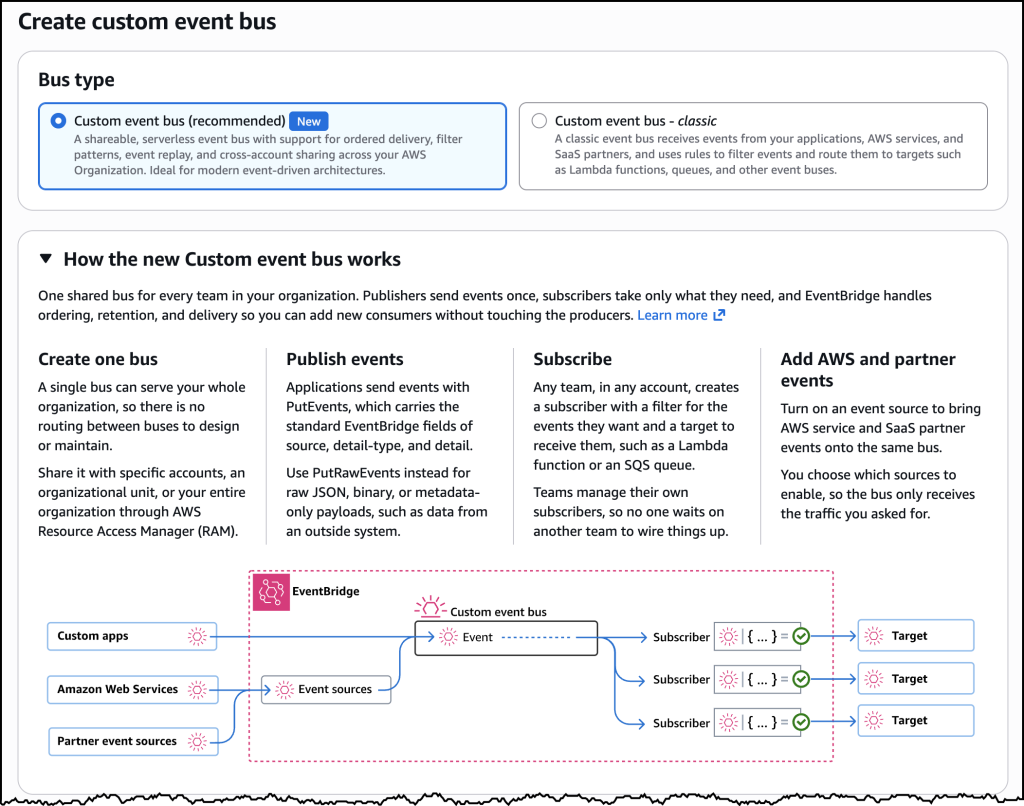
Platform engineering teams stand to gain unprecedented observability and governance over corporate event topologies without sacrificing developer agility. Application teams can now publish events to a centralized organizational fabric without needing prior knowledge of consuming entities, fostering a truly decoupled, event-driven ecosystem. Conversely, enterprises must carefully evaluate their governance strategies to ensure that centralized bus quotas and shared-resource policies are properly maintained as organizational adoption accelerates.
Global Availability
The enhanced custom event bus is commercially available immediately across a broad footprint of global cloud regions, including US East (N. Virginia, Ohio), US West (Oregon), Europe (Ireland, Frankfurt, Stockholm, Spain), and Asia Pacific (Hong Kong, Malaysia, Mumbai, Singapore, Sydney, Thailand, Tokyo). Engineering organizations can provision and manage the new resource via the AWS Management Console, the AWS Command Line Interface (AWS CLI), or programmatic EventBridge APIs, marking a new chapter in scalable, multi-account serverless application design.