Data processing architectures have long faced a fundamental constraint: the relationship between available Random Access Memory (RAM) and the volume of data being ingested. For years, developers relied on standard list-based approaches to handle logs, CSV exports, and telemetry data. However, as log rotation policies shifted—moving from granular daily files to massive, aggregated datasets reaching into the gigabytes—traditional eager-loading methods have increasingly resulted in catastrophic system failures, specifically MemoryError exceptions. This shift in infrastructure management has forced a re-evaluation of how Python-based pipelines handle data, pushing developers toward the adoption of iterators and generators as a standard for high-performance, memory-efficient streaming.
The Anatomy of a Memory Failure
The failure of a data processing script is rarely the result of faulty logic; rather, it is often a byproduct of "eager evaluation." In a typical scenario, a script might open a log file, parse every record into a list, filter that list for specific error conditions, and then apply further transformations. When a file is small, this process remains invisible to the system. However, when a single log file grows to 9 GB—often due to changes in server traffic or log aggregation policies—the act of loading that file into a list forces the Python interpreter to allocate enough memory to house every single record simultaneously.
If the system lacks sufficient RAM to accommodate this allocation, the operating system triggers an Out-of-Memory (OOM) event, effectively killing the job before a single line of summary can be produced. This is not a failure of the algorithm, but a failure of the architecture. The solution lies in shifting from an "all-at-once" mindset to a "stream-oriented" paradigm. By utilizing iterators and generators, a developer can ensure that only a single record—or a small, manageable batch of records—resides in memory at any given time.
The Iterator Contract and the Mechanics of Streaming
At the core of Python’s memory efficiency is the iterator protocol. An iterable—such as a list, string, or open file object—serves as the data source, while the iterator acts as a cursor, tracking the current position within that data. When a standard for-loop interacts with an object, it implicitly invokes the __iter__() method, followed by successive calls to __next__(). This mechanism is designed to produce a single item at a time until a StopIteration exception is raised, signaling the end of the stream.
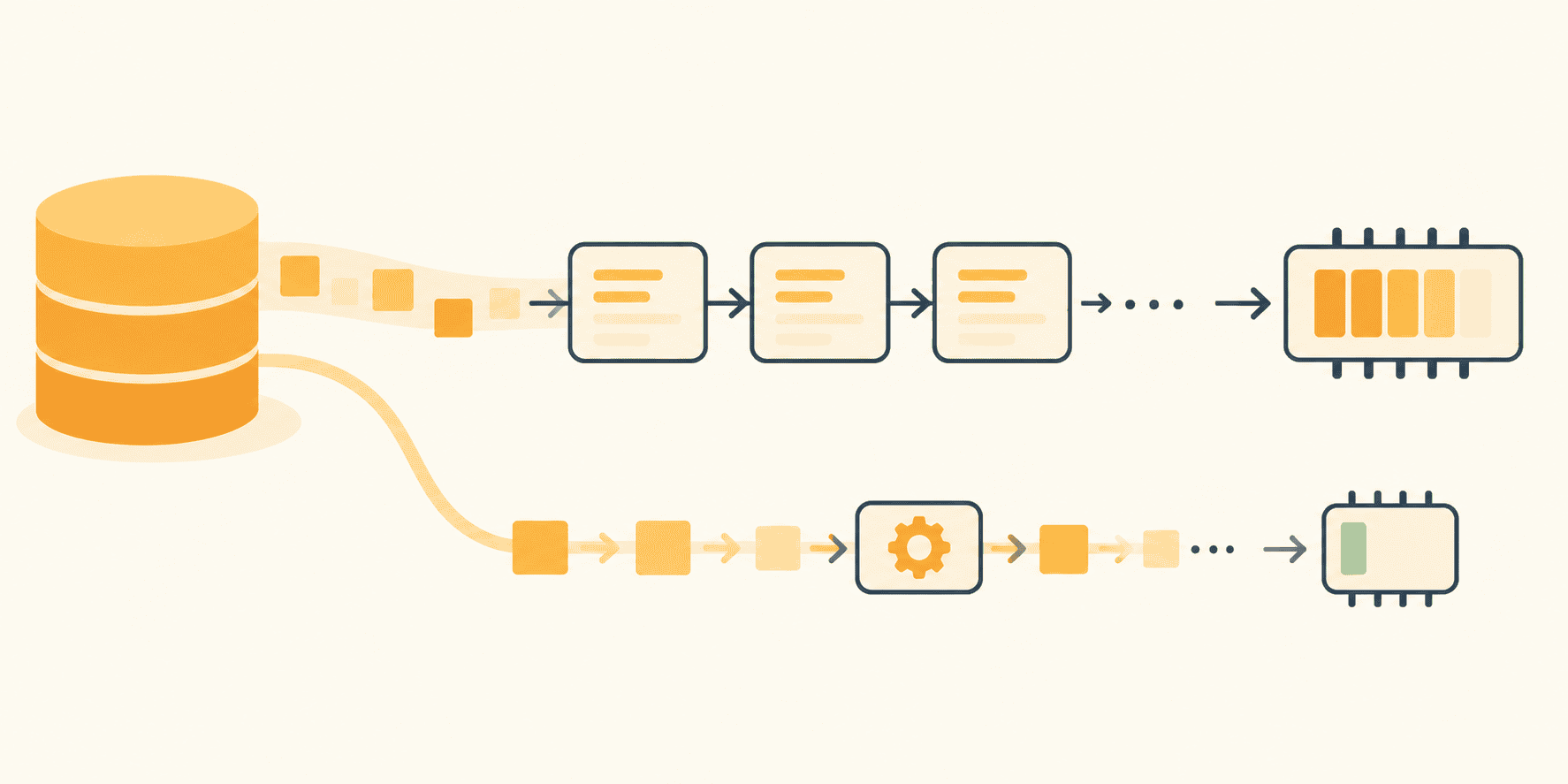
Crucially, an iterator does not duplicate the underlying data. It merely keeps a reference to the current position. This is the distinction between a data structure that consumes memory proportional to the size of the dataset and one that consumes memory proportional to the size of the buffer. By leveraging this, developers can traverse a 9 GB file with the same memory footprint as a 9 KB file, provided the processing logic remains "lazy"—meaning it performs work only when requested.
Evolution of Data Pipeline Design
The historical development of these tools dates back to the early implementation of Python’s generator functions and expressions. A generator function, identified by the yield keyword, allows a function to suspend its execution, save its internal state, and return a value to the caller. When the caller requests the next value, the generator resumes exactly where it left off.
This suspension capability is the cornerstone of modern data engineering in Python. In a multi-stage pipeline, the first stage might be a file-iterator that reads raw lines. The second stage, a generator function, might parse those lines into structured dictionaries. A third stage, perhaps a generator expression, could filter those dictionaries based on specific criteria. Because each stage is lazy, the entire pipeline is only as memory-intensive as the single record currently being processed by the chain.
Comparative Analysis: Eager vs. Lazy Processing
Data from internal performance testing highlights the stark contrast between these two approaches. When processing a synthetic 200,000-line log file (approximately 17 MB in size), an eager-loading script typically peaks at nearly 200 MB of memory usage. In contrast, a properly implemented streaming pipeline typically peaks at less than 0.5 MB. Furthermore, as the input file grows to gigabyte scale, the memory consumption of the streaming approach remains virtually flat, whereas the eager approach scales linearly, eventually hitting the hardware ceiling.
Implementation Strategies and Best Practices
To transition from eager to lazy processing, developers must adopt a staged approach:

- Direct File Iteration: Always use the file object as an iterator (
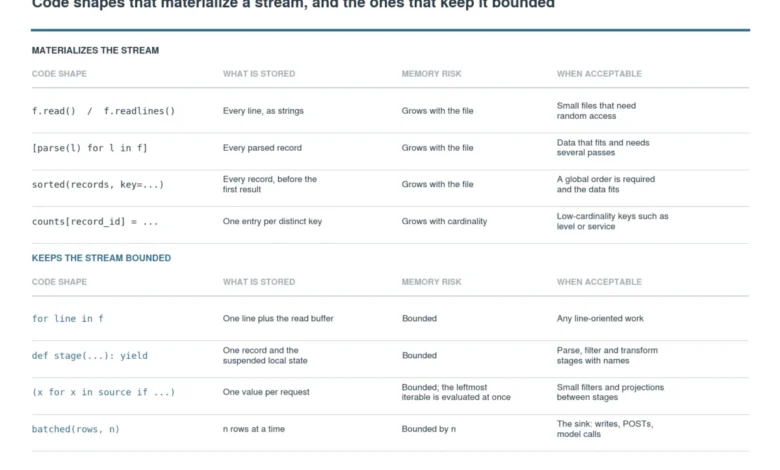
for line in f) rather than loading the file withreadlines(). This is the single most effective optimization available in the standard library. - Modular Generator Functions: Encapsulate parsing and filtering logic into generator functions. This improves testability and readability, allowing developers to verify each stage of the pipeline independently with small, dummy datasets.
- Lazy Composition: Utilize generator expressions for lightweight transformations. Note that the leftmost iterable in a generator expression is evaluated immediately; therefore, nested pipelines should be carefully structured to ensure all sources remain lazy.
- Strategic Batching: Use
itertools.batched()(available in Python 3.12+) to handle output. While laziness is ideal, external systems—such as databases or APIs—often require batched input. By defining a fixed batch size (e.g., 1,000 records), developers maintain control over memory usage while meeting the requirements of downstream consumers.
Identifying the Limits of Streaming
It is imperative to acknowledge that not every computational task is a candidate for streaming. Certain operations, by their very nature, require the entire dataset to be present. Global sorting, exact deduplication, and calculating complex statistical percentiles (e.g., the 99th percentile of latency) are "stateful" operations. In these instances, the data must be materialized in full, or processed using external, disk-based sorting algorithms.
Developers often fall into the trap of building a beautiful, streaming pipeline that feeds into a final sorted() or list() call. This negates the memory benefits of the entire pipeline. If a job requires a global sort, the memory limit is an inherent constraint of the algorithm, not the implementation. Recognizing these limitations early in the design phase prevents the wasted effort of building complex streaming chains for tasks that fundamentally require global state.
Measuring and Monitoring Peak Memory
To ensure a pipeline is truly memory-efficient, developers should employ diagnostic tools like tracemalloc. By measuring the peak memory allocation throughout the life of a process, teams can distinguish between a pipeline that is truly lazy and one that is unintentionally accumulating objects. If peak memory does not drop as expected, it usually points to one of three common issues:
- Escaping References: Keeping objects in a global list or dictionary, which prevents them from being garbage collected.
- Downstream Materialization: A library or API call that forces the generator to realize its entire sequence in memory.
- Implicit Eager Steps: Using built-in functions like
sorted()orlist()that, by definition, require all items to be loaded.
Broader Implications for Data Engineering
The shift toward memory-efficient processing is not merely a stylistic choice; it is a necessity in an era of big data. As machine learning models require increasingly large datasets for preprocessing and fine-tuning, the ability to stream data directly from source files to the model training loop is critical. This reduces infrastructure costs, minimizes latency, and prevents the "out-of-memory" crashes that often stall production deployments.
Ultimately, the goal is to create a predictable, reproducible data path. When a module is written as a series of staged generators, any developer can trace the data from its entry point to its final sink. This transparency is the best defense against future performance regressions. By adhering to the principles of lazy evaluation, teams can build robust, scalable pipelines that remain performant regardless of whether they are handling a few hundred lines or a few hundred million.