Bridging Classical Machine Learning and Large Language Models: A Guide to Using Scikit-LLM Summarization in Scikit-Learn Pipelines

The rapid evolution of artificial intelligence has historically presented developers and data scientists with a distinct architectural dilemma: choosing between the nuanced comprehension of large language models (LLMs) and the computational efficiency and predictability of classical machine learning frameworks. For years, traditional lightweight classifiers designed for text processing required exhaustive preprocessing to distill lengthy, unstructured raw data into clean, actionable signals. Without this rigorous condensation, noise within the raw text frequently compromised downstream predictive accuracy. However, a novel integration strategy developed by AI practitioners is effectively dissolving this artificial divide, allowing engineers to merge the capabilities of both paradigms into a singular, unified workflow.
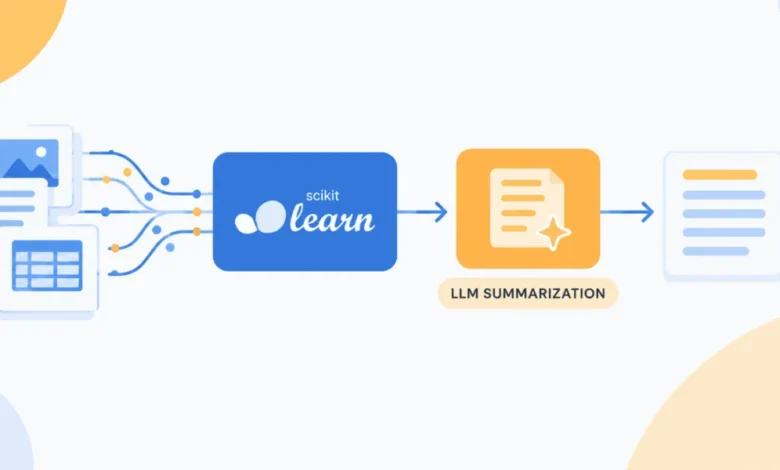
By combining Scikit-LLM estimators with traditional Scikit-Learn methods, developers can now construct sophisticated text-processing pipelines that execute LLM-driven summarization as a preliminary data-cleaning phase. This architectural synergy allows resource-efficient language models to act as intelligent text filters, distilling verbose documents into canonical keywords before feeding them into conventional vectorizers and linear classifiers. Furthermore, this approach can be executed entirely using free computational tiers and open-access APIs, democratizing advanced natural language processing for researchers and enterprises alike.
The Technical Foundation: Merging Scikit-Learn with Open-Access LLMs
At the core of this hybrid architecture is Scikit-LLM, an open-source library designed to bridge the gap between Scikit-Learn and prompt-based large language models. Historically, deploying LLMs within a standard machine learning pipeline meant dealing with complex asynchronous API calls, high per-token costs, and fragmented codebases that did not neatly align with the familiar .fit() and .predict() syntax of Scikit-Learn. Scikit-LLM resolves this friction by encapsulating LLM-driven tasks—such as text summarization, classification, and vectorization—into standard Scikit-Learn estimator objects.
To operationalize this method without incurring prohibitive cloud computing expenses, developers frequently leverage accessible, high-performance infrastructure providers such as Groq. By routing Scikit-LLM requests through Groq’s OpenAI-compatible API endpoint, engineers can utilize pre-trained models—specifically efficient architectures like the gpt-oss-20b variant—under free-tier operational parameters.
Setting up this environment requires a straightforward configuration process. Following account registration on the Groq developer console and the generation of an API key, the credential is securely stored within the runtime environment—such as a Google Secret Manager or a Google Colab secret variable designated as GROQ_API_KEY. Once the Scikit-LLM package is installed via standard Python package management, the environment configuration script intercepts default OpenAI routing and directs all text processing requests to Groq’s optimized infrastructure:
from google.colab import userdata
from skllm.config import SKLLMConfig

groq_key = userdata.get('GROQ_API_KEY')
SKLLMConfig.set_gpt_url("https://api.groq.com/openai/v1")
SKLLMConfig.set_openai_key(groq_key)
This configuration ensures that subsequent calls made by the pipeline execute seamlessly across external inference servers while maintaining complete API compatibility with standard development libraries.
Architecting the Three-Step Machine Learning Pipeline
The implementation of a hybrid text-classification workflow relies on a carefully sequenced, three-step Scikit-Learn Pipeline. In traditional machine learning scenarios, feeding raw, verbose, and noisy documents directly into a Term Frequency-Inverse Document Frequency (TF-IDF) vectorizer often results in sparse, high-dimensional feature spaces bloated with irrelevant contextual tokens.
To mitigate this, the hybrid pipeline introduces an intelligent summarization bottleneck as its first operational stage. The pipeline architecture consists of the following sequential components:
- The Summarizer: Encapsulated via the
GPTSummarizerclass from Scikit-LLM, this component utilizes a designated Groq-hosted model to distill lengthy documents down to a strict word limit—typically capped at approximately 20 words. This step strips away rhetorical noise while preserving core domain-specific entities. - The Vectorizer: Following summarization, the concise, high-signal text summaries are processed by a standard
TfidfVectorizer. Because the vocabulary has been pre-filtered by the LLM, the resulting numerical vectors are dense, highly relevant, and computationally lightweight. - The Classifier: A classical linear model, such as
LogisticRegression, consumes the TF-IDF vectors to execute the final categorization task. Because the upstream summarization standardizes the textual input into predictable keyword combinations, the classifier can achieve high accuracy even when trained on extremely sparse datasets.
The implementation of this end-to-end pipeline requires minimal code and executes swiftly within standard development environments:
from sklearn.pipeline import Pipeline
from sklearn.feature_extraction.text import TfidfVectorizer
from sklearn.linear_model import LogisticRegression
from skllm.models.gpt.text2text.summarization import GPTSummarizer

text_pipeline = Pipeline([
    ('summarizer', GPTSummarizer(
        model="custom_url::openai/gpt-oss-20b",
        max_words=20
    )),
    ('vectorizer', TfidfVectorizer()),
    ('classifier', LogisticRegression())
])
Evaluating Few-Shot Training Dynamics and Signal Extraction
A notable characteristic of this hybrid methodology is its operational efficiency regarding training data volume. Similar to few-shot prompting techniques utilized in standalone generative AI applications, the pipeline does not require massive corpora to train the underlying LLM—in fact, no gradient descent or weight optimization occurs within the LLM itself during the .fit() procedure. Instead, the training phase simply fits the downstream TF-IDF vectorizer and the logistic regression classifier on the summarized representations of a minimal initial dataset.
Consider a baseline training set comprising verbose, complex records across distinct industrial domains:
X_long_texts = [
    "The new solar panel technology efficiency has increased by 15% due to the novel perovskite layer, significantly lowering the barrier to entry for residential use and driving green energy adoption by making installations cheaper and faster than ever before.",
    "Financial markets saw a sharp downturn today following the central bank's unexpected interest rate hike, leading to massive sell-offs in the tech sector and triggering volatility indices to reach their highest points in over three years.",
    "The clinical trial for the new arthritis medication showed promising results, reducing joint swelling by 40% in the control group without severe side effects, awaiting FDA approval which could bring relief to millions suffering from autoimmune disorders."
]

y_labels = ["Energy", "Finance", "Healthcare"]

text_pipeline.fit(X_long_texts, y_labels)
When inspecting the intermediate outputs generated by the GPTSummarizer transformation step on these training records, the efficacy of the LLM-driven filtering becomes immediately apparent. For instance, the verbose energy sector text is condensed into a precise semantic summary: "New perovskite solar panels boost efficiency by 15%, reducing costs and accelerating residential green energy adoption." Similarly, financial reports detailing central bank interest rate hikes and market volatility are distilled into targeted summaries emphasizing market plunges and tech sell-offs.
Because the LLM effectively standardizes the vocabulary of incoming documents into concise, canonical expressions, the downstream TF-IDF vectorizer operates on a tightly controlled feature space. Consequently, the logistic regression model successfully learns to associate specific conceptual triggers with their respective category labels, transforming a complex natural language classification problem into a highly reliable keyword-matching operation.
Real-World Inference and Practical Validation
To validate the robustness of the hybrid pipeline, data scientists can introduce entirely unseen, noisy test documents containing complex domain terminology and variable phrasing. When passed directly into the .predict() method of the unified pipeline, the system autonomously executes the multi-stage transformation sequence—summarizing the text, vectorizing the summary, and outputting a definitive categorical prediction.
Evaluating the pipeline against diverse unseen texts demonstrates its practical utility:
X_new = [
    "A breakthrough mRNA vaccine targeting seasonal flu strains showed 85% efficacy across diverse patient demographics in stage 3 clinical trials, paving the way for a more robust global immune defense next winter.",
    "Researchers have developed a grid-scale sodium-ion battery that promises to store surplus wind and solar power at a fraction of lithium's cost, potentially resolving the intermittency issue of renewables.",
    "Stocks rallied in late trading as technology shares recovered from yesterday's losses, driven by strong earnings reports from major semiconductor manufacturers and optimistic GDP growth forecasts."
]

predictions = text_pipeline.predict(X_new)
new_summaries = text_pipeline.named_steps['summarizer'].transform(X_new)
Upon execution, the pipeline successfully isolates the core semantic signals from each unstructured document. The medical text regarding mRNA vaccine trials is accurately summarized and categorized under healthcare. The technical report discussing sodium-ion grid storage is correctly routed to the energy sector, while reports concerning semiconductor earnings and market rallies are successfully classified under finance.
Broader Implications for Enterprise AI Architecture
The successful integration of Scikit-LLM summarization within Scikit-Learn pipelines highlights a broader, highly pragmatic shift in enterprise artificial intelligence development. For several years, industry adoption of generative AI models was hindered by an all-or-nothing mentality: organizations felt pressured to replace their existing classical machine learning infrastructure entirely with massive, expensive, and opaque LLM architectures.
However, hybrid workflows demonstrate that foundation models and classical algorithms are complementary rather than competing technologies. By leveraging LLMs strictly for high-level semantic distillation—such as summarization, entity extraction, and intent recognition—and leaving heavy numerical computation and classification to deterministic, explainable models like linear regression or gradient boosting, engineering teams can achieve optimal performance without incurring unsustainable operational costs.
This modular design offers several distinct advantages for enterprise deployments:
- Cost Efficiency: By utilizing LLMs exclusively for targeted text transformation rather than exhaustive inference tasks, organizations can minimize token consumption and leverage free or low-cost API tiers.
- Interpretability: Classical classifiers situated at the end of the pipeline provide transparent decision-making pathways, addressing the "black box" critique often associated with standalone generative models.
- Maintainability: Adhering to the standard Scikit-Learn API paradigm ensures that existing machine learning operations (MLOps) tooling, serialization formats, and deployment pipelines remain fully compatible with newly integrated generative components.
As artificial intelligence continues to mature, architectures that seamlessly blend the deep linguistic comprehension of large language models with the computational rigor of classical machine learning will likely serve as the standard blueprint for scalable, cost-effective enterprise automation.