HighScalability Hot Links: Evolution of Engineering from Mainframes to Quantum Computing

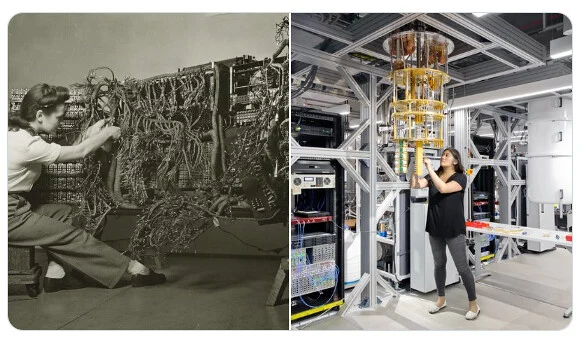
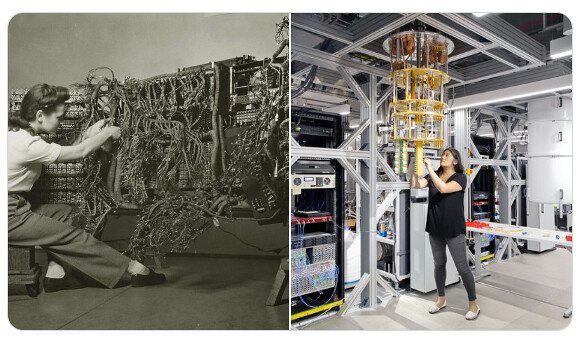
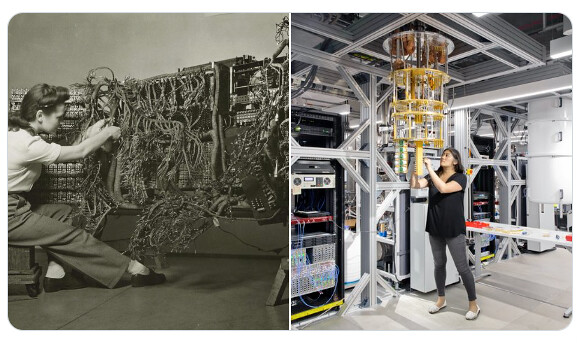
The evolution of computing infrastructure over the last seven decades reflects a profound shift in engineering complexity, moving from the mechanical and manual assembly of vacuum-tube mainframes to the delicate, cryogenically cooled architecture of modern quantum systems. A side-by-side comparison of an IBM engineer working on a 1958 mainframe and a contemporary counterpart servicing a quantum processor serves as a potent visual metaphor for the technological distance humanity has traveled. While the fundamental goals—processing power, data manipulation, and logic gates—remain consistent, the medium has transitioned from physical wiring and bulky hardware to the manipulation of subatomic particles.
The 1958 Paradigm: Building the Foundations of Data
In 1958, the computing landscape was dominated by vacuum tubes, magnetic drum memory, and punched cards. IBM was at the forefront of this industrial revolution, producing machines such as the IBM 709, a transistorized successor to the vacuum-tube-based 704. At that time, "programming" was a physical act. Engineers did not merely write code; they interacted with the hardware at a granular, tactile level. The wiring shown in historical photographs of that era illustrates the immense human labor required to construct a machine capable of performing simple mathematical operations—tasks that a modern digital watch now executes with significantly greater speed.
The engineering challenges of the late 1950s were primarily focused on thermal management, component reliability, and the sheer physical footprint of the equipment. These machines occupied entire rooms, required specialized air conditioning to prevent overheating, and necessitated teams of technicians to maintain the integrity of the soldered connections. The "wiring" visible in those archives represents the direct paths of electricity through logic circuits, a stark contrast to the printed circuit boards of today, where billions of transistors are etched onto a surface the size of a fingernail.
The Quantum Leap: Complexity at the Subatomic Scale
The modern counterpart, the quantum computer, represents a paradigm shift rather than a mere iteration of the 1958 model. While the 1958 engineer was concerned with the flow of electrons through copper, the quantum engineer is concerned with the superposition and entanglement of qubits. The aesthetic similarity—the dense, intricate web of cables and gold-plated hardware—is deceptive.
Quantum computers, such as those developed by IBM’s Quantum division, operate at temperatures near absolute zero, utilizing dilution refrigerators to shield delicate quantum states from thermal noise. The wiring seen in modern imagery is not designed to power the calculation in the traditional sense, but to transmit microwave pulses that manipulate the state of qubits while isolating them from the decoherence caused by the environment. The engineering hurdle here is not the size of the components, but the fragility of the information itself.
Chronology of Computing Architecture
To understand this transition, one must look at the key milestones that bridged the gap between these two eras:
- 1947–1959: The Vacuum Tube and Early Transistor Era. This period focused on miniaturizing the massive electrical components that defined the ENIAC and its successors.
- 1960s–1970s: The Integrated Circuit (IC) Revolution. The transition from individual components to chips containing multiple transistors allowed for the exponential growth of computing power, defined by Moore’s Law.
- 1980s–1990s: The Personal Computer and Networking Age. Complexity moved from the hardware design to the software and communications protocols, enabling global connectivity.
- 2000s–2010s: The Cloud and Big Data Era. Computing became decentralized, with massive data centers replacing the single-room mainframe model.
- 2020s–Present: The Quantum and AI Era. The focus has shifted toward non-classical computing architectures and high-density neural processing units.
Supporting Data: The Scale of Miniaturization
The scale of this shift is best quantified by the progression of transistor density. In the late 1950s, a computer might contain a few thousand vacuum tubes or early transistors. By the early 2020s, a standard consumer-grade microprocessor, such as those found in modern laptops, contained approximately 10 to 20 billion transistors.
Furthermore, the processing capacity of these systems has shifted from KFLOPS (thousands of floating-point operations per second) in the 1950s to PetaFLOPS (quadrillions of floating-point operations per second) in modern supercomputing environments. Quantum systems, while not yet measuring their utility in traditional FLOPS due to their different mathematical nature, aim to solve problems in seconds that would take current supercomputers thousands of years to calculate, such as prime factorization for cryptography or the simulation of complex molecular structures.
Official Industry Perspectives
Leaders in the field, including researchers at IBM and Google, maintain that the "wiring" stage of quantum computing is currently analogous to the early vacuum-tube era. The primary obstacle is "quantum volume"—a metric used to measure the power and error rates of a quantum computer.
"We are currently in the ‘noisy intermediate-scale quantum’ (NISQ) era," noted a lead researcher at a major quantum hardware lab. "Just as the 1958 engineer had to deal with vacuum tubes burning out, we are dealing with qubits that lose coherence. The physical infrastructure—the dilution refrigerators and the microwave signal lines—is currently as bulky as the 1958 mainframe, but the logic being processed is infinitely more complex."
Broader Implications and Future Outlook
The trajectory of this technology suggests that the "wiring" of today will eventually be abstracted away, just as the manual soldering of the 1950s was replaced by automated fabrication. The implication for the future of industry is significant. As quantum computing matures, it will likely necessitate a fundamental rewrite of existing cryptographic standards, as the Shor’s algorithm is theoretically capable of breaking current RSA encryption methods.
Furthermore, the impact on materials science and drug discovery cannot be overstated. By leveraging quantum mechanics to simulate chemical interactions, researchers expect to drastically reduce the timeline for developing new pharmaceuticals and synthetic materials.
However, the transition also brings new challenges in workforce development. The engineer of 1958 required skills in electrical engineering and mechanical assembly. The engineer of the 2020s requires a deep understanding of quantum physics, cryogenics, and specialized low-temperature electronics. The gap between these two professionals is not merely one of time, but of intellectual domain.
Summary of Technological Evolution
The comparison highlights a constant in engineering: the relentless pursuit of efficiency. The 1958 engineer was focused on reducing the size of the computer from a warehouse-sized machine to a desktop-sized one. The modern engineer is focused on expanding the capacity of the computer from simple arithmetic to solving the mysteries of subatomic interaction.
The visual legacy of the 1958 IBM mainframe remains a symbol of human ingenuity. It serves as a reminder that every high-level software abstraction, every cloud-based application, and every artificial intelligence model relies upon the physical manipulation of matter. Whether it is a wire in 1958 or a microwave guide in 2024, the fundamental human drive to master the physical world to process information remains unchanged. As we move further into the quantum era, the complexity of the hardware may increase, but the objective remains the same: to push the boundaries of what is calculable and, in doing so, expand the frontiers of human knowledge and capability.
As the industry looks toward the next decade, the focus will likely shift from building larger quantum processors to improving error correction and interconnectivity between nodes. This will require a new generation of infrastructure that bridges the gap between classical and quantum systems, effectively creating hybrid architectures that leverage the strengths of both. The wiring—both literal and metaphorical—will continue to evolve, reflecting the next great leap in the history of information technology.