Bridging the Gap: How Artificial Intelligence is Reshaping Modern Enterprise Business Intelligence and Data Governance

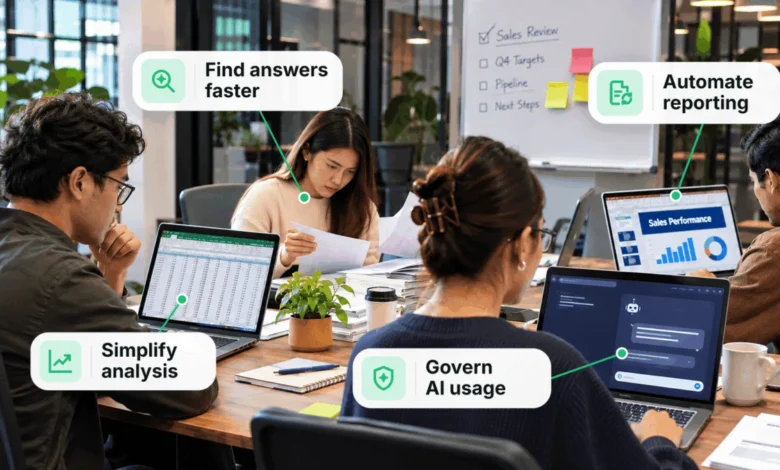
In the current global economic landscape, modern enterprises find themselves overwhelmed by the sheer volume of data they generate, yet consistently underwhelmed by their ability to harness it efficiently. For decades, organizations have invested heavily in relational databases, data lakes, and complex Enterprise Resource Planning (ERP) systems. Yet, despite these multi-million-dollar outlays, business units frequently report frustrating bottlenecks: fragmented data silos, time-consuming reporting cycles, and an over-reliance on specialized IT departments to answer even the most straightforward operational questions. While some forward-thinking corporations transitioned to self-service business intelligence (BI) platforms over the past ten years, many employees still struggle with steep learning curves, intricate query languages, and confusing report builders. Consequently, spreadsheets and disconnected desktop systems remain stubbornly entrenched in daily operations.
To resolve these enduring challenges, enterprise architects and software developers are increasingly turning to a powerful new paradigm: the integration of artificial intelligence (AI) directly into business intelligence frameworks. This technological evolution promises to bridge the long-standing divide between raw enterprise data and the non-technical decision-maker. By layering natural language processing, automated predictive analytics, and dynamic data storytelling onto a governed BI foundation, organizations aim to democratize data access while maintaining rigorous security standards. Industry analysts project that the global market for AI-enhanced business intelligence will continue its exponential trajectory, driven by corporate demands for faster operational responses and reduced IT overhead.
The Historical Evolution of Enterprise Data Access
To understand the current rush toward AI-driven BI, it is vital to examine the chronological evolution of corporate reporting. In the early days of corporate computing during the late 20th century, data retrieval was strictly the domain of IT professionals and database administrators. If a regional sales manager required a breakdown of quarterly performance, they submitted a formal ticket to the IT department, a process that could take days or even weeks.
By the early 2000s, the emergence of enterprise reporting tools and early business intelligence dashboards promised relief. These platforms allowed power users to design static reports and visualize key performance indicators (KPIs). However, they remained largely reactive and required specialized technical skills. The subsequent decade introduced the era of self-service BI. While tools like Tableau, Power BI, and Qlik revolutionized data visualization, they still demanded a foundational understanding of data structures, joins, and measure creation. For the average business user—such as an inventory clerk, a floor supervisor, or a regional marketing director—these systems often proved too complex for ad-hoc queries, leading them to extract data into local spreadsheets where version control and data integrity quickly deteriorated.
The introduction of generative AI and large language models (LLMs) represents the third major wave in this evolutionary timeline. Rather than forcing human users to learn the language of databases, AI allows the software to understand the language of humans. This shift from manual report-building to conversational analytics is fundamentally altering how organizations interact with their operational data.
Democratizing Information Through Conversational Analytics
The most immediate and tangible benefit of embedding AI into enterprise BI is the simplification of data access. In a traditional environment, answering a nuanced, multi-part operational question often requires constructing custom filters or writing complex SQL queries.
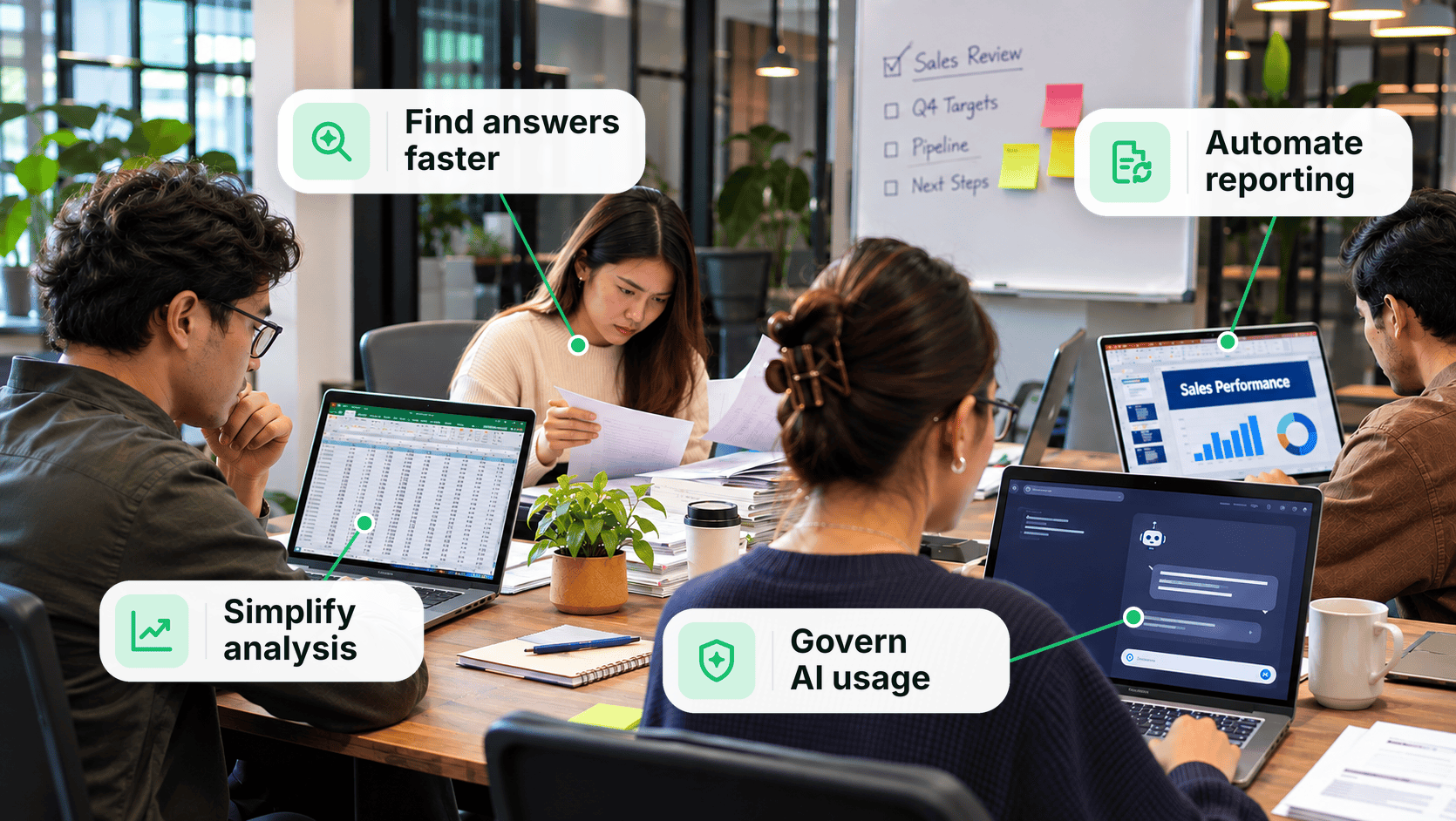
With AI-powered conversational analytics, this dynamic changes completely. For example, an operations manager reviewing daily logistics can simply type or speak a natural-language query into the system: “How many product orders are currently awaiting fulfillment across all distribution centers today?” Following that, the manager can drill down further by asking, “Can the system break those figures down by warehouse location and highlight any carrier delays?”
Modern BI platforms leverage natural language interfaces connected securely to underlying semantic layers, instantly interpreting these conversational inputs and rendering the requested figures on screen. This capability effectively eliminates the friction of report design, empowering frontline workers to answer their own operational questions in real-time. By shifting routine informational burdens away from technical teams, corporations can free up scarce IT resources to focus on strategic infrastructure rather than ad-hoc report generation.
Moving Beyond Visualization: Predictive Analysis and Automated Insights
Accessing data is merely the first step in a complex operational chain; deriving actionable insights that inform timely decisions remains the ultimate objective of any enterprise analytics strategy. Historically, dashboards have excelled at telling organizations what happened in the past, but they have struggled to explain why it happened or what actions should be taken next.
AI-assisted analytics fundamentally alter this dynamic by simultaneously examining multiple disparate business metrics, proposing root causes, and suggesting evidence-based courses of action. Consider the common retail challenge of recurring stockouts despite seemingly adequate aggregate inventory levels. In a traditional BI setup, an analyst might notice the discrepancy after the fact, spend hours cross-referencing warehouse distribution sheets, and eventually compile a retrospective report.
In contrast, an AI-augmented BI platform can autonomously analyze demand patterns, localized warehouse stock distribution, seasonal variations, and supplier lead times in seconds. The system can then flag emerging bottlenecks and rank replenishment priorities for supply chain managers. This capability transforms BI from a passive rearview mirror into an active, predictive co-pilot that helps businesses navigate market volatility with unprecedented agility.
Accelerating Cross-Functional Response and Collaboration
Even the most accurate analytical insight holds little value if it remains locked within a dashboard or fails to reach the personnel best positioned to act upon it. In many large organizations, critical operational anomalies go unaddressed simply because teams struggle to communicate their significance across departmental boundaries or fail to notify key stakeholders in time.
Artificial intelligence addresses this communication gap by translating complex analytical findings into clear, narrative-driven data stories. These automated narratives can be embedded directly into executive dashboards, highlighting immediate priorities and summarizing trends for non-technical leadership. Furthermore, intelligent alert systems can autonomously monitor data streams for anomalies—such as an unexpected spike in server error rates or a sudden drop in customer conversion metrics—and instantly dispatch contextual notifications to the relevant response teams.

Industry experts note that this reduction in "time-to-insight" directly correlates with improved operational resilience. Organizations that can rapidly synthesize data stories, circulate them internally, and coordinate a unified response are demonstrably better equipped to weather market disruptions.
Governance, Trust, and Guardrails in AI-Enabled BI
Despite the profound advantages of integrating artificial intelligence into enterprise analytics, organizations must navigate significant risks regarding data trust, privacy, and governance. The output of an AI model is only as reliable as the underlying data architecture that feeds it. Incomplete datasets, inconsistent business definitions, or lax security protocols can quickly undermine confidence in AI-driven insights, leading to costly operational missteps.
Modern enterprise BI platforms provide a vital structural advantage in mitigating these risks. By serving as a single source of truth with managed data connections, centralized semantic models, and robust security frameworks, these platforms establish the necessary guardrails for safe AI adoption. Enterprise architects recommend focusing on six core pillars when deploying AI within business intelligence environments:
- Grounding AI in Trusted, Current Data: A sophisticated AI analysis is useless if it relies on stale information. BI platforms automate data pipelines and refresh schedules, ensuring that AI models query dependable, up-to-date operational records.
- Standardizing Business Metrics and Definitions: Ambiguity destroys analytical consistency. If one department defines "revenue" as gross sales and another defines it as net receipts, AI models will generate conflicting answers. Governed semantic models ensure that AI responses adhere strictly to official corporate calculations.
- Enforcing Security and Access Controls: Natural-language access must never bypass organizational security permissions. A junior sales representative should not be able to query executive compensation or restricted financial ledgers simply by rephrasing a prompt. BI platforms enforce granular, role-based data permissions that AI interfaces must rigorously respect.
- Ensuring Verifiability of Results: Users must be able to audit the logic behind AI-generated explanations. By leveraging traditional BI drill-down views, underlying reports, and explicit reference calculations, employees can independently verify findings before committing capital or altering operations.
- Maintaining Human Oversight and Accountability: Artificial intelligence is designed to recommend and assist, not to dictate corporate strategy. Operational context—such as upcoming promotional campaigns or geopolitical supply chain risks—often exists outside the scope of historical data. Human decision-makers must remain fully accountable for final operational choices.
- Continuous Monitoring of Performance and Value: Organizations must establish baseline metrics to track the actual business value generated by AI tools, monitoring adoption rates, reductions in IT support tickets, and system accuracy to ensure continuous improvement.
Industry Perspectives and Real-World Implementation
Enterprise software providers and corporate IT leaders emphasize that successful AI adoption requires careful strategic alignment rather than a hasty, piecemeal rollout. Organizations are increasingly adopting modern, comprehensive platforms—such as LANSA BI—which integrate natively with leading AI model providers to deliver advanced natural-language querying, automated analysis, and secure data storytelling.
By consolidating and standardizing enterprise-wide data into a unified architecture, such platforms enable developers to embed intelligent analytics directly into core business applications. This seamless integration streamlines everyday workflows, allowing employees across all levels of the organization to access trusted insights with minimal reliance on overextended IT departments. Furthermore, enterprise-grade governance controls ensure that sensitive corporate data remains protected as deployment scales across the enterprise.
Industry analysts observe that companies moving from manual reporting models to modern, AI-enhanced BI are experiencing measurable improvements in operational efficiency, faster decision-making cycles, and a notable cultural shift toward data-driven accountability. As the technological capabilities of artificial intelligence continue to mature, the gap between data-rich organizations and truly data-driven enterprises will likely be defined by how effectively they implement these governed, intelligent BI frameworks. Corporations seeking to modernize their analytics infrastructure are increasingly encouraged to initiate structured proofs of concept, leveraging their own proprietary data to validate performance and align implementation strategies with long-term enterprise goals.