MARA pivots corporate strategy as it offloads 13,597 Bitcoin to prioritize AI infrastructure and balance sheet deleveraging

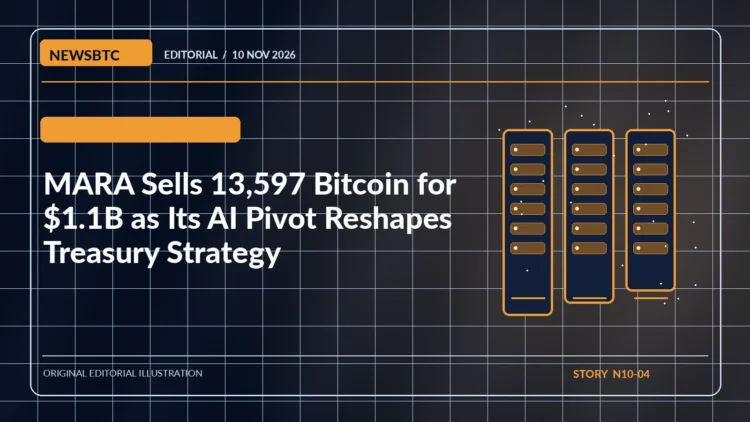
The landscape of institutional Bitcoin mining is undergoing a structural transformation, evidenced most clearly by the recent financial maneuvers of MARA Holdings, formerly known as Marathon Digital. In a decisive shift that marks a departure from its long-standing "HODL" strategy—the practice of accumulating and holding mined Bitcoin indefinitely—MARA has moved to monetize a significant portion of its reserves. According to the company’s third-quarter shareholder letter, the firm sold 13,597 BTC following the September 30 reporting cutoff, generating approximately $1.1 billion in proceeds at an average price of $81,039 per coin.
This liquidity event is not merely a divestment; it represents a fundamental reorientation of capital allocation. Of the $1.1 billion generated, $750 million was immediately deployed to retire Bitcoin-collateralized loans. This repayment has effectively freed 17,477 BTC that had previously been pledged as security for those credit facilities. By de-leveraging its balance sheet, MARA has significantly reduced its exposure to volatility-induced margin calls, transitioning from a debt-heavy expansion model to a more liquid, cash-rich position intended to fund high-growth infrastructure projects, particularly in the realm of artificial intelligence and data center development.
A Chronology of Strategic Realignment
To understand the gravity of this shift, one must look at the progression of MARA’s corporate strategy over the past eighteen months. Historically, the company operated under a philosophy shared by many in the mining sector: treat Bitcoin as a primary treasury reserve asset. By holding virtually all mined production, the company acted as a proxy for Bitcoin’s price performance, augmented by its mining hash rate capacity.
However, the third quarter of 2024 served as an inflection point. As of September 30, MARA reported holding 34,012 BTC. At that time, approximately 57% of these holdings were either lent out or encumbered by collateral agreements. This high degree of encumbrance created a systemic risk: should the price of Bitcoin have suffered a sharp, sustained drawdown, the company would have been forced to post additional collateral or face the liquidation of its primary asset.
Following the close of the quarter, the company executed its strategy with precision:
- Early October: MARA initiated the sale of 13,597 BTC.
- Mid-October: The proceeds of $1.1 billion were finalized.
- Late October: $750 million was applied to debt repayment, successfully reducing the encumbered portion of the company’s BTC holdings from 57% to less than 5%.
This rapid reduction in leverage signals that management is prioritizing financial flexibility over pure asset accumulation. The timing of these moves—occurring as the broader cryptocurrency market experienced a bullish rally—suggests that the company sought to capitalize on higher price points to clear its debt obligations before embarking on the next phase of its capital expenditure cycle.
The Macro-Economic Logic: Bitcoin vs. Infrastructure
The shift in MARA’s balance sheet logic centers on the competition for capital within the firm. In previous cycles, mining revenue was reinvested almost exclusively into mining rigs and electrical infrastructure to increase hash rate. Today, the competitive landscape has changed. Mining margins are increasingly compressed by the quadrennial Bitcoin "halving" events, which slash block rewards. Simultaneously, the demand for power-dense infrastructure to support AI and high-performance computing (HPC) has created a lucrative alternative use for the company’s power assets.
The proposed acquisition of the Long Ridge natural-gas power business is the cornerstone of this new strategy. By securing proprietary, reliable energy sources, MARA aims to transform itself from a pure-play miner into a diversified energy and infrastructure provider. The logic is clear: if the company can generate higher internal rates of return (IRR) by developing data centers for AI customers than by holding Bitcoin, the divestment of the latter becomes a rational, if difficult, economic decision.
However, this transition is not without risk. By selling 13,597 BTC, MARA has effectively capped its upside exposure to the very asset it produces. Should Bitcoin continue its upward trajectory, the firm will hold fewer coins to participate in that appreciation. Investors must weigh the potential stability of AI-driven, recurring revenue streams against the loss of the "Bitcoin beta" that previously defined the company’s stock.
Sector-Wide Trends and Peer Comparison
MARA is not acting in a vacuum. Its strategy mirrors a growing trend among the largest publicly traded mining firms, which are increasingly viewing Bitcoin as a liquid asset to be managed rather than a permanent store of value. Riot Platforms, for instance, recently liquidated over 20,000 BTC as it aggressively pursued contracts for AI-related data centers, targeting a $3.8 billion valuation trajectory for its infrastructure services.
Conversely, other players in the sector, such as Strive, have doubled down on aggressive Bitcoin accumulation, betting that the asset’s long-term appreciation will continue to outperform any infrastructure development projects they could undertake. This divergence in strategy provides investors with a clear choice: they can select miners who act as pure-play, high-volatility Bitcoin proxies, or they can choose miners who are pivoting toward becoming diversified energy and technology conglomerates.
MARA’s management has framed this as a move toward "financial flexibility." While this is undoubtedly true, it also reflects a maturation of the industry. The era of simple, machine-only mining is fading, replaced by a complex interplay of power management, grid stabilization, and specialized data processing.
Financial Implications and Shareholder Considerations
In addition to its operational changes, MARA has authorized a share repurchase program of up to $500 million. This move is designed to signal management’s confidence in the company’s intrinsic value, particularly as the firm navigates this transition period. However, shareholders should exercise caution. An authorization for share buybacks does not equate to an obligation, and the efficacy of such programs is often debated in the context of capital-intensive industries.
Furthermore, the company’s third-quarter results showed a 35% decline in revenue to $164.2 million, underscoring the volatility inherent in mining. While the company has cleared its debts, the "execution story" remains to be written. The success of the current strategy hinges on three critical variables:
- Closing the Long Ridge Transaction: Ensuring that the acquisition of power assets is finalized on favorable terms.
- Leasing Data Centers: Converting plans into signed, revenue-producing contracts with AI and cloud-computing clients.
- Capital Efficiency: Demonstrating that the capital redeployed into these projects produces yields that justify the divestment of Bitcoin reserves.
The inclusion of significant accounting effects related to digital assets in the company’s recent profit reports serves as a reminder to investors that "profit" in the mining sector is often highly sensitive to mark-to-market accounting. Investors should look past the headline numbers and focus on cash flow from operations and the tangible progress of the company’s infrastructure pipeline.
Conclusion: The Road Ahead
MARA’s decision to divest a substantial portion of its Bitcoin holdings and de-leverage its balance sheet is a definitive move toward corporate maturity. It recognizes that in a post-halving world, the economics of mining must be supported by broader, more diversified revenue streams.
The company has clearly signaled that it is no longer content to be a passive holder of Bitcoin. Instead, it is positioning itself as a foundational player in the digital economy’s infrastructure. Whether this gamble pays off will depend on the company’s ability to pivot from the world of decentralized consensus mechanisms to the high-stakes, competitive arena of AI and data center services. For now, the "HODL" era at MARA has been replaced by an era of strategic reallocation, and the market will be watching closely to see if the firm’s infrastructure bets can eventually outpace the growth of the digital asset it once treated as its sole treasury priority. The pivot is complete in terms of assets, but the long-term proof of the strategy will lie in the quarterly revenue reports of the next several fiscal years.
Related posts: