Sandboxing AI Agent Code Execution in Python: Containers, MicroVMs and Beyond

The rapid integration of autonomous AI agents into enterprise workflows has introduced a critical security paradigm: the necessity of isolating the arbitrary code these systems generate. As agents transition from simple chatbots to autonomous workers capable of executing Python scripts to manipulate data, the environment in which that code runs has become the primary battleground for cybersecurity. If an AI agent produces malicious or flawed code, the host environment’s integrity depends entirely on the strength of its sandboxing boundary. This article evaluates the three primary tiers of isolation—limited subprocesses, hardened Docker containers, and Firecracker microVMs—to determine the optimal balance between performance latency and security robustness.
The Evolution of the Execution Boundary
The history of sandboxing in software engineering is rooted in the "principle of least privilege," yet the requirements for AI agents are unique. Unlike traditional software, where code is audited and statically analyzed before deployment, AI agents generate code dynamically in response to prompts. This creates a high risk of "prompt injection" or "code injection" attacks, where a user influences an agent to execute unintended instructions.
In late 2025, the cybersecurity community faced a significant wake-up call when a series of vulnerabilities in runc—the low-level container runtime—allowed for container breakouts. These events highlighted the frailty of shared-kernel isolation. Consequently, the industry has shifted toward hardware-level virtualization as the gold standard. By mid-2026, major cloud providers like AWS and container leaders like Docker began aggressively promoting microVM-based architectures, such as Firecracker, as the default security layer for serverless and agentic workloads.
Tier One: The Limited Subprocess
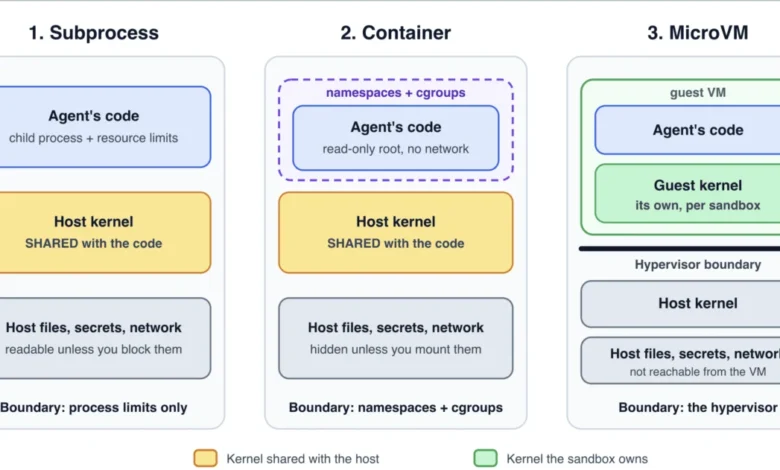
At the most granular, lightweight level lies the subprocess. This method involves spawning a child process that operates within the host’s operating system but is subject to resource constraints via Linux namespaces and cgroups.
The primary advantage of the subprocess is speed. Because it lacks the overhead of a hypervisor or a separate kernel, it can execute tasks in near-real-time. However, it is fundamentally the weakest form of isolation. Because the subprocess shares the host’s kernel and filesystem, it remains susceptible to privilege escalation. Even with strict environment variable sanitization—removing API keys and home directory access—an attacker who finds a vulnerability in the kernel can potentially bypass these constraints. Experiments show that while a subprocess can effectively block basic memory or CPU floods, it struggles to prevent sophisticated file-access leaks or process-level attacks.
Tier Two: The Hardened Docker Container
Docker containers represent the middle ground of the security spectrum. By utilizing namespaces to isolate process IDs, networks, and mount points, a container provides a significantly cleaner boundary than a standard subprocess.
To achieve a production-ready "hardened" state, developers must strip away default privileges. This includes using the --read-only flag to prevent the agent from modifying the root filesystem, setting --network none to prevent data exfiltration, and enforcing strict resource limits on memory and CPU. Despite these controls, the reliance on the host kernel remains the "Achilles’ heel" of containerized security. If a malicious script exploits a kernel-level bug, the container boundary is effectively bypassed. Recent industry data suggests that while containers are sufficient for low-risk, internal automation, they are increasingly viewed as inadequate for multi-tenant, high-stakes environments where secrets are stored on the same physical host.
Tier Three: The MicroVM Paradigm
The current pinnacle of secure execution for AI agents is the Firecracker microVM. Originally developed by Amazon for AWS Lambda, this technology enables the creation of lightweight virtual machines that each run their own kernel.
The security implications are profound: unlike a container, a microVM does not share a kernel with the host. If a malicious agent executes code that triggers a kernel panic or a zero-day exploit, the damage is contained within the VM’s virtual hardware, leaving the host operating system entirely unaffected. The trade-off is latency. While modern microVMs can boot in approximately 100 to 200 milliseconds, this is still significantly slower than a standard process launch. However, as infrastructure providers continue to optimize "warm pool" technologies—where VMs are pre-initialized and ready for immediate use—the perceived performance gap is closing rapidly.
Quantitative Analysis of Safety vs. Performance
In comparative benchmarks testing six specific attack vectors—CPU infinite loops, 512 MB memory allocation, fork bombs, disk filling, host secret reading, and unauthorized network calls—the tiers show distinct results.
The subprocess model typically allows approximately 33% of the tested attacks, particularly those involving process manipulation or kernel-level interaction. In contrast, a properly configured Docker container blocks nearly 100% of these attacks but requires rigorous maintenance to ensure that configuration flags (like --cap-drop ALL) are consistently applied. The Firecracker microVM provides the most consistent security posture. In simulated environments, it successfully isolated all malicious attempts, as the VM is ephemeral and destroyed immediately upon task completion, ensuring no persistent state can be used for future attacks.
Strategic Implications for Enterprises
The shift toward microVMs as the default for AI agent execution is not merely a technical preference but a strategic response to the evolving threat landscape. For enterprises, the choice of sandbox should follow a risk-based hierarchy:
- Development/Internal Use: For trusted scripts written by internal developers, a limited subprocess is acceptable, provided the environment is monitored.
- Operational Automation: For agents handling sensitive, non-critical data, a hardened Docker container with restricted networking and read-only filesystems serves as an effective barrier.
- Public-Facing/High-Stakes Agents: For agents that handle customer data, proprietary secrets, or have high-level system permissions, microVMs are no longer optional. They are becoming the industry standard.
Looking Toward the Future
The integration of these security layers into the AI development stack is accelerating. We are moving toward a future where "Infrastructure as Code" (IaC) will automatically provision a unique, ephemeral microVM for every single "tool use" request made by an AI agent.
The broader impact on the industry is a movement away from "model-centric" security—where we hope the AI won’t write bad code—to "infrastructure-centric" security, where we assume the agent will eventually produce malicious output and ensure the environment is resilient enough to contain it. As the latency of these hardware-level boundaries continues to drop, the cost-benefit analysis will shift heavily in favor of microVMs. The industry has reached a consensus: as AI agents become more autonomous, the boundary that contains them must be as robust as the tasks they are designed to perform. Organizations that fail to adopt these layered isolation strategies risk turning their most powerful productivity tools into their greatest security liabilities.