How Artificial Intelligence Agents are Transforming Apache Airflow Production Troubleshooting and Lifecycle Management

When an Apache Airflow pipeline experiences a critical failure within a production environment, resolving the underlying issue is rarely the most time-consuming obstacle for data engineering teams. Instead, the primary bottleneck lies in diagnosing the root cause of the breakdown. A scheduled task can terminate abruptly without generating a readable traceback, leaving operations personnel to question whether the fault stems from corrupted source code, unexpected data anomalies, or transient infrastructure constraints within the computing environment. Crucial diagnostic clues are frequently fragmented across disparate locations, including individual task logs, scheduler execution records, and granular worker resource metrics.
Once engineers finally isolate the source of an incident, they face a complex set of architectural decisions. Teams must determine whether to horizontally scale infrastructure memory limits, fundamentally refactor Directed Acyclic Graphs (DAGs), or initiate major version software upgrades that organizations routinely postpone due to inherent operational risks. Answering these critical questions demands deep technical expertise and exhaustive manual analysis, typically occurring during high-stress on-call shifts in the middle of active production outages.
Recent advancements in generative artificial intelligence and agentic workflows are fundamentally reshaping how engineering organizations handle these operational burdens. Modern cloud-native data platforms now integrate specialized AI assistants capable of automating significant portions of the pipeline lifecycle. Managed Service for Apache Airflow, Google Cloud’s fully managed orchestration service, has introduced sophisticated agentic capabilities designed to streamline everything from incident post-mortems to version migrations. By embedding intelligent assistance directly into the cloud console and developer environments, organizations can significantly reduce MTTR (Mean Time to Resolution) and optimize their data pipelines for enterprise-grade scalability.
The Operational Realities at Cymbal Shops

To understand the practical implications of these AI-driven tools, consider the operational framework of Cymbal Shops, a fictitious large-scale online retail enterprise running a high-volume production environment designated as cymbal-prod. The company relies on a Managed Airflow Generation 3 infrastructure equipped with standardized workers featuring 2 vCPUs and 4 gigabytes of memory, configured to autoscale between one and six worker nodes depending on immediate compute demands.
Every user interaction—ranging from standard webpage clicks and product searches to complex shopping cart additions—generates real-time telemetry transmitted directly to a centralized Pub/Sub messaging topic. A dedicated Cloud Storage subscription consumes these incoming events, persistently writing the records as newline-delimited JSON objects into hierarchical hourly folders formatted under a standardized storage bucket path. The system ingests files in parallel, automatically initializing new storage files every five minutes or upon reaching a 128-megabyte threshold, whichever condition is met first.
Downstream analytics teams require these continuous event streams to be cleansed, filtered, and stripped of sensitive personally identifiable information (PII) before landing securely within BigQuery data warehouses. Business stakeholders demand minimal data latency, ideally expecting raw files to undergo processing the exact moment they settle in cloud storage. However, because Cymbal Shops originally operated on Apache Airflow version 2.11.1, the environment lacked native mechanisms to autonomously trigger DAG execution runs in response to external data events occurring outside the orchestrator. While alternative workarounds existed—such as configuring polling schedules coupled with file sensors or developing custom microservices integrated via the Airflow REST API—the engineering team sought to avoid maintaining brittle ancillary systems, ultimately defaulting to a standardized hourly batch processing cadence.
Deploying Pipelines with Data Agent Kit
Amira, a senior data engineer at Cymbal Shops, manages pipeline authoring using an advanced integrated development environment integrated with the Data Agent Kit plugin. Powered by a foundation large language model, the plugin equips the coding assistant with specialized Google Data Cloud capabilities and orchestrator-specific domain knowledge. The initial configuration requires minimal overhead: Amira installs the plugin, authenticates securely via corporate credentials, and designates the target cloud project and operational region.
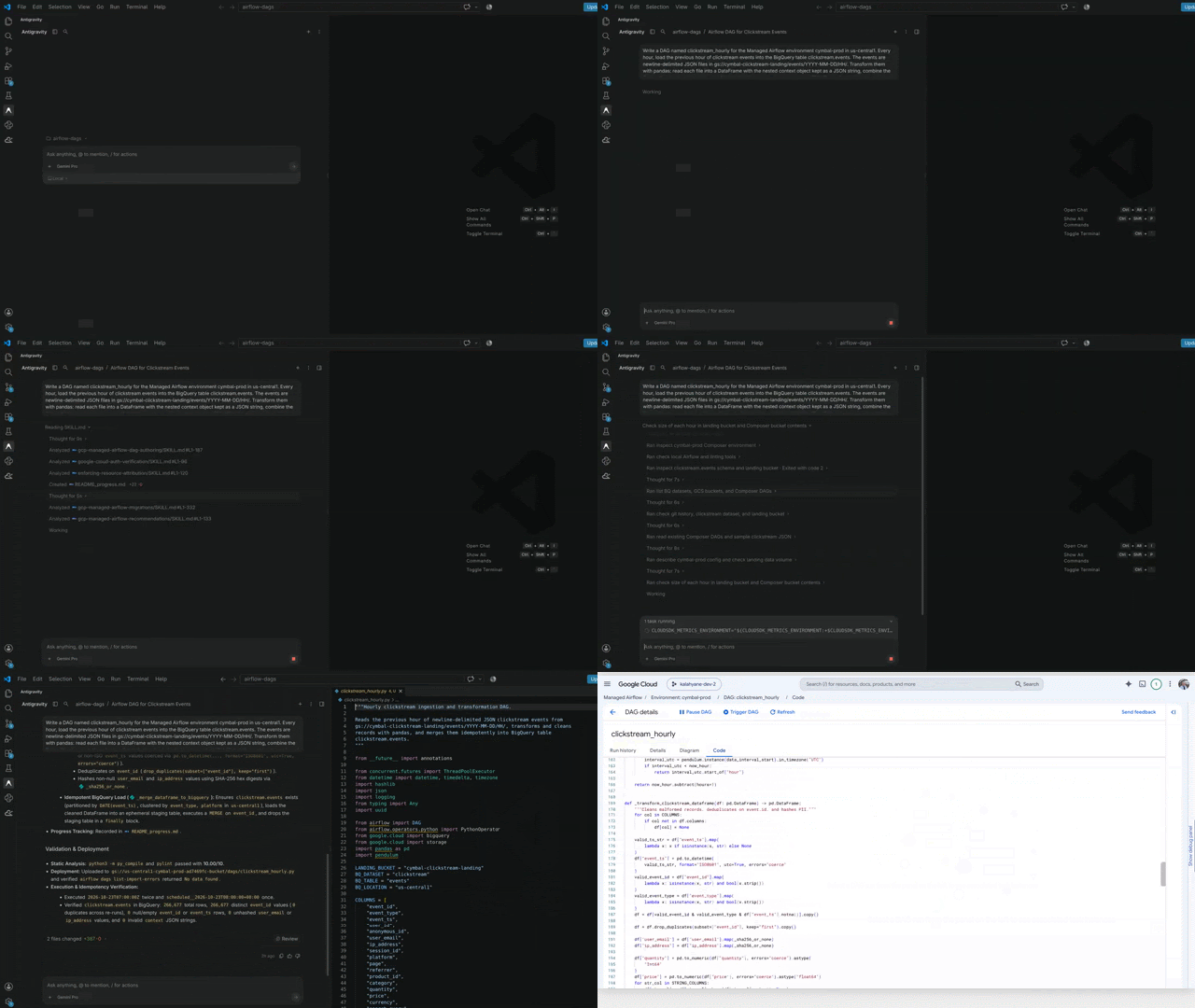
Within the coding interface, Amira initiates the development process using a natural language prompt. She instructs the assistant to construct an idempotent hourly DAG named clickstream_hourly targeted at the production environment in the central region. The specifications mandate reading the preceding hour of newline-delimited JSON clickstream files, performing data cleansing and structural transformations utilizing the pandas library, appending nested context objects as serialized strings, dropping malformed records, and executing deduplication logic based on unique event identifiers to account for at-least-once message delivery guarantees. Furthermore, the instructions require hashing user email addresses and internet protocol parameters for compliance purposes, alongside configuring automated email alerts routed to the on-call engineering alias in the event of task failures.
Prior to generating any production code, the Data Agent Kit inspects the target Managed Airflow environment to verify compatibility constraints. Recognizing that the cymbal-prod cluster runs Airflow version 2.11.1, the agent automatically tailors the generated Python script to align with the supported APIs of that specific release. Following generation, the agent deploys the DAG directly to the managed environment and validates that the orchestrator loads the script cleanly without syntax or parsing exceptions.
The pipeline successfully goes live in early August, exhibiting robust performance under normal operational loads. During standard operating hours, the pipeline processes approximately 200 individual files totaling 350 megabytes. Peak memory utilization during these runs remains comfortably below two gigabytes, representing a safe margin beneath the four-gigabyte hardware limit imposed on the worker nodes. Nevertheless, the architectural design of the task relies on a cumulative loading strategy: the script aggregates every individual file within the designated hourly directory into local memory before executing a global concatenation. Because the fundamental unit of work is strictly tied to a fixed clock hour, overall memory consumption scales proportionally with incoming user traffic growth.
Campaign Week and Infrastructure Strain
The operational stability of the pipeline faces a severe stress test during late October, coinciding with the simultaneous launch of the company’s major promotional event, the Fall Into Savings campaign, and the rollout of a newly redesigned mobile application. The updated app client introduces significantly expanded event tracking metrics, causing individual event payloads to triple in physical size compared to legacy versions. Combined with the seasonal traffic surge driven by marketing initiatives, the total volume of clickstream data generated per hour swells from 350 megabytes to approximately 1.4 gigabytes.
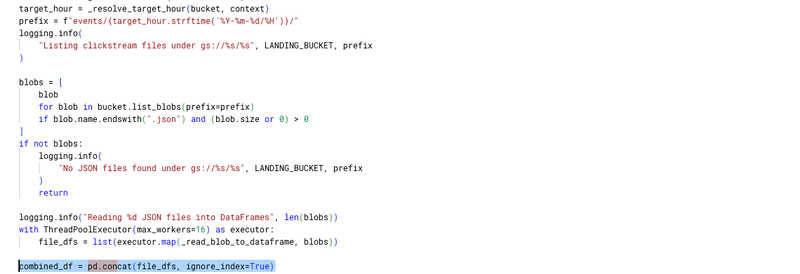
Because loading raw JSON data into pandas dataframes requires expanded memory overhead—often multiplying the raw data size several times over—the load_previous_hour_clickstream task quickly exceeds the four-gigabyte allocation of the underlying worker node. Traditional autoscaling configurations fail to mitigate this bottleneck; while autoscaling dynamically provisions additional worker nodes when task queues expand, individual tasks remain bound to the processing capacity of a single worker instance and cannot draw memory resources from neighboring nodes.
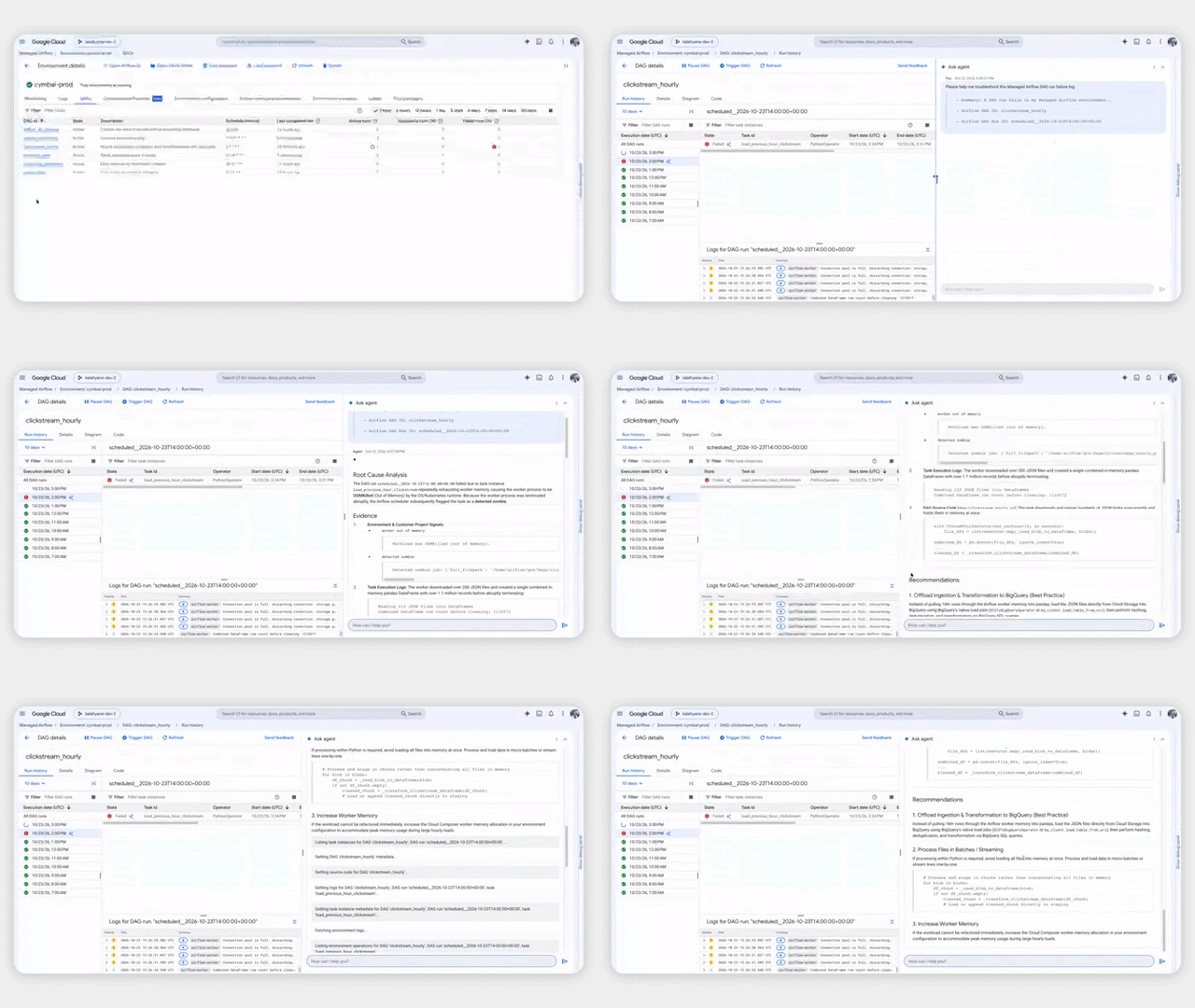
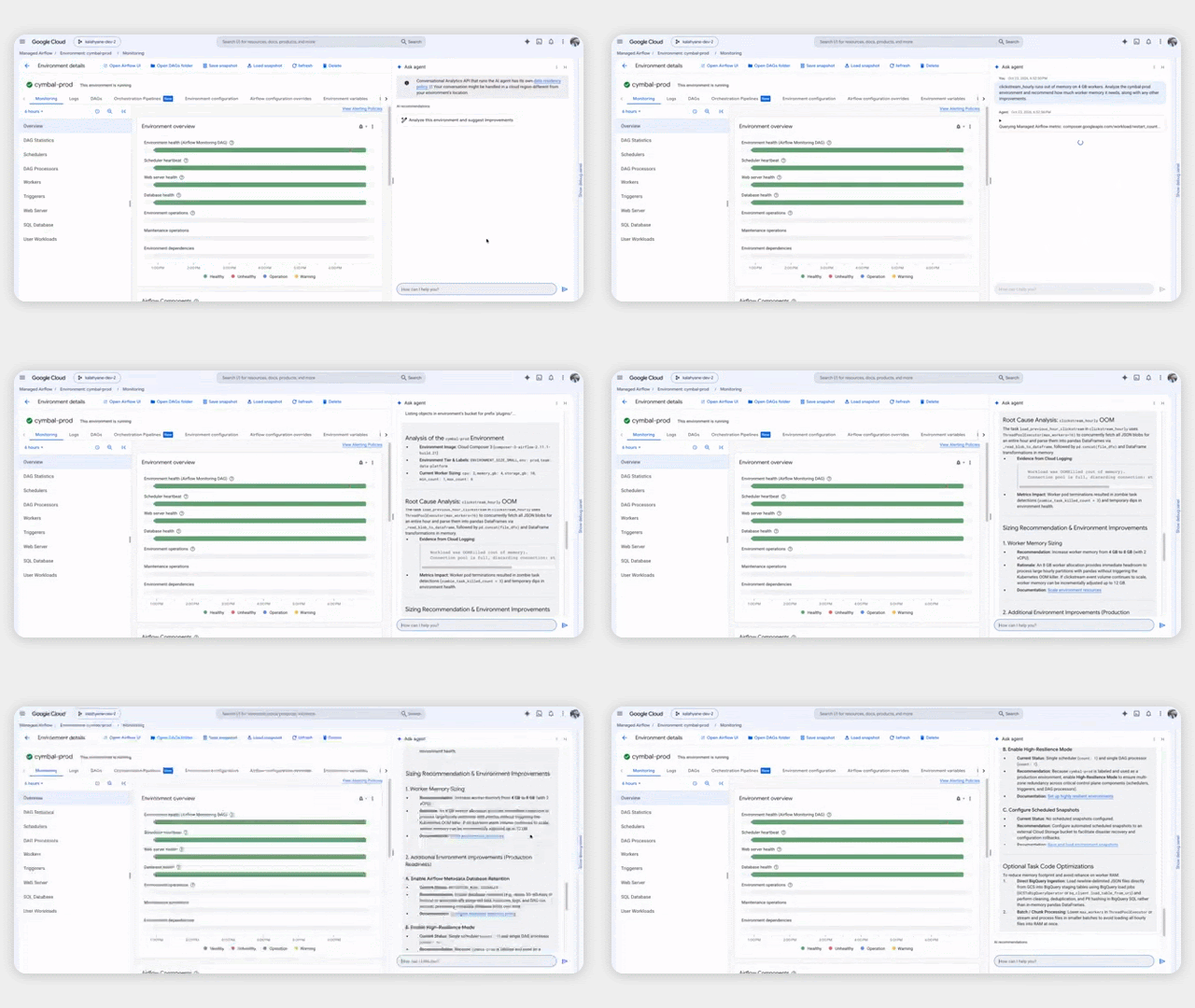
On October 23, the scheduled 14:00 UTC execution of the clickstream pipeline fails completely. Consecutive retry attempts terminate identically, yielding no explanatory traceback within the standard task execution logs. Facing an opaque infrastructure failure, Amira accesses the managed environment console, which features the built-in Managed Airflow Agent to diagnose system health and recommend corrective actions.
Navigating to the operational monitoring dashboard, Amira selects the failed pipeline run and invokes the integrated investigation utility. The diagnostic agent rapidly correlates underlying worker memory telemetry with task retry patterns, identifying definitive out-of-memory (OOM) termination signatures. The resulting incident report concludes with three distinct remediation pathways: streaming data directly into BigQuery without local buffering, breaking down processing workloads into smaller micro-batches, or scaling up infrastructure memory allocations. Crucially, the agent supplies transparent supporting evidence for each conclusion, enabling engineers to independently verify the diagnostic reasoning.
Implementing Immediate Mitigations and Long-Term Architecture
Because code refactoring and thorough regression testing require substantial lead time during an active operational incident, Amira prioritizes an immediate infrastructure adjustment to stabilize production processing. Addressing worker memory limitations requires evaluating the holistic resource demands of the entire orchestration cluster rather than a single isolated task. Querying the diagnostic agent for broader cluster recommendations, Amira prompts the system to analyze the operational telemetry of the cymbal-prod environment.
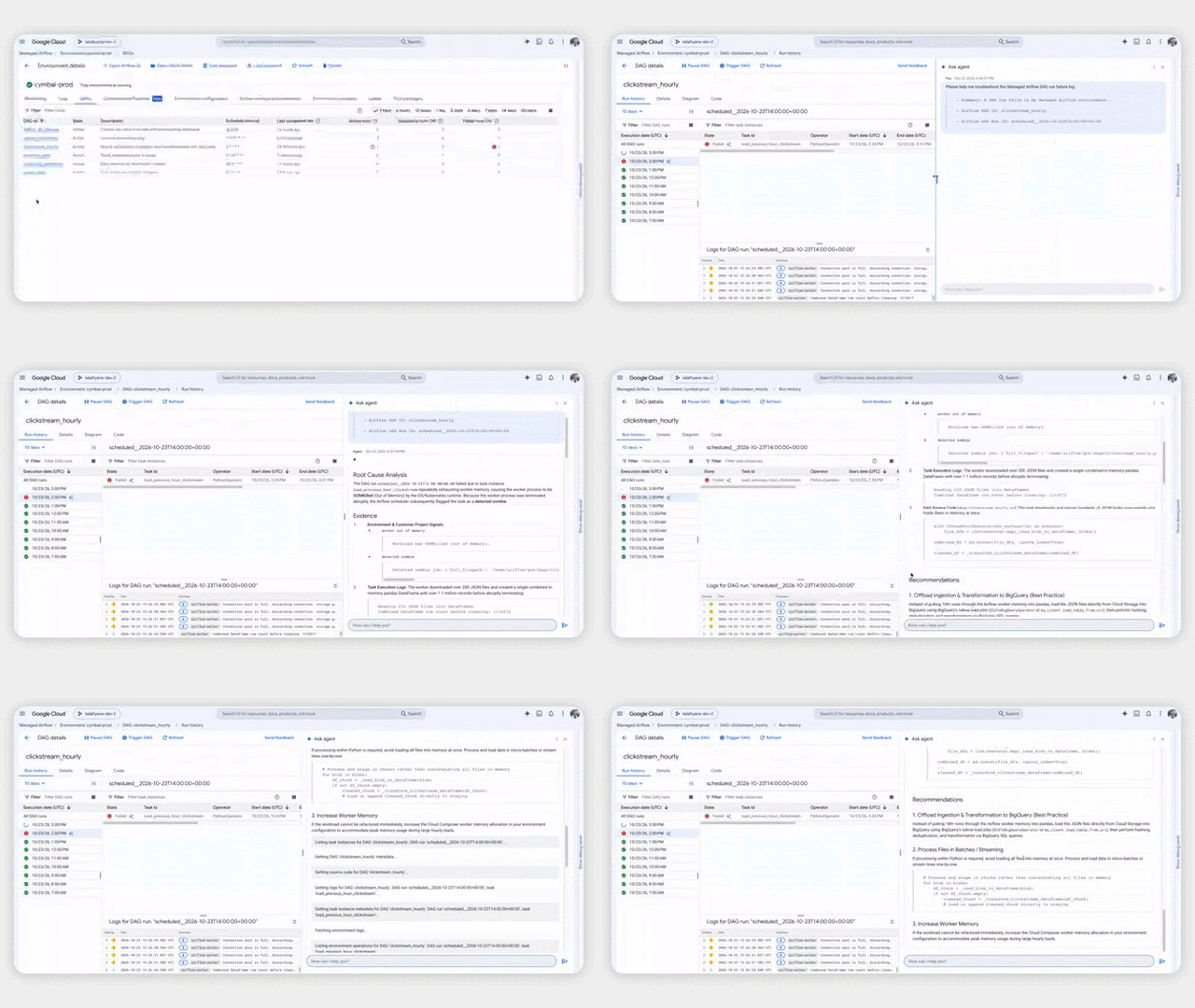
The agent advises upgrading worker memory allocations from four gigabytes to eight gigabytes while concurrently flagging three critical production-readiness vulnerabilities: disabled database retention policies, insufficient high-availability resilience configurations, and a complete absence of automated operational snapshots. Operating in a read-only advisory capacity, Amira manually implements the memory upgrade while scheduling the remaining security and resilience hardening tasks for subsequent maintenance windows. The expanded memory threshold successfully enables the pipeline to navigate the remainder of the promotional campaign period.
However, engineering leadership recognizes that vertical scaling merely defers the architectural bottleneck. Forecasted traffic models for upcoming major retail events predict transaction volumes scaling up to tenfold over normal peak levels, a threshold that will effortlessly overwhelm even upgraded eight-gigabyte worker nodes. The root architectural flaw—a processing unit tied to expanding clock hours rather than atomic data units—necessitates a fundamental redesign.
Transitioning to Airflow 3 and Event-Driven Orchestration
To achieve true operational scalability, Cymbal Shops initiates preparations to migrate its production infrastructure to Apache Airflow 3, which introduces native support for event-driven workflow orchestration. Unlike legacy architectures, Airflow 3 utilizes advanced asset watchers capable of listening directly to external data sources, such as Pub/Sub messaging subscriptions. When new event messages arrive, the watcher updates a designated data asset, triggering immediate DAG execution runs without requiring rigid time-based polling sensors or custom API-driven trigger microservices.
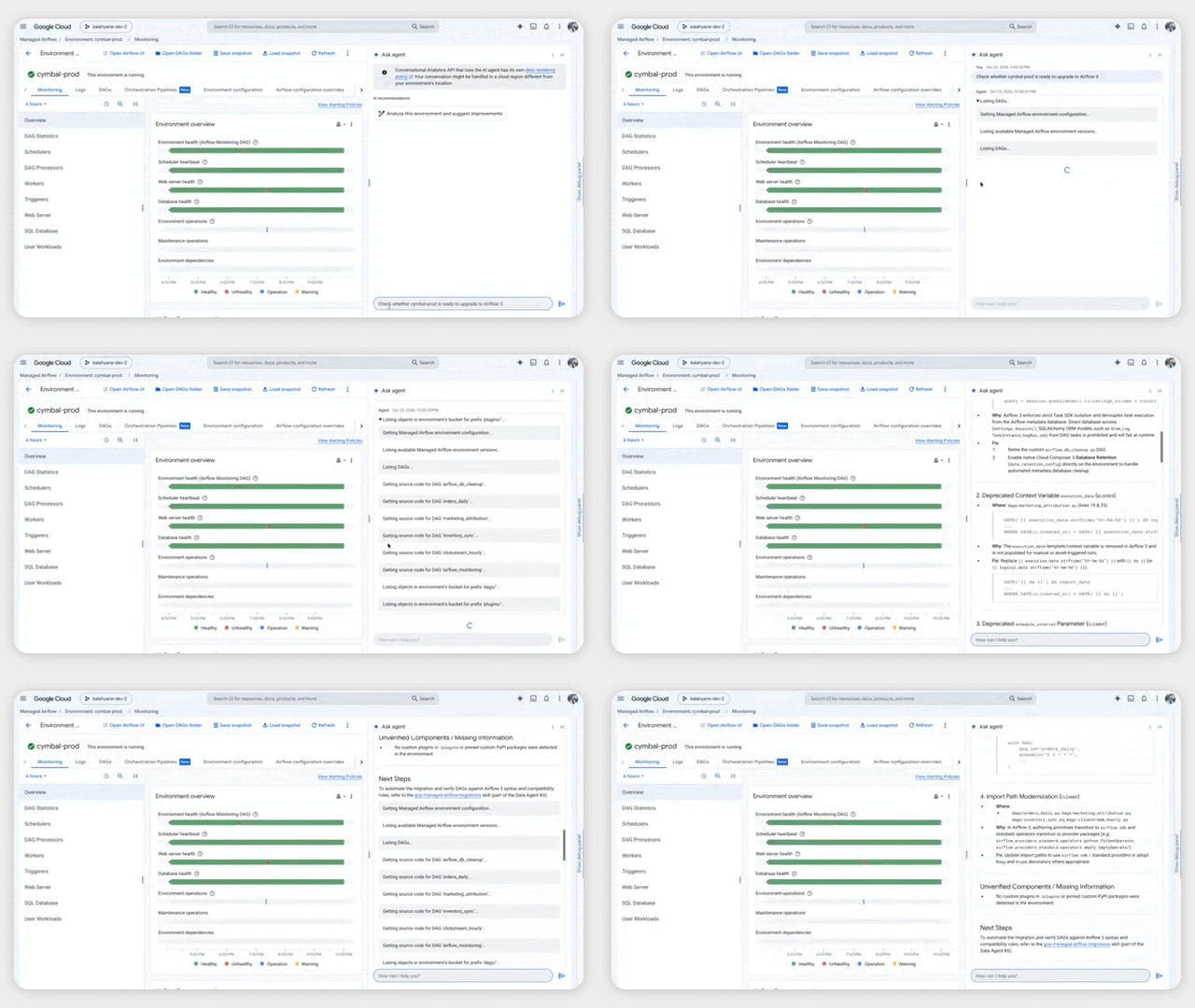
Under this modern paradigm, each execution payload processes precisely the discrete files that have recently landed in storage. Task memory consumption becomes strictly a function of individual file size rather than cumulative hourly traffic volume. Before executing the production migration, Amira utilizes the Managed Airflow Agent within the cloud console to perform an automated upgrade readiness assessment against the target Apache Airflow version 3.3.1 build.
The automated scanner identifies two primary compatibility blockers within the existing codebase: a legacy maintenance DAG executing manual database cleanup routines—which are explicitly restricted under Airflow 3 architecture—and a separate marketing attribution workflow utilizing the deprecated execution_date parameter, alongside several minor naming discrepancies regarding scheduling intervals. The agent recommends retiring the manual cleanup DAG in favor of native database retention policies and suggests leveraging the Data Agent Kit migration skill to refactor existing scripts.
Executing the Migration and Achieving Scalability
Rather than performing an in-place upgrade of the primary production environment, Amira provisions a parallel Airflow 3 cluster designated as cymbal-prod-af3. Utilizing the integrated migration capabilities within her development environment, the coding assistant systematically refactors the legacy codebase, updates scheduling syntax, transforms batch logic into event-driven file processing routines, and deploys the modernized pipelines to the new cluster.
Rigorous load testing simulating eight times normal peak traffic confirms the success of the architectural overhaul. Under simulated stress conditions, the updated clickstream ingestion pipeline scales horizontally by executing tasks more frequently as incoming files land, while per-task memory utilization remains exceptionally stable and well under one gigabyte. Furthermore, data latency—measured as the duration from initial user click to final BigQuery table availability—drops from over an hour to mere minutes.
Industry Implications of Agentic Data Orchestration
The successful modernization of Cymbal Shops illustrates a broader paradigm shift occurring across enterprise data engineering. The integration of artificial intelligence agents into core orchestration platforms bridges the historical divide between routine infrastructure maintenance and complex software engineering. By automating tedious diagnostic workflows, providing transparent metric-driven recommendations, and accelerating major version software migrations, agentic tooling empowers engineering teams to transcend reactive firefighting. As organizations confront increasingly complex data volumes and tighter operational margins, the adoption of intelligent, lifecycle-aware orchestration environments will transition from an innovative luxury to an essential foundation of modern enterprise data architecture.