ILLA Builder’s 92 Fingerprints Mark a Low-Code Control Plane With Data Connections

The rapid proliferation of low-code and no-code development platforms has fundamentally transformed how modern enterprises build and deploy internal software tools. However, this acceleration in software delivery brings distinct administrative and security challenges, particularly when platforms capable of interfacing directly with core corporate databases are inadvertently exposed to the public internet. Recent telemetry data gathered via internet-wide search engines has cast a spotlight on ILLA Builder, a popular open-source low-code platform designed for assembling dashboards, administrative panels, and customer relationship management systems.
Security telemetry collected in late November 2026 revealed a baseline footprint of nearly a hundred publicly reachable instances of the platform. While the mere presence of a web application on the public internet does not inherently indicate a misconfiguration or a security breach, the functional nature of ILLA Builder—acting as a centralized control plane equipped with live database connections, API credentials, and administrative capabilities—elevates the operational risk profile for organizations that fail to secure their deployments properly.
Understanding the Technical Anatomy and Capabilities of ILLA Builder
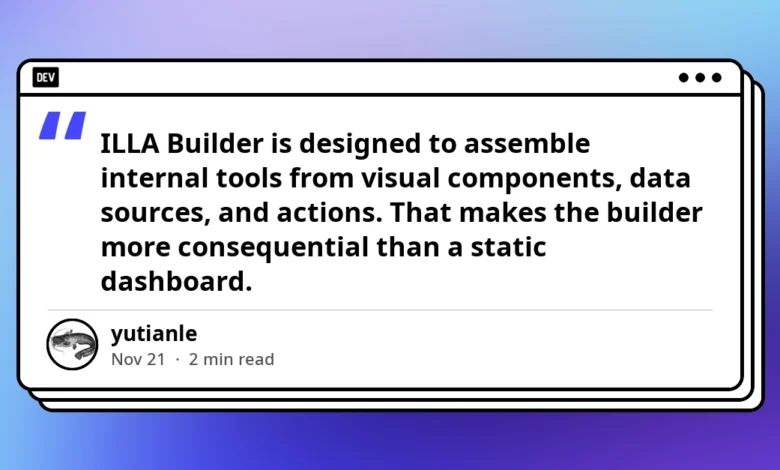
To comprehend the significance of a publicly discoverable ILLA Builder instance, one must examine its core architectural purpose. Unlike a static web page or a read-only corporate dashboard, ILLA Builder is engineered as an active development and deployment environment. It allows engineering teams and business analysts to visually assemble internal tools by dragging and dropping user interface components and binding them directly to backend data sources, custom scripts, and third-party actions.
The platform natively supports a wide array of robust data connectors. These include relational database management systems such as PostgreSQL, MySQL, and Microsoft SQL Server, as well as non-relational document stores like MongoDB. Furthermore, the platform integrates seamlessly with caching and message broker technologies like Redis, arbitrary REST APIs, GraphQL endpoints, and specialized artificial intelligence services such as Hugging Face.
Because these connectors reside within the builder environment, the platform effectively functions as a heavily privileged control plane. A deployment of ILLA Builder does not merely display data; it holds the structural keys to query, modify, or delete production data depending on how the underlying applications have been architected. Furthermore, the builder interface often retains sensitive authentication credentials—such as database connection strings, bearer tokens, and API secrets—that are utilized by background workers to execute queries. If an unauthorized individual gains access to the builder console, they do not just see the interface; they inherit the collective authority of all integrated data sources linked to that workspace.
Chronology of the Discovery and Telemetry Analysis
The recent visibility assessment of ILLA Builder deployments on the public internet was conducted utilizing advanced attack-surface discovery techniques. On November 22, 2026, researchers executing automated reconnaissance via the ZoomEye search engine platform initiated systematic probes to quantify the global footprint of the software.
The probing methodology relied on specific search parameters to ensure high fidelity in asset identification. By querying the system using standard software fingerprinting strings—specifically targeting application identifiers, HTML page titles, and raw Hypertext Transfer Protocol response bodies—investigators mapped the distribution of the platform across global Internet Protocol space.
Specifically, the search execution utilized the ZoomEye Software Development Kit with parameters set to sub_type=all, page 1, and a page size of 1. When searching specifically for application signatures using the string app="ILLA Builder", the search engine returned exactly 92 distinct matches. A parallel query targeting the HTML document title via title="ILLA Builder" yielded an identical count of 92 matches. A broader search string targeting the raw Hypertext Transfer Protocol response body (http.body="ILLA Builder") returned a slightly higher count of 109 matches.
These technical discoveries were logged between the hours of 06:46 and 06:47 Asia/Shanghai on the morning of November 22, 2026. Cybersecurity analysts examining these figures note that the precise alignment between the application signature and the title signature—both pointing to 92 confirmed instances—serves as a highly reliable indicator of the platform’s core deployment footprint. Meanwhile, the 17 additional matches identified through the body text query likely represent auxiliary pages, documentation remnants, custom landing pages, or external web properties that reference the platform without explicitly featuring the product name in their browser title tags.
Limitations of Public Exposure Metrics
It is a critical tenet of modern vulnerability management and threat intelligence that the discovery of an application fingerprint on the public internet does not automatically equate to a confirmed security vulnerability. The telemetry data gathered during the November 2026 reconnaissance sweep measures presence, not posture.
None of the 92 application matches or 109 body matches provide definitive proof regarding the authentication state of the individual deployments. A significant proportion of these instances may be securely protected behind robust enterprise identity and access management solutions, multi-factor authentication gateways, or zero-trust network access policies. Furthermore, the telemetry does not reveal whether the data sources linked to these builders are live production environments containing sensitive customer records, or whether they are isolated sandboxes populated entirely with dummy data.
Additionally, the scan results do not disclose the specific software version running on each server, nor do they verify whether the deployment administrators have successfully isolated the builder console from public-facing end-user applications. Consequently, treating these raw metrics as an indicator of widespread compromise would be analytically inaccurate. Instead, security experts characterize the findings as an important asset discovery signal—a prompt for system administrators and DevOps teams to audit their cloud environments and ensure proper perimeter defenses are enforced.
The Infrastructure Risk of Self-Hosted Low-Code Environments
The architectural flexibility of modern low-code tools often relies on containerized deployment models. Platforms like ILLA Builder are frequently deployed by internal engineering teams using Docker, Docker Compose, or Kubernetes clusters hosted on major cloud service providers such as Amazon Web Services, Google Cloud Platform, or Microsoft Azure.
While containerization simplifies the process of spinning up development environments, it also introduces complex security variables. A self-hosted deployment inherits the security posture of the underlying host operating system and network architecture. System administrators must carefully evaluate which environment variables are exposed to the container, which persistent volumes are mounted, and what Identity and Access Management service accounts or roles have been assigned to the running pod or virtual machine.
A recurring operational hazard in self-hosted environments is the inadvertent persistence of test configurations into production pipelines. When developers spin up a quick proof-of-concept instance to evaluate a low-code platform, they frequently utilize administrative database credentials or high-privilege API keys for convenience. If that same instance is subsequently migrated or left accessible without a rigorous security review, it transforms into an unintended vector for data exposure. The risk is magnified in environments where outbound network policies are overly permissive, allowing the low-code platform to communicate with internal microservices that were never intended to be reached from an administrative tooling layer.
Recommended Remediation and Asset Inventory Frameworks
In light of the visibility data and the inherent capabilities of low-code control planes, security architects recommend a comprehensive remediation and asset management strategy for organizations utilizing ILLA Builder or comparable platforms. The foundational step in this process is the execution of a thorough organizational inventory.
For every identified deployment within an enterprise network, administrators should formally document the base URL, the active authentication mode, user role configurations, workspace memberships, and all established data-source connections. Crucially, organizations must draw a hard architectural line between the builder console—where workflows, queries, and integrations are authored—and the published applications that are ultimately intended for end-user consumption. Under no circumstances should the administrative builder interface be accessible via the public internet without stringent authentication barriers.
To enforce robust defense-in-depth principles, security teams should implement the following operational controls:
- Network Segmentation: Place all administrative control planes and builder routes behind private networks, corporate virtual private networks, or zero-trust access proxies that require explicit device and user verification before granting access.
- Least-Privilege Data Access: Configure individual data connectors with the minimum level of database permissions required to fulfill their function. Never reuse a database administrator account for application previews, routine testing, or automated scheduled actions.
- Authentication Enforcement: Mandate strong, enterprise-grade authentication mechanisms for all users permitted to access the builder environment. Regularly audit workspace memberships to ensure that former employees or external contractors no longer retain active administrative rights.
- Egress Filtering and Monitoring: Monitor all outbound network requests originating from the builder platform and its associated background action workers. Implement strict egress allowlists that restrict the platform’s network reach exclusively to approved, necessary data sources, preventing unauthorized lateral movement toward internal corporate services.
- Rigorous Verification Testing: Periodically test application configurations to ensure that unauthenticated users or individuals lacking builder-level privileges are entirely blocked from enumerating available data connections or executing raw backend queries directly.
Broader Industry Implications for Low-Code Governance
The presence of numerous discoverable control planes across the global internet highlights a broader, industry-wide challenge regarding shadow IT and the governance of developer tooling. As enterprises increasingly embrace low-code and citizen-development paradigms to accelerate digital transformation, the traditional boundaries of the corporate perimeter continue to blur.
Tools that bridge the gap between visual user interfaces and powerful backend databases offer immense productivity benefits, but they simultaneously demand a commensurate elevation in security maturity. When development environments are treated with the same lax operational security as static marketing websites, the potential consequences extend far beyond simple service disruption—they threaten the confidentiality and integrity of foundational enterprise data stores.
Ultimately, the insights derived from internet-wide telemetry scans serve not as an indictment of specific software products, but as a timely reminder for the broader technology community. As low-code platforms become deeply embedded in the operational fabric of modern organizations, treating administrative control planes with the highest degree of security rigor is no longer optional; it is an essential prerequisite for safe digital innovation.
Related posts: