
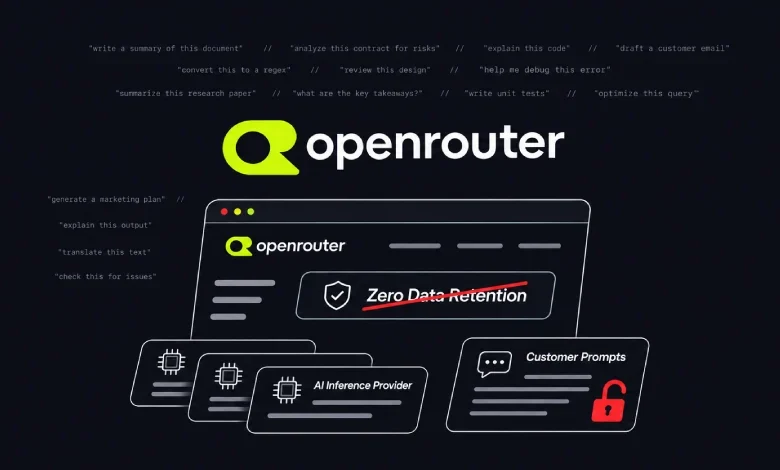
Leak Exposing Zero Data Retention Prompts
The artificial intelligence supply chain has suffered a major security reckoning following revelations that multiple AI inference providers silently leaked customer prompts—including those explicitly marked under Zero Data Retention policies—to unauthorized third parties for months. The widespread security lapses were uncovered not by internal audits or standard compliance checks, but by an extensive independent research initiative utilizing canary tokens. The findings demonstrate profound vulnerabilities within the complex routing architecture that underpins modern generative artificial intelligence deployment, impacting both prominent enterprise users and casual developers who rely on third-party aggregators and cloud-based inference marketplaces.
The revelations, published by industrial cybersecurity firm Dragos and corroborated by statements from major routing gateways and affected AI labs, highlight a fundamental flaw in the foundational trust model of distributed AI systems. While end-users frequently rely on privacy flags such as "Zero Data Retention" to guarantee that their proprietary data, source code, and sensitive prompts are discarded immediately after processing, the research proves that privacy guarantees at the application layer are virtually meaningless if underlying infrastructure, routing paths, or vendor servers have already been compromised.
Anatomy of the Research and Canary Token Methodology
The scope of the security breakdown only came to light because researchers deployed a sophisticated tracking operation between July and November of this year. By seeding approximately two million AI prompts with unique, untraceable web links and cryptographic canary tokens, the team was able to monitor when, where, and by whom these hidden secrets were accessed. Because a planted canary token can only be triggered if a human or an automated scraper actually reads the text of the prompt carrying it, every unauthorized access served as undeniable proof of data leakage.
The tracking methodology revealed multiple distinct vectors of compromise. The most severe involved direct intrusions into the internal infrastructure of AI inference providers. In these instances, attackers managed to install traffic-copying mechanisms at the very earliest points of arrival, siphoning incoming requests before safety filters or model execution even occurred. In some cases, attackers intercepted requests that had been explicitly rejected by the model providers, yet the raw traffic was still successfully harvested.
Simultaneously, the researchers identified vulnerabilities requiring no sophisticated break-ins whatsoever. Shady vendors operating within unverified AI inference marketplaces deliberately undercut market prices, configuring their nodes to log all incoming traffic. This harvested data was then systematically repurposed. In several instances, individual operators utilizing residential broadband connections in Europe and Asia were observed manually testing credentials extracted directly from customer prompts against cloud environments and internal network endpoints.
Chronology and Timeline of Breaches
The timeline of vulnerabilities stretches back months, underscoring the persistence of threat actors operating within the AI supply chain.
Mid-July: The earliest of the major third-party inference provider breaches began. Planted bait prompts were processed alongside genuine customer requests, resulting in the widespread copying of sensitive user data. Despite the severity of the compromise, the provider in question initially blamed internal misconfigurations before a subsequent internal forensic review uncovered unauthorized access to administrative credentials.

Late October: The largest of the infrastructure breaches materialized during a series of short operational windows. Attackers deployed hundreds of stolen Amazon Web Services (AWS) keys into targeted inference pipelines, capturing virtually all traffic traversing specific server endpoints. Within hours of theft, these keys were actively exploited to probe cloud storage buckets, search Secrets Manager parameters, and attempt privilege escalation through the creation of unauthorized Bedrock API keys and Identity and Access Management (IAM users).
November 1: The operational sophistication of the threat actors escalated. A known actor utilized ARTEX, an advanced AI-driven penetration testing framework, to systematically verify whether the previously stolen credentials remained active. During this phase, security telemetry captured specific automated agent user agents—namely artex-agent and artex-judge-r121—which matched no existing indicators of compromise in public threat intelligence databases, prompting urgent calls for defensive integration across corporate security teams.
November 8: Phala officially contained an active intrusion into its inference servers, marking one of the first formal infrastructure disclosures related to the wider sweep.
Official Responses and Industry Fallout
In response to the cascading discoveries, OpenRouter, a prominent gateway service that distributes customer requests across a diverse pool of third-party inference providers, took immediate remedial action. The company confirmed that while its own internal infrastructure remained uncompromised, it purged three third-party providers from its network and stripped 125 distinct endpoints of their Zero Data Retention eligibility. OpenRouter has formally notified all potentially affected customers and initiated a sweeping technical overhaul, introducing continuous automated validation checks and thorough network path verification to trace how and where upstream partners handle payload data.
Public disclosures from affected companies have painted a sobering picture of how easily administrative oversights can cascade into major data exposures.
Phala released a preliminary incident report confirming that an unauthorized party seized control of an internal inference server, gaining the capability to observe active request processing between October 21 and November 8. The provider advised all customers who routed requests for the DeepSeek V4 Flash 0731 model through the affected window to treat any embedded API keys, passwords, or authentication tokens as permanently compromised and rotate them immediately.
Together AI disclosed a separate security event stemming from an inadvertent credential leak. An AI coding assistant accidentally committed sensitive credentials to a public GitHub repository, enabling an unauthorized actor to access stored samples of customer prompts collected for routine software testing. These samples, originating from requests sent during June and July for models including MiniMax M3, GLM-5.2, and Kimi K2.6, were subsequently searched for reusable third-party credentials. Together AI confirmed that while several of the researchers’ canary tokens were swept up in this breach, the company has found no evidence of broader data dissemination and has since elevated Zero Data Retention to the default standard for all newly created accounts.
Novita, another key ecosystem participant, verified that routing configuration errors inadvertently forwarded specific MiniMax customer requests directly to official upstream APIs rather than handling them locally under expected privacy perimeters.
Implications for Enterprise Security and AI Supply Chain Management
The broader implications of these cascading incidents extend far beyond individual consumer annoyance or minor credential leaks. As corporate entities increasingly integrate generative artificial intelligence into core software pipelines, autonomous agents, and internal development workflows, the volume of sensitive data transmitted through third-party APIs has skyrocketed.

Industry experts emphasize that traditional perimeter security paradigms are fundamentally inadequate for the modern AI supply chain. When an enterprise sends a prompt containing proprietary intellectual property, internal source code, or cloud access tokens to an inference provider, it is effectively placing complete trust in a multi-tiered ecosystem of cloud hosts, routing gateways, and third-party resellers.
HD Moore, Chief Research Officer at Dragos, succinctly summarized the core systemic vulnerability: privacy flags and zero-retention policies are functionally useless if an attacker has already bypassed software controls to siphon raw traffic at the network level. Furthermore, autonomous AI agents—increasingly designed to fetch data, execute code, and manage infrastructure autonomously—frequently transmit sensitive credentials within their prompt contexts without human oversight, turning routine text generation into an inadvertent vector for corporate espionage.
Recommended Mitigation Strategies and Defensive Posture
In light of these findings, cybersecurity analysts and industry stakeholders are strongly urging organizations to fundamentally reevaluate how they consume artificial intelligence services:
-
Prioritize Self-Hosting and Direct Vendor Relationships: Where data sensitivity is paramount, organizations should transition toward self-hosted open-weights models or establish direct, single-vendor contracts with first-tier AI providers, bypassing multi-hop aggregators and opaque reseller marketplaces whose foundational infrastructure cannot be independently audited.
-
Enforce Strict Credential Scrubbing: Automated pipelines must implement aggressive pre-transmission filtering to strip all API keys, passwords, and sensitive environment variables from prompt strings before they leave local corporate environments.
-
Deploy Canary Tokens as Tripwires: Security teams are encouraged to adopt the methodology utilized by researchers, embedding free canary tokens or monitoring tripwires within internal testing scripts and agent workflows to detect unauthorized access or exfiltration attempts instantly.
-
Rigorously Audit Upstream Routing: Enterprise administrators utilizing AI gateways must manually verify downstream provider pools rather than accepting default configurations, ensuring that data processing agreements are backed by continuous cryptographic and network-level verification.
As the AI industry continues its rapid expansion, the revelations brought to light by this research serve as a stark reminder that convenience and cost-optimization in AI inference often come at a severe security deficit. Without rigorous transparency, strict architectural isolation, and continuous third-party validation, the promise of data privacy in generative AI will remain an illusion easily shattered by persistent threat actors.