
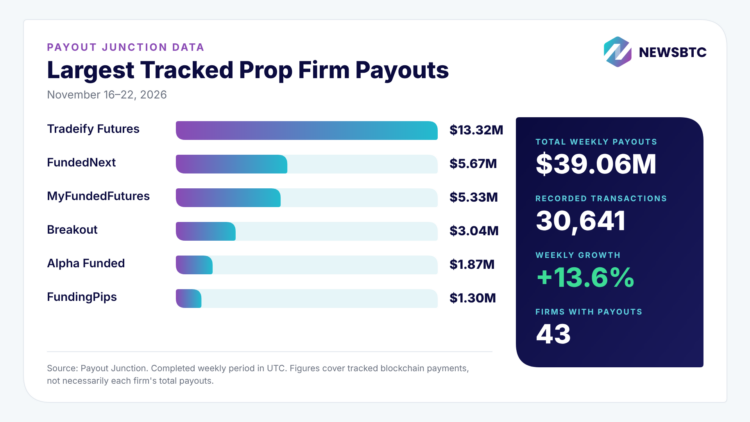
The proprietary trading industry has officially entered a new era of scale, with cumulative payouts to retail traders rapidly approaching the $2 billion threshold. According to the latest data aggregated by Payout Junction, nearly $1.97 billion has been distributed across 45 major firms since October 2023. November 2026 alone has seen a surge in activity, recording over $115 million in payouts across more than 91,000 individual transactions. While these figures underscore the massive growth of the "funded trader" model, they also highlight a growing need for transparency regarding the operational realities, risks, and hidden costs that define the current market.

The rapid rise of the prop firm sector can be traced back to the post-pandemic search for alternative income streams. In early 2023, the industry was largely fragmented, with only a few dominant players in the forex space. By late 2026, the landscape has evolved into a sophisticated ecosystem incorporating futures, cryptocurrencies, and tokenized assets. However, as the industry matures, the disparity between advertised account balances and actual trading conditions has widened, making it critical for traders to scrutinize the fine print of every evaluation program.
The Anatomy of the Modern Prop Challenge
For a trader, the allure of a $100,000 funded account is undeniable, but it often masks the underlying risk architecture. The most common pitfall for newcomers is the misinterpretation of account size versus risk tolerance. A $100,000 futures account with a $3,000 maximum drawdown does not provide $100,000 worth of "room for error." In practical terms, the trader is restricted to a $3,000 loss buffer. When combined with consistency requirements, withdrawal caps, and restrictions on trading strategies, two accounts with identical headline balances can offer vastly different paths to profitability.
The industry has moved toward a more tiered structure in 2026. Traditional models, such as those pioneered by FTMO, favor the two-step evaluation process, which provides a structured, albeit rigorous, path for traders who prioritize stability. Conversely, newer market entrants are experimenting with "evaluation-free" models or one-step challenges, which aim to reduce the time-to-funding but often impose stricter daily drawdown limits or more aggressive profit targets.
Strategic Selection: A Comparative Overview
When evaluating firms in the current climate, traders should categorize platforms by their specific utility rather than their total payout volume.

For those favoring traditional methodologies, FTMO remains a benchmark for forex and CFD traders. Its two-step model is mathematically transparent, offering a clear 10% profit target in the first phase and 5% in the verification phase. However, traders must weigh these targets against the 5% daily loss limit, which requires a disciplined risk-to-reward approach.
FundedNext offers a more diverse product catalog, appealing to traders who wish to switch between CFD and futures environments. Their "Stellar" models are designed to accommodate varying risk appetites, though this variety necessitates a deeper dive into their specific performance reward policies, which can vary significantly depending on the account chosen.

For futures specialists, Topstep has maintained its reputation for structure. By utilizing the "Trading Combine," it forces a rigorous testing phase that mirrors professional institutional environments. It is essential to note, however, that the dollar-based trailing loss limits at firms like Topstep operate differently than percentage-based drawdowns found in the forex sector. A $100,000 account at Topstep with a $3,000 loss limit is a starkly different instrument than a 10% drawdown account, and traders transitioning between asset classes must adjust their risk management parameters accordingly.
Emerging Trends: Crypto and Tokenized Assets
Perhaps the most significant development in 2026 is the expansion into digital assets. Firms like HyroTrader are leading this shift by building programs specifically for crypto-native traders. Rather than retrofitting forex rules to include Bitcoin or Ethereum, these platforms offer market data and infrastructure tailored to the volatility of the crypto space. This is a crucial distinction; the high leverage and rapid price movements inherent in crypto markets can lead to quick liquidation under standard forex drawdown rules. Consequently, crypto-focused prop firms provide a more realistic environment for participants who specialize in digital assets.

The Hidden Costs of Professional Trading
The $2 billion payout figure is often misunderstood as $2 billion in net profit for the trading community. This is a fundamental error. To arrive at a "net" figure, one would need to subtract the aggregate cost of challenge fees, resets, subscription costs, and data feed expenses. For many retail traders, the path to a single successful payout involves multiple failed attempts.
Consider the "Four-Try Rule": A trader purchases four $100 challenges before successfully qualifying for a $100,000 account. This individual has spent $400 in overhead before their first dollar of potential profit is realized. If their first payout is $300, they remain in a net loss position despite having "received a payout." This economic reality is rarely captured in marketing materials, leading to an overly optimistic perception of the industry’s profitability.

Regulatory Scrutiny and Market Integrity
The rapid growth of the sector has not gone unnoticed by regulators. The Financial Services and Markets Authority (FSMA) in Belgium has issued warnings regarding "shadow investment" games, cautioning that retail prop programs should not be conflated with genuine brokerage accounts. The primary distinction is ownership: in a prop firm, the trader is participating in a simulated environment or a proprietary fund, not trading personal capital.
This distinction has profound implications for legal recourse and financial security. If a firm changes its terms, pauses payouts, or ceases operations, the trader’s claim to the funds is governed by a private contract rather than institutional investor protections. Therefore, due diligence must extend beyond the platform’s interface to its underlying corporate entity and jurisdictional oversight.
Analyzing the "Buffer" and Drawdown Mechanics
The technical barrier to success is often the drawdown calculation. Traders must distinguish between "static" and "trailing" drawdowns. A static threshold is fixed at a certain level, whereas a trailing drawdown follows the account’s high-water mark. In many cases, an intraday trailing drawdown can trigger a failure based on a temporary price spike, even if the position eventually closes in profit.
The "payout buffer" is another critical metric. Many firms require a certain amount of profit to remain in the account to ensure a cushion against future losses. This means a trader might be eligible for a withdrawal on paper but may only be allowed to remove a fraction of their actual earnings. Understanding these buffers is essential for long-term account viability, as it dictates the speed at which a trader can extract profit.

Conclusion: A Disciplined Approach to 2026
As the industry approaches the $2 billion milestone, the focus must shift from the volume of payouts to the quality of the trading environment. The most successful traders of 2026 are those who treat their prop firm relationship as a business contract rather than a gambling opportunity.
To navigate this landscape effectively, traders should:

- Analyze the Risk-to-Target Ratio: Don’t just look at the account size. Divide the profit target by the maximum loss allowance to understand the actual difficulty of the challenge.
- Review the Payout Eligibility: Determine if the firm requires a "buffer" and how that affects your ability to withdraw profit during the early stages of a funded account.
- Verify Consistency Rules: Ensure your trading style—whether it be day-trading, swing-trading, or scalping—aligns with the firm’s specific definitions of "consistent" performance.
- Research the Entity: Understand the jurisdictional backing of the firm. Where is the company registered, and what are the terms for dispute resolution?
The prop trading industry offers unprecedented access to capital for skilled individuals, but it is not a substitute for financial literacy. The data shows that while millions of transactions are occurring, the individual trader’s success depends entirely on their ability to master the specific, often rigid, rules of their chosen platform. As we head toward the end of 2026, the firms that will continue to thrive are those that prioritize transparency and provide sustainable, fair conditions for their participants. For the trader, the goal remains the same: treat the challenge not as a race to the largest balance, but as a test of strategy, discipline, and risk management.
Related posts: