Amazon Web Services Expands Elastic Block Store Capabilities with Cross-Account Volume Clones and Advanced Encryption Controls

Amazon Web Services (AWS), a subsidiary of Amazon.com Inc., has officially announced a significant enhancement to its cloud infrastructure storage portfolio by introducing cross-account copy functionality for Amazon Elastic Block Store (Amazon EBS) Volume Clones. This new feature allows cloud administrators and enterprise developers to securely create instant point-in-time copies of EBS volumes across distinct AWS accounts, while simultaneously providing options to re-encrypt the replicated data utilizing target-account keys managed by AWS Key Management Service (AWS KMS).
The launch builds upon the foundation established last year when AWS initially rolled out EBS Volume Clones, a capability designed to generate instantaneous, same-Availability Zone copies of block storage volumes without immediate physical data duplication. By extending this architecture to support multi-account environments, AWS aims to streamline modern software development pipelines, enhance security posture isolation, and simplify compliance management for organizations operating complex, multi-tiered cloud ecosystems.
Main Facts of the Release
The newly released cross-account capability addresses a persistent operational challenge for enterprises utilizing multi-account architectures for governance, security, and billing isolation. Previously, while organizations could share snapshots across accounts, the process of restoring those snapshots into active, fully provisioned volumes in secondary environments often introduced latency and administrative overhead.
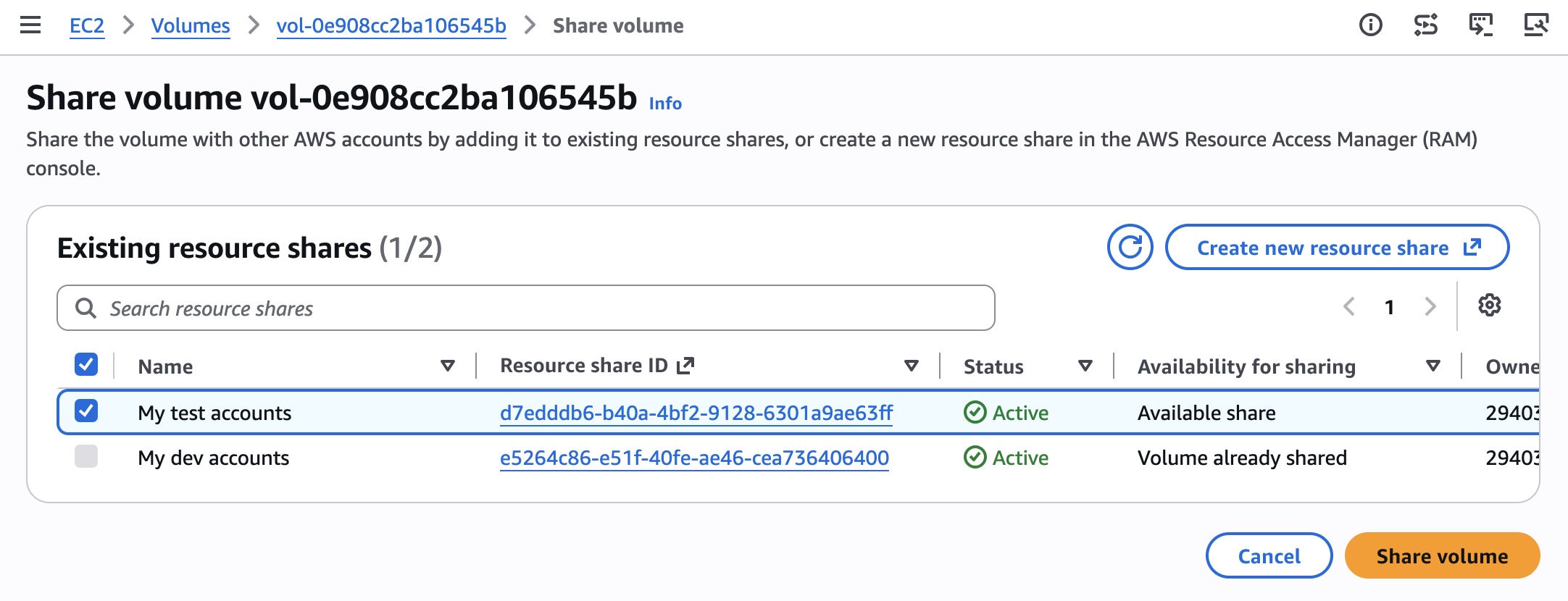
With cross-account EBS volume clones, the workflow is fundamentally optimized. A source account owner can authorize a target AWS account to access a specific production EBS volume. This authorization is managed seamlessly through AWS Resource Access Manager (AWS RAM), a service designed to facilitate secure resource sharing across AWS accounts and within centralized AWS Organizations. Once the resource share is accepted by the target account administrator through the RAM console, the recipient can initiate an immediate volume copy.
Crucially, the feature supports custom encryption controls. When copying the volume into the target environment, administrators can apply a localized AWS KMS key. This ensures that production data utilized for downstream tasks such as software testing, staging, and vulnerability patching adheres to strict internal data governance policies and cryptographic separation standards. Furthermore, the integration with AI-assisted developer workflows—such as the AWS MCP Server and associated plugins—allows engineering teams to automate these cross-account sharing and copying procedures programmatically using natural language or integrated AI coding environments.
Background Context and Evolution of EBS Storage
To understand the significance of cross-account volume clones, one must examine the evolution of Amazon EBS since its inception. Launched in 2008, Amazon EBS revolutionized cloud computing by providing persistent block storage volumes for use with Amazon Elastic Compute Cloud (EC2) instances. Over the subsequent decade and a half, EBS evolved from standard magnetic storage to high-performance solid-state drives (SSDs), offering scalable input/output operations per second (IOPS) and multi-attach capabilities designed for clustered databases and high-availability enterprise applications.
Despite these performance leaps, managing data mobility between environments remained a critical friction point. Traditional backup and recovery mechanisms relied heavily on Amazon EBS snapshots. While snapshots are invaluable for long-term data durability and point-in-time recovery, converting a snapshot into an active, high-performance volume in a separate AWS account required a restoration phase that could introduce administrative delays, particularly for large-scale enterprise databases and multi-terabyte data lakes.

In response to customer feedback demanding higher agility, AWS introduced EBS Volume Clones last year. Utilizing a metadata-driven architecture, these clones allowed teams to duplicate volume structures instantly within the same Availability Zone. The introduction of cross-account capabilities represents the logical next step in this evolutionary chain, bridging the gap between high-speed internal volume replication and decentralized, multi-account organizational topologies.
Chronology of Development
The deployment of the cross-account EBS volume cloning feature follows a structured timeline of cloud storage innovation orchestrated by AWS:
- 2008: Amazon Web Services officially launches Amazon EBS, providing foundational block-level storage for EC2 instances.
- 2012–2020: Continuous enhancements are introduced, including incremental snapshots, encryption-at-rest by default, and tiered performance options such as gp3 and io2 Block Express volumes.
- October 2024 (Approximate): AWS introduces Amazon EBS Volume Clones, enabling instant, point-in-time copies of storage volumes within a single Availability Zone.
- Early 2025: Early adopter feedback highlights the need for data mobility across organizational boundaries, specifically requesting cross-account integration and granular KMS re-encryption capabilities.
- Current Release: AWS officially launches cross-account EBS volume clones, integrating AWS RAM and AWS KMS to allow secure, cross-organizational data duplication and localized cryptographic control.
Operational Workflow and Implementation
Implementing cross-account volume clones involves a coordinated interaction between the source account holder, the target account administrator, and AWS resource management services. The operational sequence is structured to maintain rigorous security boundaries while removing unnecessary administrative bottlenecks.
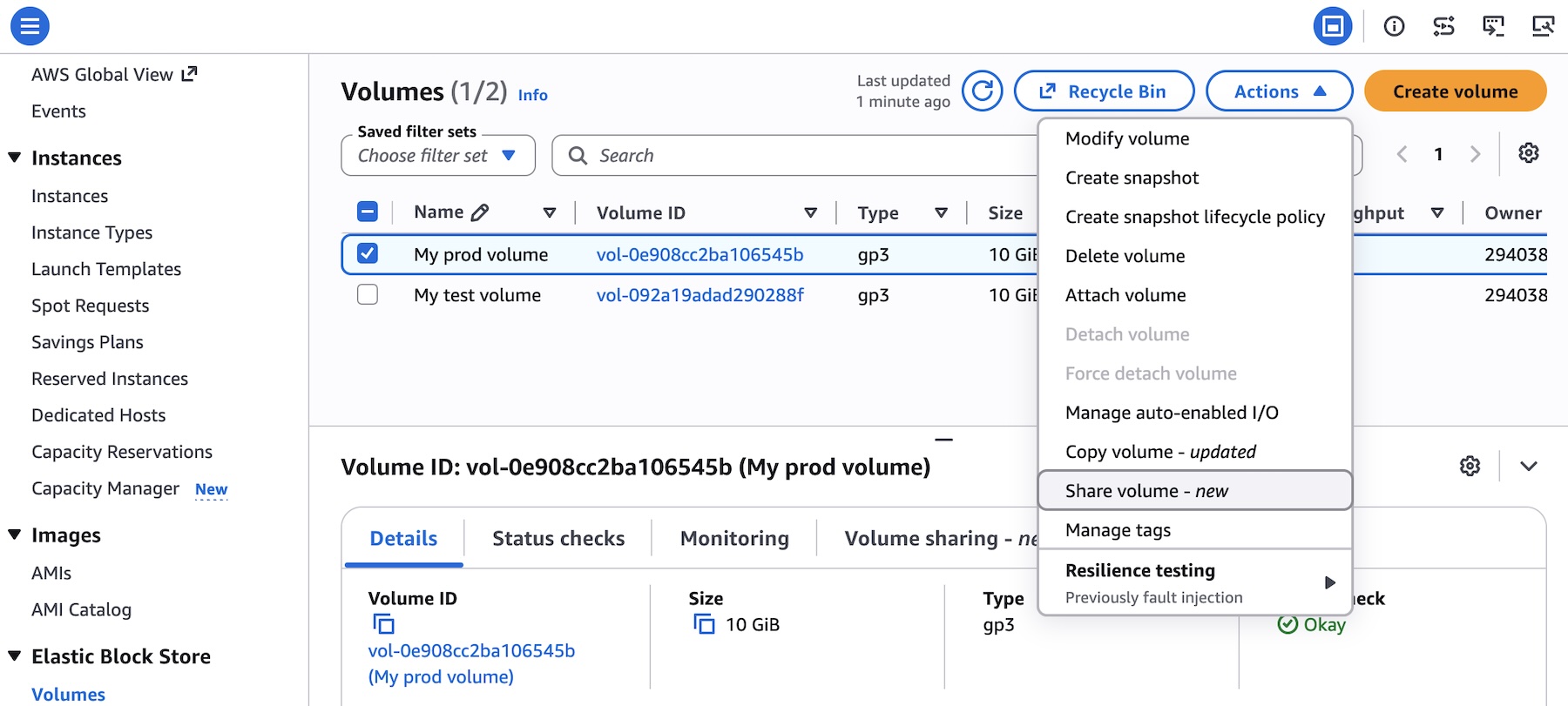
First, the owner of the source EBS volume navigates to the Amazon EBS console, selects the volume in question, and chooses the "Share volume" option. The administrator then designates the target AWS account—or an entire AWS Organization—by associating the volume with an existing or newly created resource share within the AWS RAM console. AWS RAM acts as the authorization broker, ensuring that cross-account access policies are centrally enforced and auditable via AWS CloudTrail.
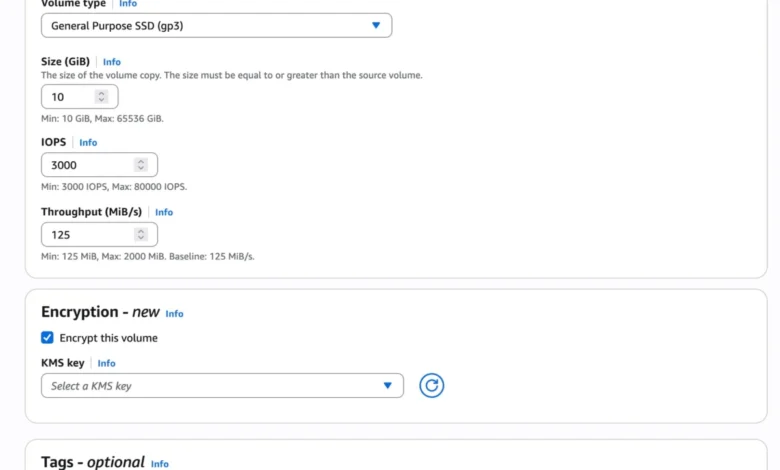
Once the resource share is initiated, a notification is dispatched to the target account. The administrator of the target account must formally accept the resource share through their respective AWS RAM console. Upon acceptance, the shared volume becomes visible within the EBS volume management interface of the secondary account. The target user can then select "Copy volume," at which point they are prompted to define parameters such as volume type, size, and—critically—the specific AWS KMS encryption key belonging to the target account.
This decoupling of encryption keys is vital for enterprise security. It ensures that production encryption keys are never exposed to or utilized within development or testing environments, satisfying the principle of least privilege and adhering to compliance frameworks such as SOC 2, HIPAA, and PCI-DSS.
Analysis of Business and Technical Implications
The introduction of cross-account EBS volume clones carries profound implications for enterprise software engineering, DevOps efficiency, and data security governance.
From a productivity standpoint, development and quality assurance (QA) teams frequently struggle with stale data in non-production environments. Testing applications against outdated datasets often leads to undetected bugs that only manifest in production when exposed to real-world data structures and volumes. By enabling fast, frictionless replication of live production data into isolated development accounts, organizations can maintain up-to-date test environments with minimal latency. This capability supports modern CI/CD (Continuous Integration/Continuous Deployment) pipelines, allowing automated testing suites to validate software against realistic data states safely.
From a security perspective, the feature addresses one of the most persistent risks in software development: the accidental exposure of production data in lower-security environments. By embedding AWS KMS re-encryption directly into the cloning workflow, AWS ensures that data copied across account boundaries is automatically wrapped in cryptographic keys controlled exclusively by the target account team. Even if access controls within the development account were somehow compromised, the underlying data remains protected by secondary encryption keys inaccessible to unauthorized parties.
Furthermore, financial optimization is a notable benefit. Traditional methods of moving large datasets across accounts often involved exporting data to Amazon S3 buckets, managing bucket policies, and re-importing the data—a process that incurred both time penalties and data transfer costs. EBS Volume Clones leverage underlying storage metadata virtualization, reducing the resource overhead required to duplicate large volumes of data.
Industry Context and Market Position
Cloud storage is a fiercely contested battleground among major hyperscalers, including Microsoft Azure, Google Cloud Platform (GCP), and AWS. While all major cloud providers offer block storage solutions and snapshot capabilities, enterprise customers increasingly evaluate storage platforms based on their native integration with governance frameworks, multi-tenant security features, and developer automation tools.

AWS continues to maintain a dominant market share in cloud infrastructure services, driven in large part by its deep ecosystem of interconnected services. By integrating Amazon EBS with AWS RAM, AWS KMS, and modern AI developer toolkits (such as the AWS MCP Server), the company reinforces its value proposition: providing deeply integrated, highly secure, and programmable infrastructure building blocks that scale from nimble startups to Fortune 500 enterprises.
Regional Availability and Getting Started
AWS has confirmed that cross-account volume clones for Amazon EBS are available immediately across all AWS Regions that currently support standard Amazon EBS Volume Clones. Organizations seeking detailed regional availability matrices and future feature roadmaps can consult the AWS Capabilities by Region documentation portal.
Cloud architects, system administrators, and DevOps engineers can begin experimenting with the feature immediately through the Amazon EC2 console. Feedback and technical inquiries can be directed to the AWS re:Post community for Amazon Elastic Block Store or submitted via standard AWS Support communication channels.
Related posts: