Amazon Web Services Unveils Amazon ECS Gateway to Streamline Containerized Ingress Networking and Eliminate Operational Bottlenecks

In the modern enterprise technology landscape, managing containerized applications at scale on cloud infrastructure has become the gold standard for agility, resilience, and microservices architecture. However, as platform teams scale their operations on platforms like Amazon Elastic Container Service (Amazon ECS), they have increasingly encountered a persistent operational bottleneck: configuring and maintaining ingress networking for individual microservices. Historically, for every newly deployed service, engineering organizations have had to provision, integrate, and manually manage a complex web of supporting infrastructure. This included setting up Application Load Balancers (ALBs), generating and binding AWS Certificate Manager (ACM) SSL/TLS certificates, configuring AWS WAF web access control lists (ACLs), and writing tightly scoped security groups.
Keeping these resources synchronized as applications scaled up, underwent continuous deployment, or faced rolling updates introduced a massive overhead. This per-service operational friction not only hampered deployment velocity but also drastically increased the risk of configuration drift, security misconfigurations, and human error across enterprise cloud estates. To address these industry-wide challenges, Amazon Web Services (AWS) has announced the official launch of Amazon ECS Gateway, a transformative, account-level resource designed to fundamentally abstract and automate ingress networking for containerized workloads.
Understanding the Architecture and Core Mechanics of ECS Gateway
Amazon ECS Gateway introduces a paradigm shift by creating a clear, definitive separation of responsibilities between centralized platform teams and distributed application development teams. Platform engineers can now establish overarching networking policies, security baselines, and shared infrastructure pools at the account level, while application developers can seamlessly plug their individual services into these pre-configured gateways with minimal friction.

At its technical core, ECS Gateway provides sophisticated host-based routing leveraging Application Load Balancers. One of its most powerful cost-optimization features is the ability for up to 25 distinct microservices to securely share a single ALB. Amazon ECS manages the entire lifecycle of this underlying infrastructure dynamically. When a platform team or developer connects their first service to a gateway, ECS automatically provisions the initial ALB. As services scale and that specific load balancer reaches its capacity threshold, ECS automatically provisions additional ALBs. Conversely, when services are decommissioned and capacity requirements shrink, the system gracefully scales down and removes unused infrastructure, ensuring organizations never pay for idle assets.
Furthermore, upon successful provisioning, every connected service is automatically assigned a unique DNS hostname. This grants development teams an immediate, ready-to-use production-grade endpoint the exact moment their deployment completes, eliminating the tedious DNS record management that traditionally slowed down release cycles.
Deployment, Configuration, and Programmatic Management
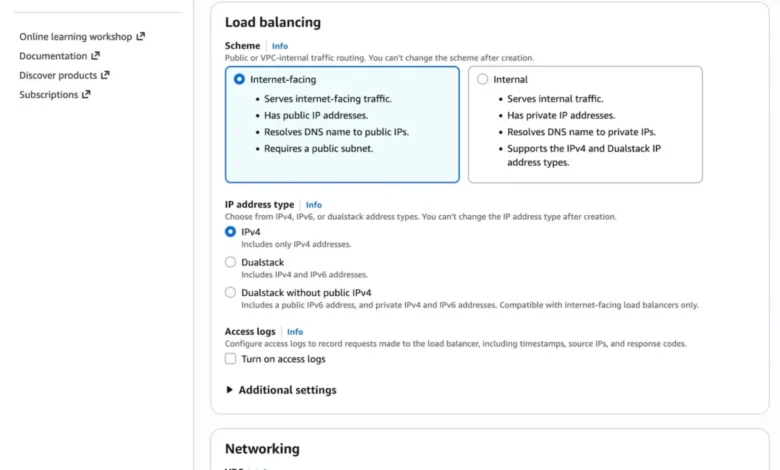
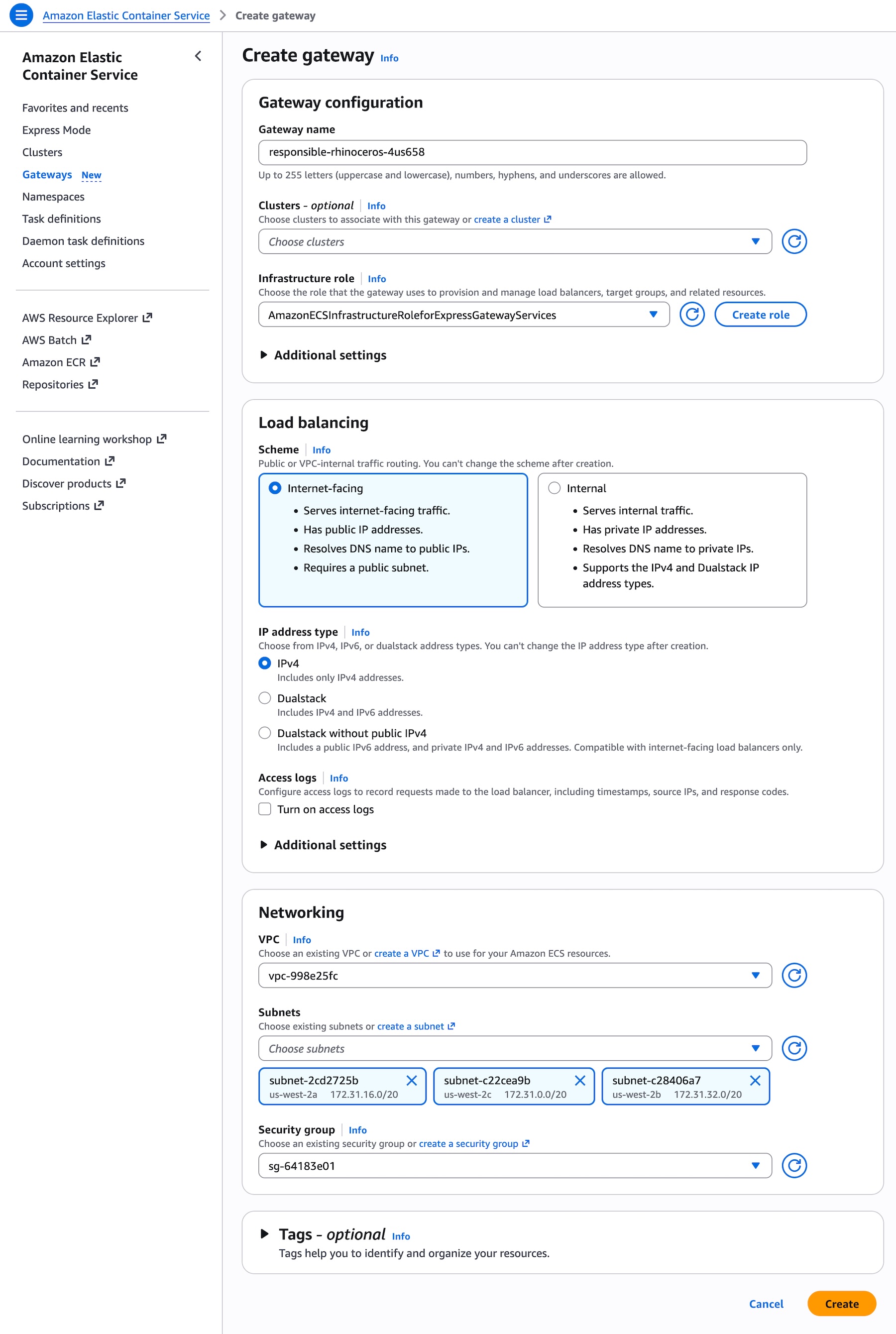
Configuring an ECS Gateway is designed to be straightforward yet deeply customizable, accommodating both graphical console users and infrastructure-as-code automation workflows. Within the Amazon ECS console, platform teams can initiate a gateway creation wizard by designating a unique gateway name and selecting a specialized AWS Identity and Access Management (IAM) infrastructure role. This IAM role grants ECS the necessary permissions to provision and manage networking resources—such as ALBs, security groups, and certificates—directly within the customer’s AWS account.
Administrators must choose between a public (internet-facing) or a VPC-internal load balancing scheme during the initial setup. Under advanced settings, operators can define listeners, ports, maximum load balancer scaling thresholds, and associate AWS WAF web ACLs to harden web applications against common layer 7 attacks. Certain foundational parameters—such as the gateway name, routing scheme, VPC selection, subnet assignments, IP address types, and listener protocols—are intentionally immutable after creation to preserve security and architectural integrity.

For organizations leveraging automation, the AWS Command Line Interface (AWS CLI) supports programmatic gateway provisioning via the CreateGateway API call. For example, platform engineers can execute commands specifying the unique gateway name, infrastructure role ARN, and comprehensive configuration objects defining subnets and networking schemes.
Once established, the gateway can be associated with up to 10,000 individual ECS clusters, while a single cluster can support up to five distinct gateway associations. This flexible many-to-many relationship enables platform engineering groups to design sophisticated multi-tenant or environment-segregated architectures, such as maintaining separate public-facing and internal-only gateways for the same underlying cluster infrastructure.
Incremental Adoption and Application-Level Integration
A critical design consideration for enterprise adoption is migration friction. Organizations with thousands of legacy ECS services already operating traditional, manually managed load balancers cannot afford disruptive "rip-and-replace" upgrades. To solve this, AWS engineered ECS Gateway to support incremental, non-disruptive adoption.
Application teams can adopt ECS Gateway by simply updating their service definitions using the UpdateService API or by adding a gateway connector during initial service creation via CreateService. During this transitionary phase, both the legacy ingress path and the new ECS Gateway path can remain active simultaneously. This dual-path capability allows engineering teams to thoroughly validate DNS routing, SSL termination, and security group behaviors on the new gateway before safely decommissioning the old load balancer configurations.
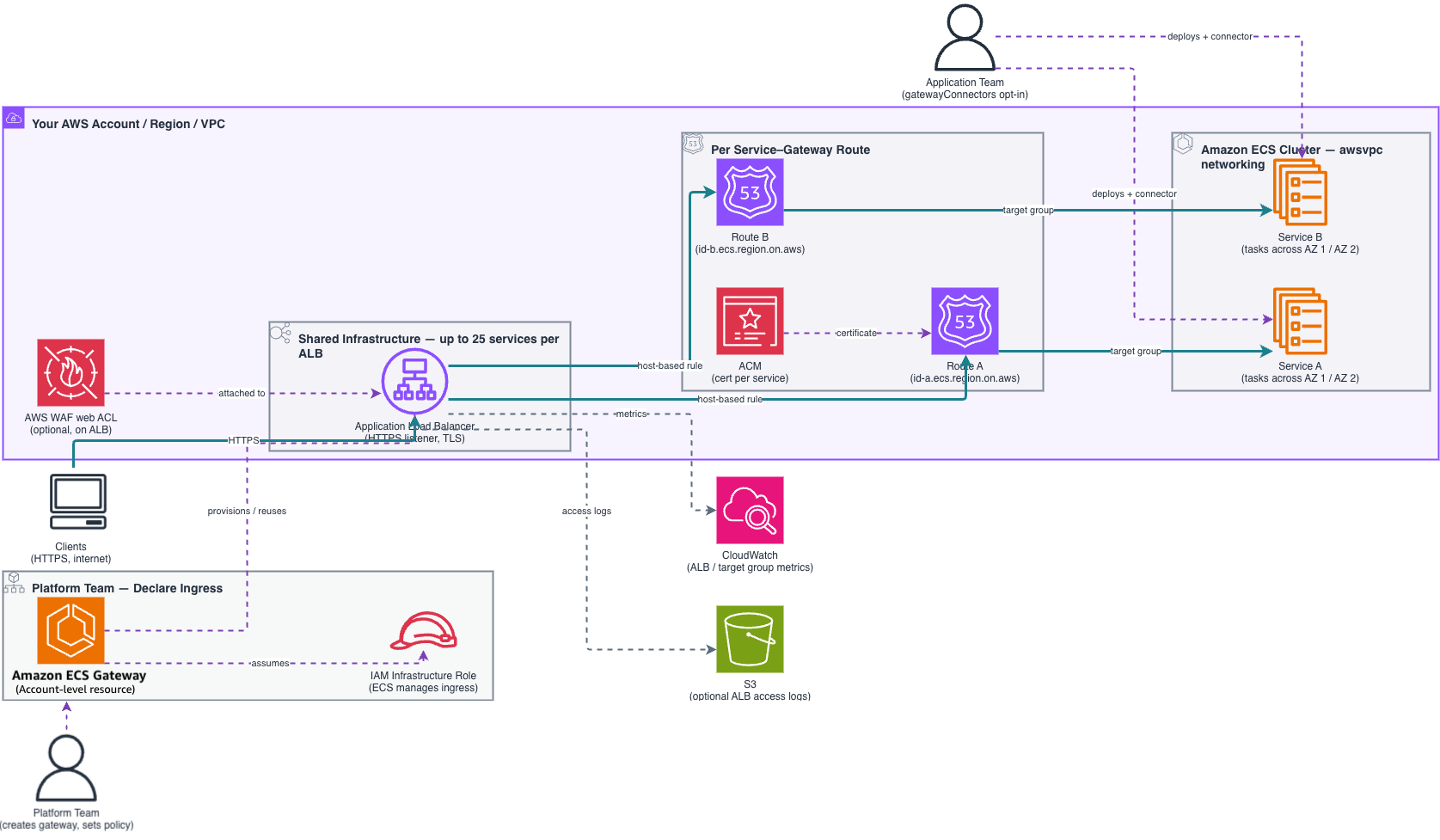
When a deployment is executed, Amazon ECS evaluates the gateways associated with the target cluster and connects the service to every compatible gateway. Compatibility is dynamically verified by matching access type filters, verifying VPC boundaries, and ensuring that the gateway spans all Availability Zones utilized by the service’s configured subnets.
Behind the scenes, ECS instantly provisions the necessary per-service artifacts: a dedicated ACM certificate, a unique DNS hostname, precise listener routing rules pointing traffic to the target group, and tight security group rules restricting ingress strictly to the ALB. Once these automated steps conclude, the gateway route transitions to an active state, and the service URL begins safely accepting production traffic.
Background Context and Industry Implications
The release of Amazon ECS Gateway arrives at a time when container orchestration platforms are experiencing hyper-growth, yet platform engineering groups are facing mounting pressure to rein in operational complexity. Over the past decade, containerization shifted the focus from virtual machine management to application packaging and deployment velocity. However, the networking perimeter—specifically ingress controllers, load balancing, and edge security—remained notoriously complex.
Historically, platform teams either had to build brittle, custom automation scripts using tools like AWS CloudFormation or Terraform to manage per-service ALBs, or they adopted heavy, self-managed service mesh solutions that introduced steep learning curves and operational overhead. By baking intelligent, automated ingress management directly into the native Amazon ECS control plane, AWS is effectively abstracting the undifferentiated heavy lifting of cloud networking.
Industry analysts and early enterprise evaluators note that this feature directly addresses the "day-two operations" burden of microservices. As organizations scale from a handful of monolithic services to hundreds or thousands of distributed microservices, infrastructure costs and management overhead scale non-linearly. By enabling up to 25 services to share a single Application Load Balancer dynamically, ECS Gateway promises substantial cost reductions for enterprises that previously provisioned dedicated ALBs for minor internal microservices.
Furthermore, the integration of ECS Gateway with modern developer tooling—such as the AWS MCP Server and AI coding assistants—signals a broader industry trend toward AI-augmented cloud operations. Platform engineers can now query APIs, search documentation, and orchestrate gateway deployments conversationally through their preferred integrated development environments (IDEs).
Availability, Pricing, and Future Outlook
Amazon ECS Gateway is available immediately across all commercial AWS Regions where Amazon ECS is supported. In terms of economic structure, AWS has introduced ECS Gateway at no additional software license or control-plane charge. Customers pay solely for the underlying AWS infrastructure resources that are dynamically provisioned within their accounts when services connect to a gateway. This includes standard Application Load Balancer hourly and capacity unit charges, CloudWatch logs and metrics ingestion fees, AWS Certificate Manager certificate fees, and standard cross-availability zone data transfer costs.
As enterprises continue to migrate mission-critical workloads to cloud-native architectures, features that bridge the gap between developer velocity and platform governance will dictate market leadership. With Amazon ECS Gateway, AWS has delivered a powerful, native solution that promises to drastically simplify container networking, reduce cloud waste, and free platform teams to focus on core business innovation rather than infrastructure plumbing.