Microsoft is revolutionizing cloud operations with "Brain," an advanced AI-powered system designed to provide unprecedented real-time intelligence about Azure’s health and performance. This sophisticated AIOps (Artificial Intelligence for IT Operations) platform acts as an intelligent layer atop Azure Resource Graph, seamlessly integrating platform telemetry, cutting-edge AI/ML models, service dependencies, and crucial customer impact data. The result is a single, continuously updated view of how every service, region, and customer workload is performing across the global Azure infrastructure. Brain is not merely a concept; it is already actively powering critical Azure functions, including customer Azure resource health notifications, deployment safeguards, and the declaration of outages. Furthermore, it serves as the foundational bedrock for agentic AI, a transformative approach that is reshaping the very operational fabric of Azure. This article marks the beginning of a multi-part series that will delve into the intricacies of Brain, its development, lessons learned from operating at hyperscale, and its future trajectory.
The Genesis of a Cloud Health Digital Twin
At its core, Azure operates on a sophisticated digital representation of its own health. Brain, the AI-powered cloud health intelligence system, functions as an intelligent overlay for Azure Resource Graph (ARG). Together, these components forge a comprehensive digital twin of the Azure platform. This system masterfully integrates platform telemetry, advanced AI/ML models, and robust data engineering pipelines. Its primary objective is to perpetually maintain and enrich a real-time, unified perspective on the performance of services, regions, and the myriad customer workloads that depend on Azure. This shared, dynamic understanding is rapidly evolving into the cornerstone of a more automated reliability surface, one capable of transforming raw insight into decisive action.
While the intricacies of Brain’s internal workings might be complex, its impact is becoming increasingly tangible for Azure users. The system is already instrumental in several critical reliability workflows across Azure. This includes providing accurate and timely health notifications for customer resources, implementing robust deployment safeguards to prevent potential disruptions, and facilitating swift and precise outage declarations. For businesses and individuals operating on Azure, Brain is actively influencing their experience in three key observable ways:
- Proactive Issue Detection and Notification: Brain’s ability to correlate disparate signals allows it to identify potential issues before they escalate, often before traditional monitoring systems or even customers become aware. This leads to earlier notifications and a reduced Mean Time To Detect (MTTD).
- Enhanced Deployment Stability: By analyzing the potential impact of new deployments against the backdrop of existing service health and dependencies, Brain can trigger safeguards, pausing or rolling back problematic deployments to prevent widespread issues.
- More Accurate and Faster Outage Declarations: When an outage occurs, Brain’s comprehensive understanding of the platform allows for quicker and more precise identification of the root cause and scope, leading to faster declarations and more informed customer communications.
This initial post will lay the groundwork, exploring the fundamental aspects of Brain and how it empowers Azure to operate differently. The subsequent articles in this series will offer an in-depth exploration of Brain’s architecture, the engineering challenges overcome during its development, the invaluable lessons learned from operating such a complex system at hyperscale, and the ambitious vision for its future evolution.
The Imperative for Brain: Addressing the Signal-to-Comprehension Gap
The scale of Azure is, by any measure, staggering. The platform encompasses hundreds of distinct services distributed across more than 80 global regions, supported by over 500 datacenters and a vast network of over 800,000 kilometers of fiber optic and subsea cable. This immense global footprint represents one of the largest and most complex interconnected digital infrastructures in the world. Despite the sophisticated tooling and extensive monitoring in place, the sheer volume of activity generated, managed, and processed by Azure services worldwide has, at times, led to a critical challenge: learning about an issue from a customer before internal systems detect it. For customers, this gap is the most detrimental type of incident, forcing them into the frustrating position of debugging their own applications only to discover the root cause lies within the underlying cloud infrastructure.
This discrepancy between what Azure measures and what it truly understands represents a significant bottleneck in achieving optimal cloud reliability today. The issue is not a deficit of tooling; Azure possesses an abundance of sophisticated monitoring and diagnostic tools. Instead, the challenge is fundamentally one of comprehension. The sheer volume of signals generated by a hyperscale cloud has surpassed the capacity of human operators to effectively parse and interpret them in real-time. The conventional response—deploying more dashboards, generating more alerts, and increasing on-call rotations—has proven to be an unsustainable treadmill, offering a semblance of control rather than a true solution. Each additional dashboard provides an operator with yet another window to gaze through; what has been conspicuously absent is a system that can interpret the information presented, provide context, and guide timely action.
Bridging this gap necessitated the creation of something unprecedented: not merely better dashboards or smarter alerts, but a continuously updated, holistic model of the platform’s health. This model must be capable of reasoning across every available signal in real-time and autonomously acting upon its conclusions at the immense scale demanded by the Azure platform. This is the fundamental purpose that Brain was designed to fulfill.
Brain: Azure’s Centralized AIOps Engine for Cloud Reliability
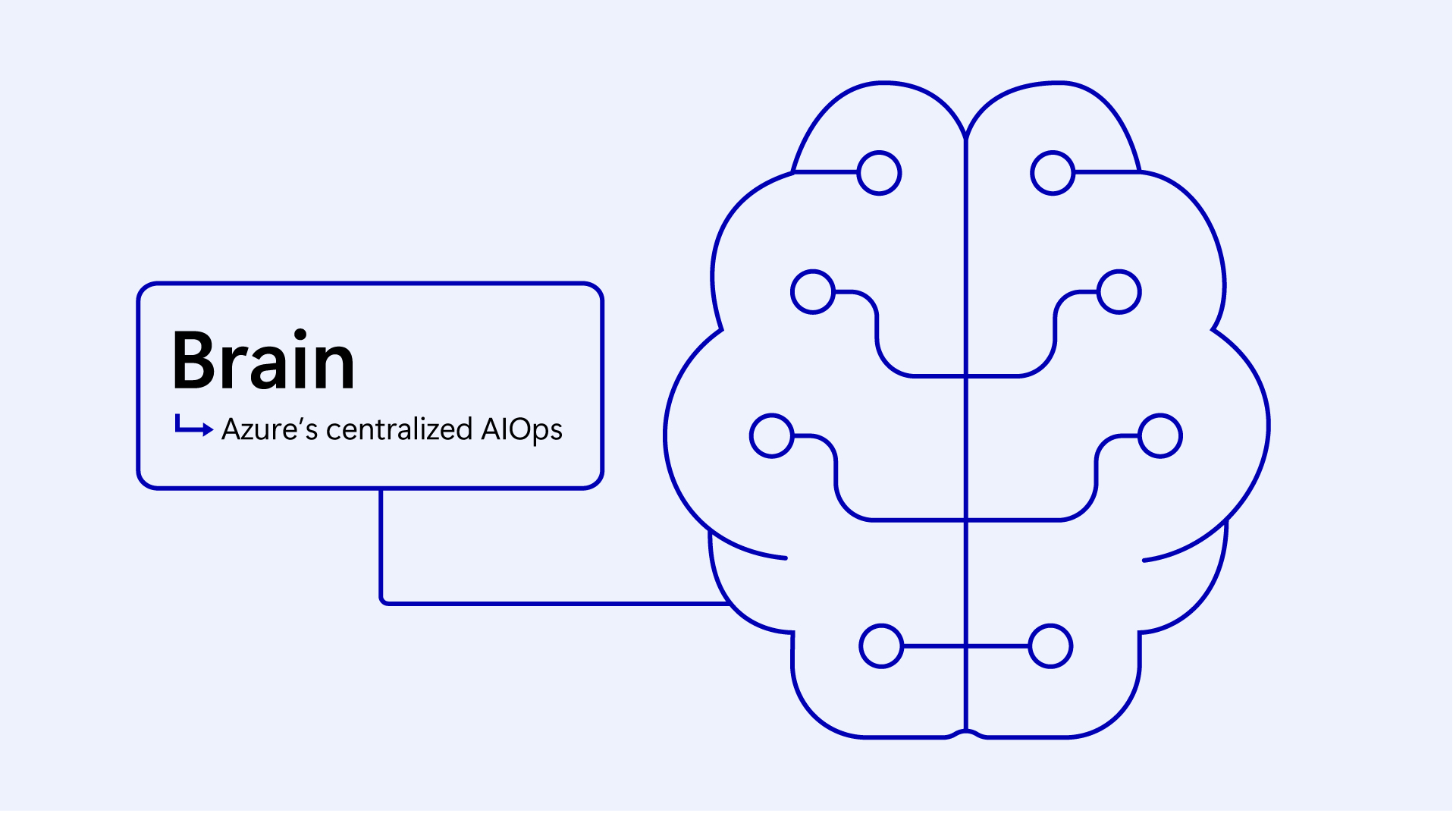
Brain is Azure’s centralized AIOps-powered cloud health intelligence system. It leverages advanced AI/ML techniques, including agentic AI and sophisticated data engineering, to continuously model Azure’s health and to automate reliability actions based on its comprehensive understanding. Since its integration into Azure production, Brain has been instrumental in generating resource health determinations across the entire platform, significantly enhancing the reliability posture.
At its core, Brain’s functionality can be understood through three key components: what data it ingests, how it processes and analyzes that data, and what actions its outputs drive.
Brain ingests signals from three distinct classes of sources, each offering a unique perspective on the platform’s state:
- Platform Telemetry: This encompasses a vast array of operational data generated by Azure’s infrastructure itself. This includes metrics from compute, storage, networking, and numerous other services, detailing performance, resource utilization, error rates, latency, and availability. This data provides a granular, low-level view of the system’s internal workings.
- Service Health Models: Beyond raw telemetry, Brain integrates pre-existing models and knowledge bases about the expected behavior and interdependencies of Azure services. This includes understanding service-level agreements (SLAs), known failure modes, and the hierarchical relationships between different components and services.
- Customer Impact Data: This crucial input captures signals directly related to how Azure’s performance is affecting its customers. This can include telemetry from customer applications (where permissions are granted), customer-reported issues, and anonymized usage patterns that might indicate service degradation. This data provides the vital end-user perspective.
Each of these data pathways serves a distinct purpose, and their combined integration provides Brain with a holistic coverage that no single path could achieve independently.
Regardless of the input source, Brain systematically evaluates every subject within its purview—whether it be a specific service, a geographical region, a deployment unit, or an individual customer resource. For each subject, Brain generates four critical outputs:
- Health State: A classification of the subject’s current operational status (e.g., healthy, degraded, unhealthy, unknown).
- Severity: An indication of the criticality of the identified health state, ranging from informational to critical.
- Impact: An assessment of the extent to which the health state is affecting services, infrastructure, or end-users.
- Reason for Conclusion: A clear, concise explanation detailing the specific signals and reasoning that led to the determination of the health state, severity, and impact.
These standardized outputs, expressed in a common vocabulary, ensure that every downstream system operates with a consistent understanding. This eliminates the ambiguity and disconnects that can arise when different teams or tools interpret terms like "impacted" in disparate ways.
The insights generated by Brain are the driving force behind a growing suite of automated reliability actions designed to proactively manage and improve the Azure platform. These actions include:
- Automated Outage Declaration and Notification: Triggering official outage declarations and initiating timely, targeted communications to affected customers.
- Deployment Pausing and Rollback: Automatically pausing or rolling back problematic deployments that are identified as causing or likely to cause service degradation or customer impact.
- Automated Remediation and Mitigation: Initiating predefined remediation steps or mitigation strategies to address identified issues and restore service health.
- Intelligent Alerting and Incident Routing: Generating highly contextualized alerts that are routed to the most appropriate engineering teams, reducing noise and accelerating response times.
- Resource Health Status Updates: Continuously updating the health status of customer resources to provide accurate and up-to-date information through Azure portals and APIs.
Foundations of Azure’s Digital Twin for Cloud Health
To truly appreciate what distinguishes an "intelligence system" like Brain from a mere "dashboard," it is essential to examine the foundational elements that underpin its operation. Brain’s comprehensive representation of Azure is built upon a unified integration of several critical data streams, each of which, while not novel in isolation, collectively form a powerful, cohesive whole:
- Platform Topology: A detailed understanding of how Azure’s physical and logical infrastructure is interconnected, including datacenters, regions, network paths, and the relationships between hardware and software components.
- Runtime State: Real-time data on the current operational status of all active components, services, and workloads, including performance metrics, resource utilization, and error logs.
- Deployment Intent: Information about active and planned deployments, including their scope, expected changes, and rollback strategies. This allows Brain to correlate changes with observed behavior.
- Historical Patterns: A vast repository of past operational data, including performance trends, incident histories, and the outcomes of previous events. This enables Brain to identify anomalies and predict future behavior.
- Customer-Side Evidence: Data points that directly reflect the customer experience, such as application performance indicators, error rates reported by customer applications, and usage patterns.
- Service Dependencies: A comprehensive map detailing the intricate web of dependencies between different Azure services, crucial for understanding the cascading effects of issues.
Individually, these elements are common components of cloud platforms. However, Brain’s innovation lies in its ability to synthesize them into a single, unified, AI-driven representation, rather than scattering them across numerous disparate dashboards and tools that an operator would need to mentally correlate under immense time pressure.
When Brain declares a service to be degrading, this statement is not merely the result of a simple threshold being crossed. It represents a sophisticated determination achieved through simultaneous reasoning across topology, runtime state, deployment intent, historical patterns, and customer-side evidence. It is the intelligence system speaking, not a solitary metric firing. Crucially, the speed of this determination, measured in seconds rather than the minutes a human would take to assemble the same picture from separate tools, translates directly into an improved customer experience. This speed leads to shorter incident durations, more precise notifications, and faster, more accurate routing of issues to the correct engineering teams.
Operating Against a Cloud Intelligence System: A Paradigm Shift
The advent of an integrated cloud intelligence system like Brain represents a fundamental shift in how Azure customers and operators interact with the platform. This transformation is most profoundly felt when considering how disruptions are managed. To grasp this shift, it is helpful to contrast the operational paradigms in two distinct worlds: one without a unified intelligence system, and one with Brain.
Consider a scenario where a deployment-driven degradation occurs.
In a world without a shared intelligence system, the operational response is characterized by reconstruction and reactive investigation. A new software rollout is in progress. Concurrently, a region’s error rate begins to exhibit a gradual, concerning drift. The engineering team responsible for the rollout might not immediately recognize the correlation, especially if the deployment spans multiple services or regions. They might continue the rollout, potentially exacerbating the issue. Meanwhile, other teams monitoring different aspects of the platform might detect isolated symptoms—an increase in latency for a specific database, a higher number of failed requests for a particular API. These teams would likely initiate their own investigations, creating duplicate alerts and potentially opening multiple, overlapping incident tickets. The process involves extensive manual correlation of disparate data points from various tools, a time-consuming and error-prone endeavor. The objective is to piece together the puzzle retrospectively, identifying the point of failure after the impact has already been felt. This often leads to extended incident durations and a less than optimal customer experience.
In a world with Brain, the operational response shifts from reconstruction to informed consumption. The rollout is a known entity within the intelligence system. Brain is aware of its in-flight status, understands what it is intended to change, the regions it is targeting, and its expected operational behavior. The observed error-rate drift is also within the system. Brain immediately correlates this drift with the ongoing rollout, weighing it against the established dependency graph and evaluating it against historical patterns that differentiate a minor, expected "wobble" from genuine "degradation."
Crucially, affected customers are also represented within the system. Their tenants are mapped to the platform resources that are experiencing issues due to upstream dependencies, which are themselves potentially impacted by the rollout. Brain synthesizes all of this information to produce a single, definitive determination: "The current rollout is causing customer-visible impact in this region. Expected resolution requires the rollout to be paused."
This determination then propagates instantaneously to every system that needs to act upon it. The deployment system, receiving this information, automatically pauses the rollout for as long as the determination remains true, thereby preventing further customer impact. Simultaneously, the incident management system creates a single, unified incident, with the upstream dependency clearly identified. This prevents the creation of three duplicate incidents by three confused teams, ensuring the right engineer engages with the right problem first. The customer communication system, empowered by Brain’s assessment, drafts a notification tailored to the correct tenant scope and provides a clear, plain-English description of the situation. This ensures that affected customers receive timely updates from Microsoft with actionable information.
For Azure customers, the intricate coordination and automated decision-making powered by Brain remain largely invisible. What they experience is a significantly shorter incident duration, an accurate alert that triggers their own automation rather than a human operator, and a diagnosis that is already clearly articulated when their on-call engineer opens the incident bridge. On services where Brain’s resource-health evaluation is actively in production, there has been a substantial improvement in detection precision for service-impacting issues, and the coverage of relevant incidents continues to expand.
Over the past year, a significant majority of outages integrated with Brain have been automatically communicated to affected customers. On these incidents, the time-to-notification has improved materially compared to manually issued notifications, demonstrating the efficiency gains of an AI-driven approach.
Critically, none of the downstream systems are undertaking their own independent investigations in this scenario. Instead, they all consume the same determination from the intelligence system, expressed in the same consistent vocabulary, and supported by the same factual evidence. This is the essence of "operating against an intelligence system"—a foundational capability that had to be established before the more advanced agentic AI initiatives, often associated with Azure today, could become viable. This approach not only enhances Azure’s inherent reliability but also directly benefits Azure customers by providing unprecedented transparency into service health and ensuring timely, accurate communications.
The Future of Agentic AI and Cloud Operations
A significant conversation is unfolding across the cloud industry this year, focusing on agentic AI—systems capable of taking action, not merely observing. Microsoft is a key participant in this dialogue. However, this conversation often overlooks a critical asymmetry that deserves greater attention.
For AI agents to be truly effective, they require a robust foundation upon which to operate. Specifically, agents need:
- A Comprehensive World Model: Agents must have a detailed and accurate understanding of the environment they are operating within. In the context of cloud operations, this means a unified, real-time model of the entire platform’s health and state.
- A Shared Understanding of Goals and Objectives: Agents need to be aligned on what constitutes success and what actions are permissible or desirable to achieve those goals. This requires clear definitions of reliability, performance, and customer experience.
- A Common Vocabulary and Reasoning Framework: For multiple agents to collaborate effectively, they must communicate using a standardized language and adhere to a consistent logic for decision-making.
This is precisely what makes Brain’s "digital twin" concept so pivotal. It serves as the prerequisite, not the consequence, of scalable agentic operations. If one were to build agents first, operating on fragmented and disparate data, the result would likely be a federation of confident but ultimately disagreeing systems within the production environment. Conversely, by building the intelligence model first, the agents become truly composable. They can reason from the same, singular picture, and that picture is one that can be rigorously audited and understood.
This principle forms the central theme of the series that commences today. Brain represents the cloud health intelligence system that the next generation of cloud agents will absolutely require. For organizations exploring agentic AI for any operational function—whether managing their own cloud infrastructure, applications, or on-premises environments—the architectural pattern embodied by Brain is one that warrants careful consideration. While the agents may capture the headlines, the underlying intelligence system is the true engine of transformation.
What’s Next for Azure Reliability and Brain
With the intelligence system in place, and the system capable of making determinations, the next phase of development involves refining the nuances of those determinations. Consider the statement: "A service in a region is degrading." While accurate, this statement raises further critical questions:
- Degrading compared to what? What is the baseline for "healthy" performance?
- Healthy by whose definition? When two engineering teams independently assess their service’s health and arrive at conflicting conclusions, which assessment holds precedence?
- What is the true state when the platform is degrading but no individual customer is yet impacted? This represents a critical pre-outage state that requires precise definition and management.
These are not abstract, philosophical inquiries. They represent the next frontier of engineering challenges that must be addressed. A sophisticated system, by definition, cannot make determinations until the humans who build and govern it agree on the precise definitions and criteria that constitute those determinations. Historically, much of the industry has operated on a foundation of implicitly understood, often inconsistent, definitions of cloud health. This has led to confusion and inefficiencies.
In the subsequent post of this series, Microsoft will provide a detailed exposition of how these challenges are being met. The article will reveal the specific methodologies and systems developed to replace the often-broken vocabulary of cloud health that has been the industry standard for the past decade. To stay informed as new posts in this series are published, readers are encouraged to follow the "Advancing reliability" blog tag.
Acknowledgments
This significant undertaking is the culmination of extensive collaboration and dedicated effort from numerous engineers and researchers across the Brain AIOps team, Microsoft Research (MSR), and various Azure service teams. Their collective expertise and commitment have been instrumental in bringing this groundbreaking intelligence system to fruition.
Related posts: