Benchmarking Gemma 4 E2B Quantization-Aware Training on Amazon SageMaker NVIDIA L4 Endpoints

The deployment of large language models in enterprise production environments requires a constant balancing act between inference latency, hardware resource allocation, and overall operational expenditure. Recent benchmarking evaluations conducted on Amazon SageMaker using NVIDIA L4 hardware provide concrete empirical data on how Quantization-Aware Training (QAT) impacts the performance of Google’s Gemma 4 E2B model. By transitioning from a full-size bfloat16 (bf16) release to a 4-bit weight QAT checkpoint (google/gemma-4-E2B-it-qat-w4a16-ct), infrastructure engineers can achieve dramatic throughput gains without sacrificing output accuracy.
The evaluation framework utilized a single Amazon SageMaker ml.g6.xlarge instance equipped with one NVIDIA L4 GPU boasting 24 GB of VRAM, hosted in the us-east-2 (Ohio) region. Operating on the official AWS vLLM container build running vLLM version 0.30.0, the tests evaluated raw decode speeds, parallel request handling under heavy load, and response fidelity across a standardized validation suite. The findings indicate that QAT-enabled checkpoints effectively double token generation speeds while reducing memory overhead, reshaping the economic calculations for cloud-based AI serving.
Architectural Context and the Mechanics of QAT
Quantization-Aware Training differs fundamentally from post-hoc quantization techniques. Instead of compressing a fully trained model after the fact—which frequently introduces quantization noise and degrades output quality—QAT simulates low-precision arithmetic directly during the training loop. Google exports these checkpoints using the native compressed-tensors format, which inference engines like vLLM can interpret seamlessly.
In the specific case of the google/gemma-4-E2B-it-qat-w4a16-ct checkpoint, the suffix denotes 4-bit weights paired with 16-bit activations (-w4a16-ct). A granular examination of the model’s memory distribution reveals that the quantization is targeted specifically at the transformer body. Out of the total footprint, the transformer body consumes 1.056 GB stored as packed 4-bit weights, representing roughly 12.7% of the model architecture. Conversely, heavier static components—such as the per-layer embeddings (4.698 GB or 56.5%), vocabulary embeddings (1.611 GB or 19.4%), the audio tower (0.614 GB or 7.4%), and the vision tower (0.337 GB or 4.1%)—remain preserved in 1,6-bit bfloat16 format.
This selective compression yields an 18% reduction in total GPU weight memory, shrinking the footprint from 9.75 GiB down to 8.01 GiB on the NVIDIA L4. Crucially, the VRAM reclaimed from weight storage is directly reallocated to the Key-Value (KV) cache. The KV cache capacity expands from 723,484 tokens under the standard bf16 configuration to 867,999 tokens with the QAT checkpoint, directly increasing the maximum concurrent request threshold for long-context operations.
Chronology and Deployment Methodology
To ensure strict empirical validity, the benchmarking process followed a controlled A-B-A deployment methodology. Because physical hardware variations across cloud instances can introduce noise into performance metrics, the evaluation deployed the standard bf16 model, followed by the QAT checkpoint fifteen minutes later, and concluded with a second independent deployment of the bf16 model to verify consistency.
The lifecycle of each deployment followed standard Amazon SageMaker real-time inference patterns, which rely on three core constructs:
- Model Object: Encapsulating the custom container image, environment variables (
SM_VLLM_MODELand associated vLLM parameters), and the necessary IAM execution roles. - Endpoint Configuration: Defining the target instance type (
ml.g6.xlarge) and scaling parameters. - Active Endpoint: The running HTTPS service routing OpenAI-style chat completion requests via
aws sagemaker-runtime invoke-endpoint.
Across all test phases, initialization times from creation to an InService status remained stable, averaging approximately 9.9 minutes for the bf16 configuration and 10.1 minutes for the QAT variant. However, actual weight loading times improved under the compressed format, dropping from 82.75 seconds to 66.19 seconds as fewer bytes were transferred from Hugging Face repositories into container memory during boot.
Performance Metrics: Throughput and Latency
The performance divergence between the two checkpoints is most pronounced during token generation and parallel request handling. Because each sequential decode step requires reading the transformer layer weights from GPU memory into compute units, memory bandwidth acts as the primary hardware bottleneck on the NVIDIA L4.
When evaluated at a temperature setting of zero across standardized prompts, the performance metrics demonstrated clear operational advantages for the QAT model:
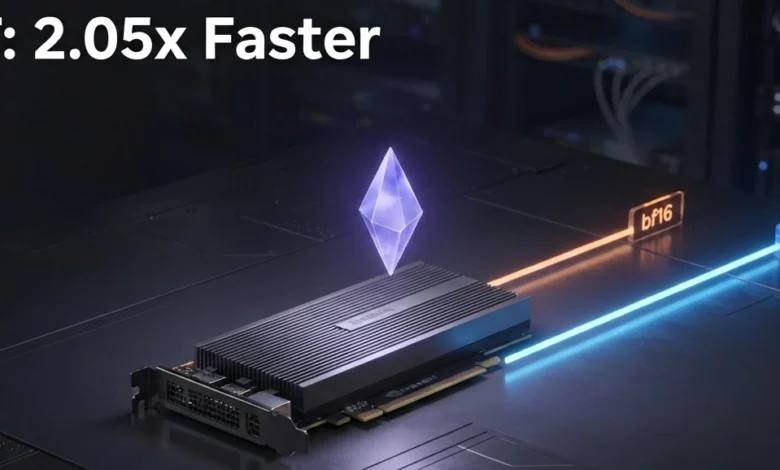
- Single-Stream Decode Speed: The standard bf16 model achieved a decode rate of 51.3 tokens per second. The QAT checkpoint reached 105.1 tokens per second, representing a 2.05x performance multiplier.
- 512-Token Generation Latency: Generating a 512-token response required between 10.49 and 10.66 seconds under bf16. Under QAT, completion times dropped to a range of 5.39 to 5.53 seconds—meaning the slowest QAT generation completed in roughly half the time of the fastest unquantized run.
- Parallel Request Scaling: Under concurrent request loads, QAT maintained its performance lead. At 1 request, throughput sat at 85.35 tokens per second compared to bf16’s 45.6. At 4 concurrent requests, QAT scaled to 328.7 tokens per second versus 171.6. At 16 parallel requests, QAT achieved 1,077.25 tokens per second against the bf16 baseline of 619.1 tokens per second.
Re-running the baseline bf16 deployment at the conclusion of the test cycle yielded 51.5 decode tokens per second and 625.15 tokens per second at 16 concurrent requests, confirming that performance differentials were strictly attributable to the model checkpoint rather than transient infrastructure anomalies or thermal throttling.
Output Fidelity and Quality Assurance
A critical concern for enterprise architects adopting quantization is the potential degradation of logical reasoning and factual accuracy. To evaluate output quality, both endpoints were subjected to a 40-question validation suite comprising three distinct categories: 15 multi-digit multiplication tasks, 15 multi-step arithmetic calculations ($a + b – c$), and 10 geopolitical capital queries.
Both the bf16 and QAT endpoints achieved identical aggregate scores, answering 37 out of 40 questions correctly. A deeper inspection of the results revealed that 35 out of the 40 individual responses matched character-for-character across both models. The remaining five discrepancies occurred exclusively within the multi-step arithmetic category, where each model independently faltered on three distinct calculation problems.
For instance, when queried with 876 + 608 - 558 (expected output: 926), the bf16 model returned an erroneous 1026, while the QAT model returned the correct 926. Conversely, for 257 + 388 - 290 (expected output: 355), the bf16 model was correct, whereas the QAT model returned 655. These findings indicate that while small-scale evaluation suites have limitations in capturing nuanced variance, QAT introduces no systemic degradation in foundational reasoning capabilities for the Gemma 4 E2B architecture.
Economic Implications and Cost-Performance Analysis
Infrastructure cost efficiency remains a decisive factor in production AI deployments. On-demand pricing for an ml.g6.xlarge instance in the us-east-2 region is pegged at $1.1267 per hour. Because SageMaker real-time endpoints bill continuously for the duration of their existence—regardless of active request volume—maximizing token output per hourly dollar is paramount.
By doubling the effective decode speed and expanding parallel capacity, the QAT checkpoint dramatically alters the unit economics of LLM serving. Calculating the cost per million output tokens based on sustained operations reveals significant savings:
- Single Request Workloads: Costs drop from $6.86 per million tokens under bf16 down to $3.67 under QAT.
- Moderate Concurrency (4 Requests): Expenses decrease from $1.82 per million tokens to $0.95.
- High Concurrency (16 Requests): Operational costs fall from $0.51 per million tokens down to $0.29 per million tokens.
Broader Industry Implications and Recommendations
The empirical results from the SageMaker NVIDIA L4 evaluations establish a clear operational precedent for deploying lightweight large language models. For engineering teams utilizing Google’s Gemma 4 E2B, adopting the google/gemma-4-E2B-it-qat-w4a16-ct checkpoint requires minimal friction—necessitating only an adjustment to the SM_VLLM_MODEL environment variable within the standard AWS vLLM container framework.
Given that the QAT deployment delivers double the inference velocity, expands available KV cache memory by roughly 20%, slashes the effective cost per million tokens nearly in half, and maintains parity on standard evaluation benchmarks, it emerges as the default deployment configuration for production workloads. Unquantized bf16 releases remain useful primarily as verification baselines when evaluating highly specialized enterprise domain tasks that demand exhaustive evaluation protocols beyond standard arithmetic and factual queries.
Resource teardown procedures executed via the AWS CLI (delete_endpoint) successfully purged the model configurations, endpoint parameters, and underlying artifacts without lingering billing liabilities, confirming that the toolchains surrounding modern MCP (Model Context Protocol) and SageMaker orchestration can manage the full lifecycle of quantized deployments cleanly and efficiently.