How to Turn an Ordinary Python Script Into an Autonomous AI Agent Using the OpenAI Agents SDK

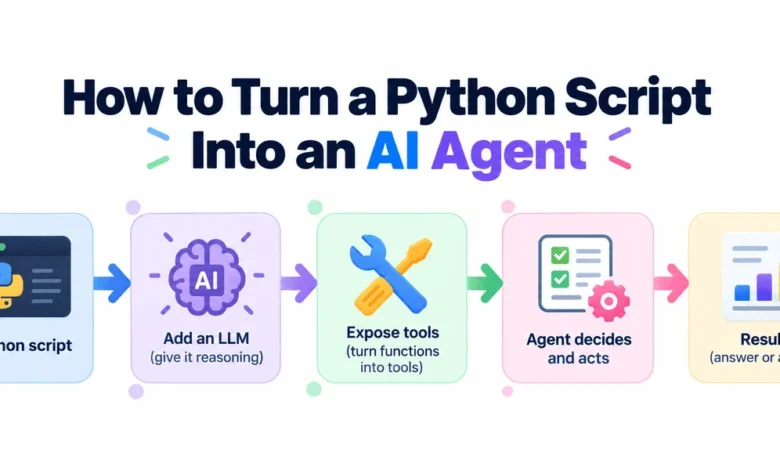
The rapid evolution of generative artificial intelligence has fundamentally altered how developers approach software architecture, moving away from rigid, hardcoded control flows toward dynamic, goal-oriented orchestration. Historically, integrating large language models into traditional software engineering pipelines required heavy refactoring, complex prompt engineering frameworks, and manual state management. However, recent developer tooling paradigms are bridging this gap, allowing engineers to leverage existing codebases without rewriting underlying logic. A primary example of this shift is the OpenAI Agents SDK, a lightweight runtime designed to seamlessly transform standard Python functions into intelligent tools that autonomous models can invoke dynamically.
The Paradigm Shift: From Fixed Logic to Agentic Orchestration
In traditional software development, automation scripts rely on deterministic control flows. A developer defines an exact sequence of operations using loops, conditional statements, and sequential function calls. For instance, evaluating the health, latency, and uptime of a series of web servers requires explicit programmatic loops that iterate through a predefined array of uniform resource locators (URLs). While reliable, this approach lacks adaptability. If an application needs to dynamically select targets based on real-time telemetry, adapt its execution path depending on intermediate HTTP error codes, or synthesize unstructured diagnostic reports, developers must write increasingly complex branching logic.
Agentic AI introduces a fundamentally different architectural model. Instead of dictating how a task must be executed step-by-step, developers define a high-level goal, provide the model with a set of contextual tools, and permit the underlying large language model to orchestrate the workflow. The model autonomously determines when a tool is necessary, what parameters to supply, how to interpret the output, and whether subsequent actions are required to satisfy the user’s initial prompt. This capability transforms ordinary utility scripts into autonomous problem-solving units capable of managing multi-step tasks with minimal human intervention.
Technical Foundations and Development Prerequisites
Implementing this transformation does not require complex infrastructure or deep enterprise software rewrites. Using the OpenAI Agents SDK alongside modern Python package management tools streamlines the transition from a standard script to a managed agentic workflow.
To establish the development environment, developers typically utilize modern dependency managers like uv or traditional package managers like pip. The foundational installation sequence involves initializing a dedicated project directory and acquiring the necessary libraries:
mkdir website-agent
cd website-agent

uv init
uv add openai-agents requests
Alternatively, standard Python package management via the Python Package Index can be executed:
pip install openai-agents requestsOnce the packages are successfully installed, authentication requires configuring the environment with a valid OpenAI API key. This credential permits the runtime to communicate securely with the model endpoints that power the agentic decision loop:
export OPENAI_API_KEY="your-api-key"The underlying architecture of the Agents SDK provides a lightweight, performant runtime environment specifically engineered to manage agent lifecycles, function tools, inter-agent handoffs, execution sessions, and telemetry tracing. This design minimizes boilerplate code, enabling developers to focus on the core business logic of their applications rather than the underlying API communications.
Transforming Standard Functions Into Intelligent Tools
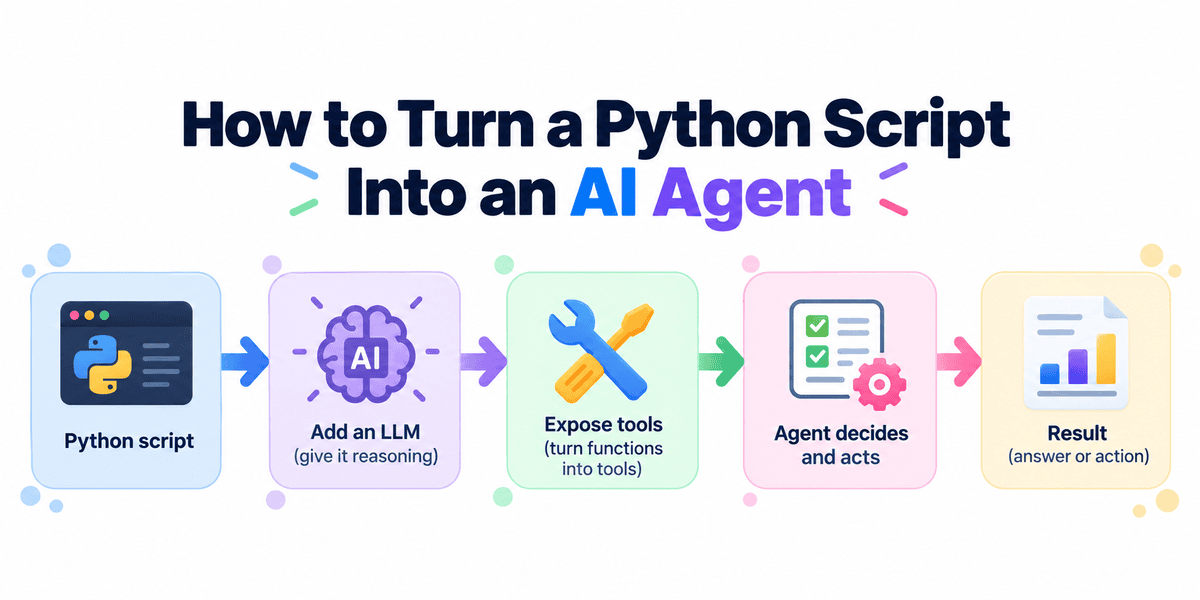
The cornerstone of converting an existing Python script into an AI agent lies in tool exposure. In a standard Python program, functions are invoked explicitly by other segments of code. In an agentic framework, these same functions are annotated to serve as callable tools that the language model can invoke based on semantic comprehension of user intent.
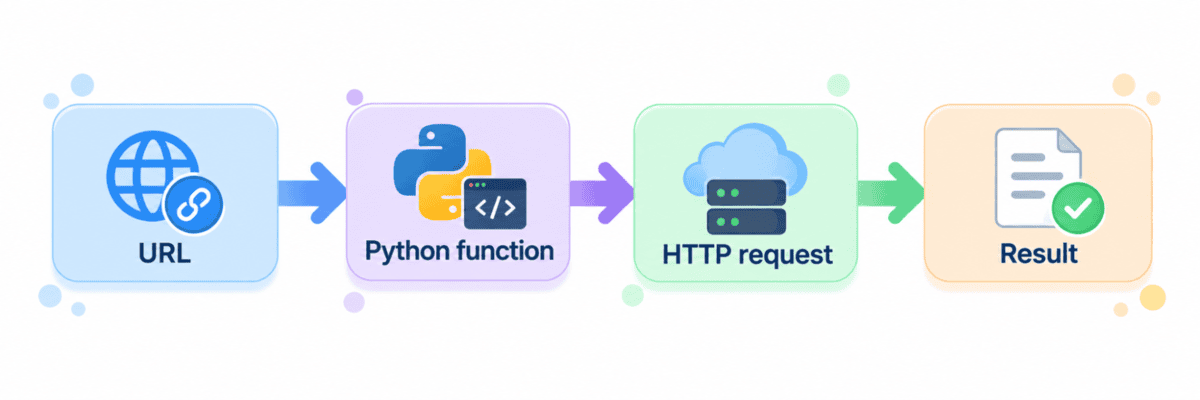
Consider a standard website monitoring script designed to measure HTTP response status and network latency:
from time import perf_counter
import requests

def check_website(url: str) -> str:
    start = perf_counter()

    try:
        response = requests.get(url, timeout=10)
        latency = perf_counter() - start

        return (
            f"urln"
            f"Status: response.status_coden"
            f"Response time: latency:.2fs"
        )

    except requests.RequestException as error:
        return f"urlnError: error"

print(check_website("https://www.python.org"))
To integrate this function into an agentic workflow, the developer retains the core logic—such as performance counting, HTTP requests, and exception handling—while introducing the @function_tool decorator provided by the OpenAI Agents SDK.
from time import perf_counter
import requests
from agents import function_tool

@function_tool
def check_website(url: str) -> str:
    """Check a website's HTTP status and response time."""
    start = perf_counter()

    try:
        response = requests.get(url, timeout=10)
        latency = perf_counter() - start

        return (
            f"URL: urln"
            f"Status: response.status_coden"
            f"Response time: latency:.2fs"
        )

    except requests.RequestException as error:
        return f"URL: urlnError: error"
By applying the @function_tool decorator and providing a clear docstring, the SDK automatically inspects the function signature, extracts parameter types, and compiles a comprehensive JSON schema that the language model understands. This eliminates the need for manual schema definitions, ensuring that the model knows precisely what arguments are required and what output format to expect.
Instantiating and Executing the Autonomous Agent
With the tool defined, the next phase involves instantiating the Agent object, setting behavioral instructions, and assigning the newly created tool to its operational toolkit. Modern lightweight models, such as advanced iterations optimized for tool use like GPT-5.6 Luna, offer high performance and cost efficiency, making large-scale agentic deployments economically viable.
The initialization of the agent and the execution of a complex query are structured as follows:
from agents import Agent, Runner

agent = Agent(
    name="Website Monitor",
    model="gpt-5.6-luna",
    instructions="""
    Monitor websites using the available tool.
    Compare results and explain problems clearly.
    """,
    tools=[check_website],
)

result = Runner.run_sync(
    agent,
    "Check python.org, github.com, and openai.com. "
    "Which one has the slowest response?"
)

print(result.final_output)
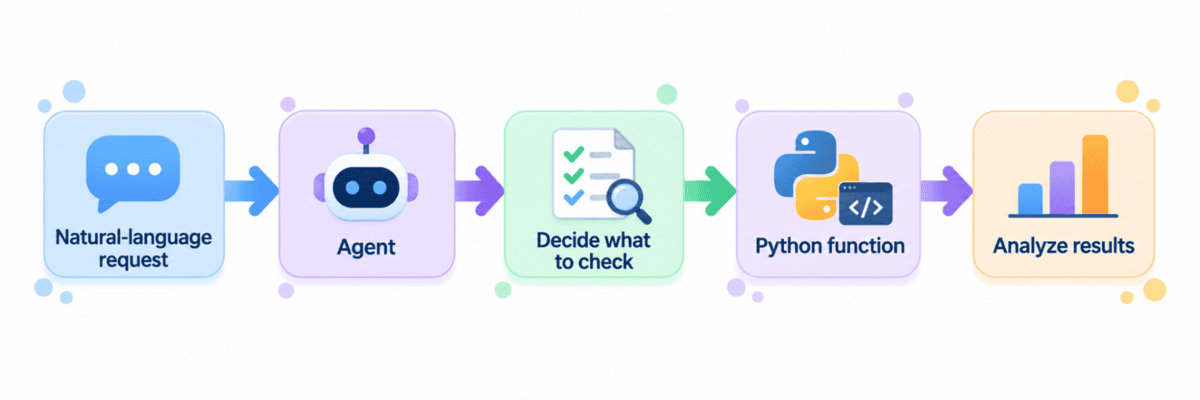
When executed, the system bypasses the need for explicit iteration loops written in Python. Instead, the Runner manages the execution loop, parsing the user’s natural language request, instructing the model to invoke the check_website tool across multiple target domains, compiling the telemetry data, and generating a synthesized comparative analysis:
python.org is the slowest, responding in **1.59 seconds**.

- github.com: 0.83s
- openai.com: 0.49s

All returned HTTP 200.
The Mechanics of the Agentic Execution Loop
Understanding the internal mechanics of the runtime is essential for designing robust applications. The interaction between the language model, the execution runner, and the local Python environment operates through an iterative loop:
- Intent Analysis: The user submits a natural-language query to the
Runner. - Tool Selection: The model analyzes the request against the available tool schemas and determines whether external functions are required to fulfill the prompt.
- Parameter Generation: If tool execution is deemed necessary, the model generates the specific argument payload required by the Python function.
- Execution and Feedback: The local runtime executes the Python function with the model-provided arguments, capturing the returned string or data structure.
- Synthesis or Iteration: The model evaluates the output. If additional steps are required—such as checking secondary sources or verifying anomalous data—the loop repeats. Once sufficient information is gathered, the model constructs the final human-readable response.
This iterative loop represents the fundamental advantage of agentic software design. Rather than failing when confronted with unstructured or multifaceted requests, the application dynamically adapts its execution path to achieve the stated objective.
Broader Implications and Industry Adoption
The integration of natural language understanding with deterministic code execution marks a significant milestone in enterprise software engineering. Organizations across various sectors are transitioning from rigid automation scripts to autonomous agent architectures to handle complex, multi-step workflows such as automated incident response, continuous infrastructure monitoring, intelligent data ETL pipelines, and customer support escalation.
Industry analysts note that the decreasing computational cost of executing tool-capable language models has accelerated this adoption curve. As specialized models become more efficient, developers can deploy multi-agent systems at scale without incurring prohibitive infrastructure expenditures. By treating existing Python functions as modular tools rather than rewriting applications from scratch, engineering teams can modernize their software stacks securely, incrementally, and cost-effectively, bridging the gap between traditional programming and advanced artificial intelligence.