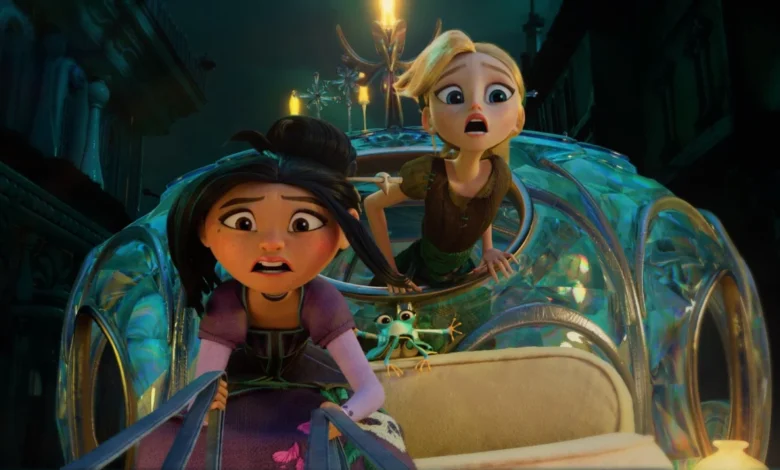
Netflix is expanding its catalog of contemporary fairy tale subversions with the upcoming release of Steps, an animated feature film that reimagines the classic Cinderella narrative through the perspective of the historically maligned stepsister. Scheduled to premiere on streaming platforms on November 20, the project infuses the centuries-old folklore with alternative aesthetics, contemporary thematic elements, and a star-studded voice cast that includes Ali Wong, Amanda Seyfried, Stephanie Hsu, and Daniel Radcliffe.
Rather than adopting the dark, visceral horror elements seen in recent genre adaptations like 2025’s The Ugly Stepsister, Steps positions itself as a family-friendly animated comedy. The production aims to balance accessible humor with deeper allegorical messages regarding systemic privilege, social assimilation, and the psychological impact of societal beauty standards.

Narrative Structure and Premise
The film adopts a meta-narrative framing device popularized by modern animated features such as DreamWorks’ Shrek. It opens by acknowledging the traditional, idealized storybook version of Cinderella—a cheerful, perpetually optimistic maiden who communicates with woodland creatures and performs domestic chores with unwavering grace. However, the narrative quickly pivots away from this archetype to center on Lilith, voiced by Ali Wong.
Lilith is cast as the purported "Evil Stepsister," a label she vigorously contests. The film recontextualizes her traditionally malicious actions—such as assigning grueling household tasks, dismissing animal companions, and destroying Cinderella’s handmade ballgown—as expressions of teenage alienation, anti-conformity, and sibling rivalry rather than inherent malice.
The story traces Lilith and her younger sister, Margot (voiced by Stephanie Hsu), as they travel from town to town alongside their seamstress mother before settling down in a predominantly homogenous, traditional kingdom. Upon arrival, the family encounters cultural friction. The local populace, led by the resident social arbiter Priscilla (voiced by Nikki Glaser), ostracizes the newcomers for wearing Eastern-inspired garments and sharing unfamiliar folklore. Despite her noble reputation, Cinderella (voiced by Amanda Seyfried) initially remains passive, failing to intervene as Lilith is systematically marginalized by her peers.

Themes of Assimilation and Privilege
Faced with social rejection, Lilith undergoes a transformation heavily inspired by alternative countercultures. Eschewing the conventional bouffant hairstyles and pastel-toned gowns favored by the kingdom’s elite, she adopts an unapologetically Gothic aesthetic characterized by dark apparel, DIY asymmetrical hairstyles, and heavy footwear. This stylistic rebellion serves as a visual metaphor for the broader struggles of adolescence, identity formation, and the friction between individuality and societal pressure to conform.
As the narrative progresses, Lilith’s internal resentment toward her seemingly flawless stepsister catalyzes a series of escalating conflicts that threaten not only Cinderella’s romance with the prince (voiced by Daniel Radcliffe) but the safety of the entire community.
A central narrative turning point arrives with the introduction of the fairy godmother, voiced by Bette Midler. The revelation that Cinderella has been quietly aided by magical intervention introduces a sharp commentary on systemic privilege. The narrative explores how unearned advantages—facilitated by magical assistance and patriarchal patronage—distinction between the struggles of marginalized youth and those born into idealized circumstances. When the protective enchantments eventually fail, Cinderella is forced to confront harsh realities such as physical vulnerability and naivety, compelling the two stepsisters to form an alliance.

Production and Creative Ensemble
Steps is the collaborative result of an extensive screenwriting team, reflecting a concerted effort to weave multifaceted sociological concepts into a mainstream animated format. The screenplay and story credits are shared by Ava Tramer, James Madejski, Jen Chuck, Dana Schwartz, Felicia Ho, Riki Lindhome, and Kate Micucci.
Beyond its primary cast, the film populates its fantasy landscape with eccentric supporting characters, including a manic manservant voiced by Peter Dinklage, a motorcycle-riding biker gang of trolls mounted on goats, and a romanticized troll counterweight voiced by Young Mazino.
Industry Context and Market Implications
The release of Steps follows a growing trend within the entertainment industry to deconstruct foundational children’s literature, subverting traditional morality tales to resonate with contemporary audiences who value narrative complexity and diverse representation. By exploring themes of systemic bias through an accessible animated lens, Netflix continues to target multi-generational viewership, appealing simultaneously to younger audiences through slapstick and fantasy tropes while engaging older demographics with satirical subtext.

The film’s reception will serve as an indicator of audience appetite for animated revisionist fairy tales, particularly those that prioritize internal character rehabilitation over traditional binary depictions of heroism and villainy. Steps is slated to debut globally on Netflix on November 20.