A seemingly minor oversight in system design—specifically, the responsibility for creating "derived records"—can lead to significant user frustration, empty dashboards, and a cascade of support tickets. This issue, often manifesting as a failure to automatically provision necessary data structures when they are first implied by user actions, underscores a critical challenge in modern software development: ensuring data integrity and a seamless user experience, particularly in concurrent environments. This article delves into the complexities of auto-provisioning derived records within the .NET ecosystem, highlighting common pitfalls and robust solutions to prevent race conditions and ensure data consistency.
The Case of the Empty Teams Page
Imagine a scenario within a collaborative platform, let’s call it "Loop," where users are tasked with managing teams and their members. A common support request might read: "The Teams page is empty. I added a member, but no team shows up." Upon investigation, the system’s API dutifully returns an empty response, indicating zero items and a total count of zero. This is not a bug in the traditional sense, but a symptom of a deeper design flaw: the absence of a crucial record that the system implicitly relies upon. The problem lies in the assumption that a human administrator will manually create a "Team" record before inviting members, a step that is often overlooked or forgotten, leading to a disconnected state where members exist, but their associated team does not.
This scenario exemplifies a recurring design challenge: determining whether a derived record, whose existence is logically dependent on another entity, should be initiated by the user or automatically provisioned by the system. The latter approach, when implemented correctly, can prevent user confusion and data anomalies.
Understanding Derived Records and Their Implications
In the context of Loop, a "Team" record serves as a foundational element for organizing members. However, the existence of a Team is not always an independent piece of information; it can be derived from the first member invited under a specific plan within an organization. When the system expects a human to manually create this derived record (the Team) before associating members with it, it introduces a potential point of failure.
The implications of this design flaw are far-reaching:
- User Confusion and Frustration: Users perform actions they believe are correct, only to be met with empty interfaces or incorrect data displays. This erodes trust in the platform.
- Data Inconsistency: In concurrent systems, the race to create records can lead to duplicates or missing links, making data management and reporting a nightmare.
- Increased Support Load: "Is this a bug?" tickets become commonplace, consuming valuable engineering resources that could be allocated to feature development.
- Operational Overhead: Manual data correction or complex workarounds may become necessary, adding to the operational burden.
The fundamental principle for robust systems is to shift the responsibility of provisioning such derived records from the user to the system itself, ideally at the moment the derived record becomes logically necessary – typically, the first write operation that implies its existence.
The Naive Solution and its Inherent Traps
A straightforward approach to address this is to modify the member creation process. When a new member is added, the system can proactively check if a corresponding team exists and, if not, create one.
public async Task AddMemberAsync(NewMember input, CancellationToken ct)

    var member = Member.Create(input);
    await _members.AddAsync(member, ct);

    // Create the team if this is the first member on this plan.
    var exists = await _teams.AnyAsync(
        t => t.OrganizationId == input.OrganizationId
          && t.PlanCode == input.PlanCode, ct);

    if (!exists)

        var team = new Team(input.OrganizationId, input.PlanCode);
        await _teams.AddAsync(team, ct);


    await _unitOfWork.SaveChangesAsync(ct);
While this code appears functional in a controlled, single-user environment, it harbors two critical traps that can undermine its reliability in a production setting: the "check-then-insert" race condition and normalization mismatches.
Trap 1: The Check-Then-Insert Race Condition
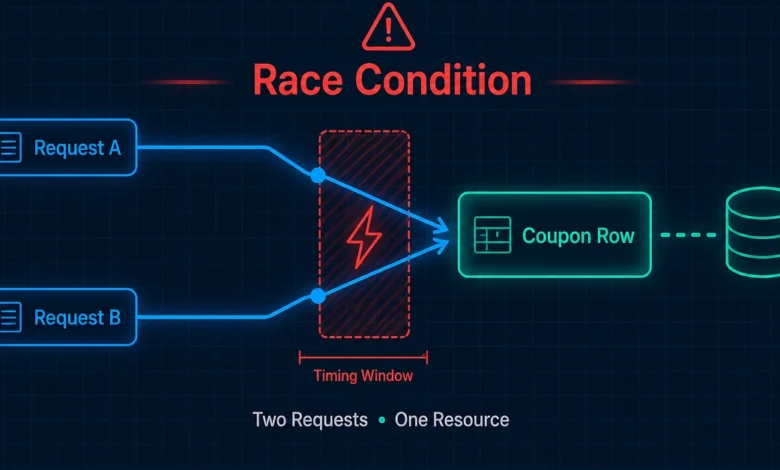
The core vulnerability in the naive approach lies in the non-atomic nature of the AnyAsync check followed by the AddAsync operation. Consider a scenario where two users attempt to invite the first member to a new team concurrently. Both requests might execute the AnyAsync check simultaneously, observe that no team exists (exists == false), and proceed to create a team. This leads to the creation of duplicate team records, each associated with the same organization and plan code. Consequently, dashboards might display multiple identical team cards, and any downstream data aggregations, such as member counts, will be erroneously split across these duplicates.

Application-level checks like AnyAsync are inherently insufficient to guard against these race conditions. The only truly reliable mechanism to prevent duplicate record creation is a database-level unique constraint. This constraint ensures that the database, as the single source of truth for all data writes, will reject any attempt to insert a record that violates the uniqueness rule.
To implement this, a unique index should be defined on the combination of OrganizationId and PlanCode within the Team entity’s model configuration:
// EF Core model configuration
modelBuilder.Entity<Team>()
    .HasIndex(t => new  t.OrganizationId, t.PlanCode )
    .IsUnique();
With the unique constraint in place, the application logic can be reframed. Instead of a strict "check-then-insert," the strategy becomes "try to insert, and treat a uniqueness violation as a success." If a DbUpdateException is caught and identified as a unique constraint violation, it signifies that another concurrent request has already created the desired team. This outcome is precisely the intended end state, so the exception should be handled gracefully as a non-error.
The EnsureTeamExistsAsync helper method illustrates this refined approach:
private async Task EnsureTeamExistsAsync(
    Guid organizationId, string planCode, CancellationToken ct)

    // This check is still valuable for the common path to avoid unnecessary DB roundtrips.
    var exists = await _teams.AnyAsync(
        t => t.OrganizationId == organizationId
          && t.PlanCode == planCode, ct);
    if (exists) return;

    _teams.Add(new Team(organizationId, planCode));

    try

        await _unitOfWork.SaveChangesAsync(ct);

    catch (DbUpdateException ex) when (IsUniqueViolation(ex))

        // A concurrent request created the same team first.
        // This is the desired end state, so this is a no-op, not an error.
        // The IsUniqueViolation method would need to be implemented to detect
        // specific database unique constraint violation error codes.
The AnyAsync call, while not a sole guardian against race conditions, remains beneficial for optimizing performance by avoiding a database write when the record already exists. The unique constraint, however, is the bedrock of correctness under concurrency. The combination of an efficient check for the common case and a robust constraint for the edge cases ensures both performance and integrity.
Trap 2: The Normalization Mismatch
A subtler, yet equally problematic, issue arises from inconsistent data normalization. If the PlanCode is used as a key for joining members to teams, variations in its representation can lead to silent failures. For instance, storing "pro" in one record and "pro " (with a trailing space) or "PRO" (different casing) in another will prevent the join from succeeding. This results in a situation where a team might be created, members are associated with it, yet the dashboard still displays a zero count, mimicking the original problem and causing significant confusion.
To prevent this, a consistent normalization strategy must be applied universally to the key. This typically involves trimming whitespace and standardizing casing at the point of data entry or during entity creation.
public Team(Guid organizationId, string planCode)

    OrganizationId = organizationId;
    // Trim once, here, so the stored key matches how members store it.
    PlanCode = planCode.Trim();
    Id = Guid.NewGuid();
Whatever normalization rule is chosen—trimming, lowercasing, or collapsing whitespace—it must be applied consistently across all read and write operations involving the key. The reliability of any join operation is directly proportional to the robustness of the normalization applied to its constituent parts.
The Retroactive Gap: Addressing Existing Data
The solutions discussed so far—implementing unique constraints and enforcing normalization—address new data being written to the system. They effectively resolve the problem for any members invited after these changes are deployed. However, they do nothing for the backlog of data that already exists. Organizations that invited members before the fix was implemented will still lack the necessary team records, and their dashboards will continue to appear empty until a manual intervention occurs.
This "retroactive gap" is a critical oversight that can be easily forgotten. The fix requires not only updating the write path but also backfilling the missing data. A one-time data migration job is essential to create the missing team records based on the existing member data.

A SQL query can achieve this efficiently and idempotently, ensuring it’s safe to run multiple times without causing unintended side effects:
-- Create the missing team for every distinct (org, plan) that has members
-- but no team yet. Idempotent: safe to run more than one time.
INSERT INTO teams (id, organization_id, plan_code, created_at_utc)
SELECT gen_random_uuid(), m.organization_id, TRIM(m.plan_code), now()
FROM   members m
LEFT JOIN teams t
  ON t.organization_id = m.organization_id
 AND t.plan_code = TRIM(m.plan_code)
WHERE  t.id IS NULL
GROUP BY m.organization_id, TRIM(m.plan_code);
This SQL statement identifies all combinations of organization_id and plan_code that have members but no corresponding team. It then inserts new team records for these missing associations. The TRIM(m.plan_code) ensures that the normalization logic is applied during the backfill, consistent with the live system’s requirements.
It is imperative that the forward-looking fix and the backward-looking data migration are deployed together as a single, cohesive change. Relying solely on the write path to resolve historical data issues is a flawed strategy.
Best Practices for Auto-Provisioning
To effectively implement auto-provisioning of derived records, several best practices should be adhered to:
- Identify Derived Relationships: Clearly map out entities whose existence is implied by others.
- Leverage Database Constraints: Utilize unique constraints to prevent duplicate record creation under concurrent access.
- Enforce Consistent Normalization: Standardize the representation of keys used for joining entities to avoid mismatches.
- Implement Idempotent Operations: Ensure that operations can be executed multiple times without altering the outcome beyond the initial execution.
- Develop Backfill Strategies: Plan for and execute data migration jobs to address existing data inconsistencies.
- Comprehensive Testing: Rigorously test concurrency scenarios, error handling, and data integrity.
Common Mistakes to Avoid
Developers often stumble on these common pitfalls:
- Over-reliance on Application-Level Checks: Assuming
AnyAsyncis sufficient to prevent race conditions. - Ignoring Data Normalization: Failing to standardize keys, leading to join failures.
- Forgetting Backfills: Deploying fixes for new data without addressing historical inconsistencies.
- Treating Unique Constraint Violations as Errors: Not recognizing that a violation can signify a successful concurrent operation.
- Lack of Idempotency: Creating migration scripts that can corrupt data if run multiple times.
Lessons Learned
The challenge of auto-provisioning derived records, while seemingly technical, reveals a fundamental aspect of system design: an empty response from an API does not always equate to "no data." It can signify that the necessary foundational record was never created because its creation was implicitly assumed rather than explicitly handled.
The most enduring solution involves migrating the responsibility for creating these derived records from the user to the system. This system-driven approach must be robust, safe under concurrency, and cognizant of historical data. The true engineering sophistication lies not merely in the "get or create" logic itself, but in the surrounding mechanisms: the database constraints that guarantee correctness, the normalization rules that ensure data integrity for joins, and the data migration strategies that bring historical data into alignment. By meticulously addressing these aspects, developers can build more resilient and user-friendly applications.
LinkedIn Account: LinkedIn
Twitter Account: Twitter
Credit: Graphics sourced from Medium