Building Resilient Data Pipelines: How Scraper Factory Won the Zero Downtime Hackathon through Automated Verification

On Saturday, August 22, 2026, software engineer Nitish Mane walked into a San Francisco workspace with nothing more than a laptop, three sponsor accounts, and a high-stakes premise: could a data pipeline autonomously repair itself without sacrificing the integrity of the information it processed? By the close of the day, that premise had evolved into Scraper Factory, a robust project that secured the solo grand prize for Best Full-Stack Integration at the Zero Downtime Hackathon. Organized by WeMakeDevs in partnership with industry leaders Port, Bright Data, and SigNoz, the event challenged developers to solve the perennial industry headache of brittle data pipelines.
The Silent Crisis of Brittle Data
Modern software ecosystems are built on a foundation of external data sources—API feeds, partner databases, and web-scraped content—that are often outside the control of the organizations consuming them. The core issue, as Mane demonstrated, is that these sources rarely fail catastrophically in a way that triggers traditional monitoring alerts. Instead, they fail "quietly."
A website redesign might shift a CSS selector, or an API might subtly alter its JSON schema. The result is not a system crash, but "data rot." Titles might swap places with descriptions, time formats might drift, or critical rows may disappear entirely. Because the pipeline continues to execute without throwing an error, these discrepancies often go unnoticed until a downstream business metric—such as a user-facing recommendation list—displays nonsensical information. For enterprise-level applications, this latency in detecting failure can lead to severe reputational damage and data corruption.
Chronology of a Hackathon Victory
The development of Scraper Factory followed a rigorous, compressed timeline typical of high-pressure hackathons.
- Morning (09:00 – 12:00): Mane established the core architectural design, opting to separate deterministic logic from AI-assisted reasoning. He defined seven deterministic health checks to serve as the system’s "first line of defense."
- Midday (12:00 – 15:00): The team integrated the stack. Port was utilized as the state management layer, Bright Data was configured for the scraping and extraction logic, and SigNoz was deployed as the observability backbone for audit trails.
- Afternoon (15:00 – 18:00): The "Repair Loop" was developed. Mane programmed the system to generate a repair proposal using a Large Language Model (LLM) only when drift was detected, followed by a mandatory, non-AI verification step.
- Evening (18:00 – 20:00): Final stress testing was conducted using a "mutated fixture" strategy. By intentionally breaking the scraper and watching the system identify, propose a fix, and reject inadequate repairs, Mane finalized the project demo.
The Architecture of Automated Resilience
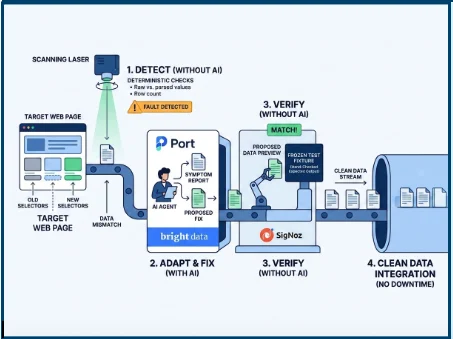
The success of Scraper Factory hinged on a design philosophy that separates detection, adaptation, and verification. Mane’s "three-tier" approach avoids the common pitfall of allowing an AI agent to operate without oversight.
The system relies on seven deterministic checks to maintain integrity. These include monitoring the number of rows per page, tracking the null rate of required fields, and generating a hash of returned field names. Crucially, the system maintains a "raw string" cache. By storing the raw, unparsed text alongside the structured data, the system can cross-reference what it thinks it saw against what the source actually provided. If the parsed time field is empty but the raw string clearly shows a timestamp, the system flags a "drift" event, triggering the repair protocol.
The adaptation layer uses AI to suggest a fix. However, the most innovative aspect of the project is the verification gate. A frozen "fixture"—a real-world page snapshot with verified outputs—acts as the ultimate judge. When the AI proposes a repair, it must first run that fix against the fixture. If the output does not perfectly match the expected outcome, the fix is rejected, the scraper is taken offline, and the system defaults to the last known "good" data state.

Integration of Industry-Standard Tools
The project functioned as a cohesive system rather than a collection of demos, a requirement for the grand prize. By leveraging the unique capabilities of the sponsoring platforms, Mane created a template for production-grade operations:
- Port: Served as the "brain" of the operation. It tracked the lifecycle of scrapers, managing the state transitions from "Healthy" to "Drifting." By utilizing Port’s workflow capabilities, Mane ensured that an AI agent could write a symptom report, but never approve its own fix.
- Bright Data: Provided the extraction capabilities. The platform acted as the source-of-truth for the data, while also hosting the endpoint that received repair suggestions based on the symptoms identified by the system.
- SigNoz: Provided the observability. Using OpenTelemetry auto-instrumentation, the system tracked every step of the lifecycle—fetch, extract, validate, repair, and verify. This created a permanent audit trail, allowing developers to trace the exact moment a failure occurred and review how the system attempted to resolve it.
Implications for Production Environments
The industry-wide impact of this project is significant, particularly as companies increasingly look to automate their data infrastructure. The "unhappy path"—the demo in which the system purposefully failed—was what secured the victory. By injecting a fault that caused the scraper to return only two rows instead of the expected 30, Mane demonstrated that the system would refuse to ship inaccurate data.
"Automatic repair is only safe when something that isn’t the repairer checks the result," Mane stated. This observation addresses a growing concern among engineers: the tendency to over-delegate complex tasks to AI agents. In production settings, the risk of "hallucinated" code or incorrect data schemas is too high for unverified autonomous agents.
Industry experts note that Scraper Factory’s approach provides a blueprint for what is known as "Human-in-the-Loop" (HITL) automation. By keeping a deterministic, rules-based verifier as the final gatekeeper, organizations can achieve the speed of AI-driven development with the safety of traditional, rigorous software engineering.
Moving Toward a More Reliable Data Future
As organizations continue to rely on third-party APIs and external data feeds, the fragility of these pipelines will remain a primary concern. The lessons drawn from the Scraper Factory project—the necessity of idempotent repair endpoints, the importance of alerting for silence (not just errors), and the mandate for deterministic verification—are likely to influence the next generation of data pipeline architecture.
The project effectively bridges the gap between the experimental nature of AI-driven coding and the stability required for production systems. While the hackathon version of the project relied on local tunnels and simplified fixtures, the architectural principles are scalable. As development teams look to reduce the manual labor associated with "babysitting" scrapers and feeds, the integration of intelligent, self-auditing systems will likely become the industry standard.
For the participants at the Zero Downtime Hackathon, the event served as a reminder that innovation is not just about building new features, but about creating systems that can survive the inherent instability of the digital ecosystem. In the case of Scraper Factory, winning the grand prize was less about the cleverness of the scraper itself, and more about the unwavering commitment to a verification process that refuses to accept anything less than accurate, validated data.