PrivacyHawk Review: Balancing Comprehensive Mobile Privacy Tools With Limited Broker Coverage

In an era where personal data has become a lucrative commodity harvested constantly from online interactions, digital privacy tools have transitioned from niche software to essential consumer utilities. When individuals post information online—ranging from basic contact details to professional histories—that data frequently winds up in the sprawling databases of third-party information brokers. These entities aggregate, package, and sell consumer profiles without explicit ongoing consent, presenting substantial risks ranging from targeted spam to identity theft.
To mitigate these exposures, automated data removal services have emerged as frontline defenders. PrivacyHawk is one such platform navigating this crowded market. Positioned as both a data broker removal tool and a broader digital security application, PrivacyHawk promises to reclaim user privacy through automated scanning, deletion requests, and auxiliary security features. However, a rigorous examination of the platform reveals a mixed value proposition defined by innovative mobile integration, intuitive design, and notable limitations regarding customer support and broker network reach.
Evolution of the Data Broker Industry and Privacy Regulations
The commercial trade of personal information is a multi-billion-dollar industry built on the aggregation of public and semi-public records. Data brokers harvest details from social media profiles, court documents, property registries, and marketing surveys to construct detailed behavioral and demographic profiles. Historically, consumers had to manually track down hundreds of these registries and submit individual, often tedious opt-out requests—a process that is virtually impossible to maintain given the dynamic nature of online data.
In response to growing consumer anxiety and regulatory pressures, particularly the implementation of privacy frameworks like the California Consumer Privacy Act (CCPA) and the European Union’s General Data Protection Regulation (GDPR), automated removal services have proliferated. These services leverage legal mandates that require data brokers to honor opt-out and deletion requests. Yet, the efficacy of any given tool depends heavily on the scale of its broker network, the frequency of its automated scans, and the persistence of its follow-up mechanisms. PrivacyHawk enters this landscape with a distinct approach that prioritizes mobile accessibility and holistic digital hygiene over raw database volume.
Pricing Structure and Subscription Tiers
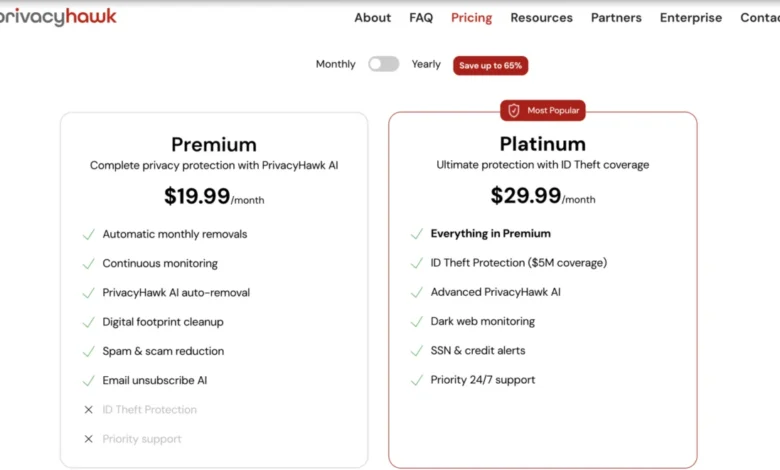
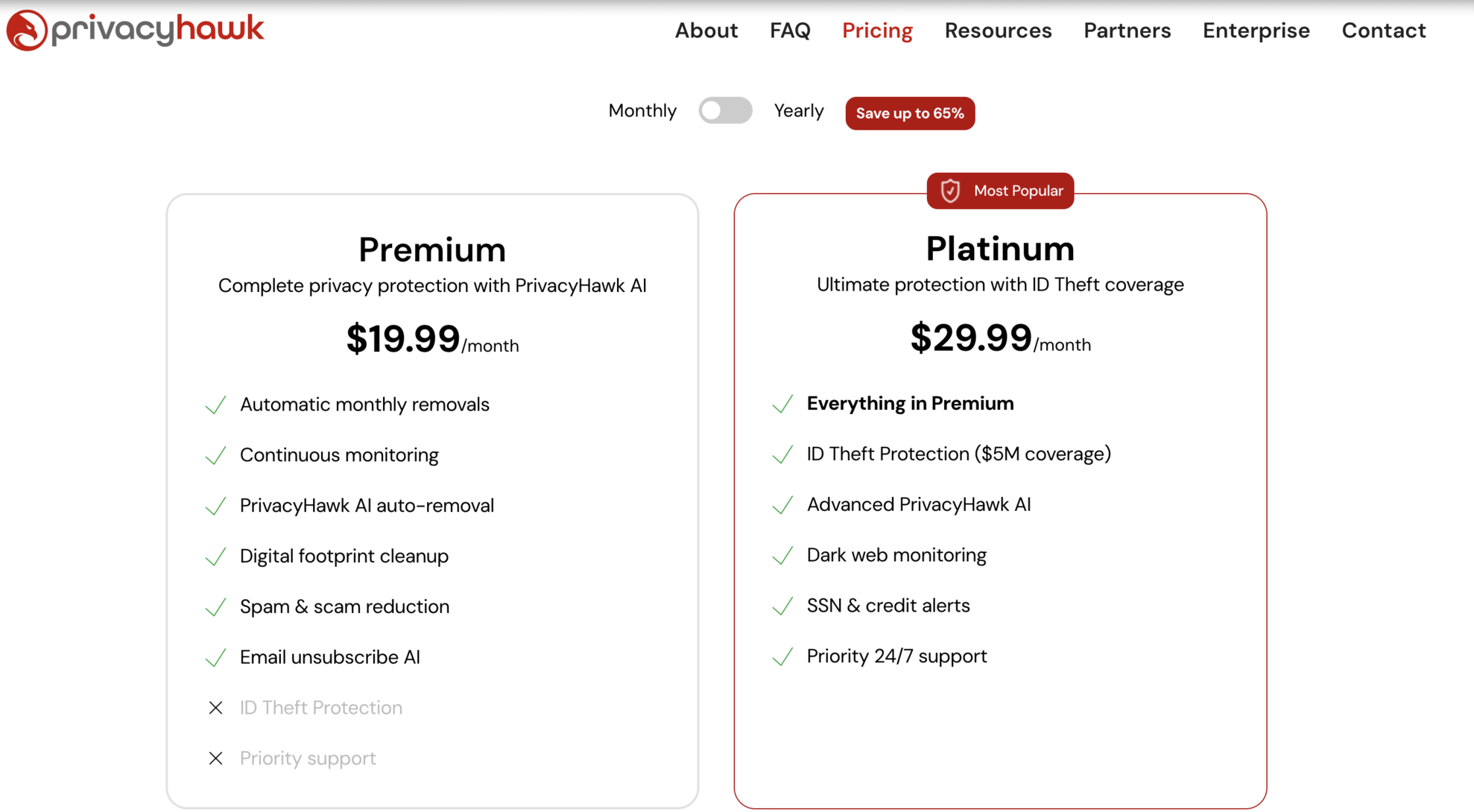
PrivacyHawk employs a straightforward, tiered pricing model tailored primarily to individual users and households, though its cost-efficiency hinges heavily on billing frequency. The platform offers two primary tiers: the Premium plan, which focuses predominantly on core data removal, and the Platinum plan, which layers on advanced security features such as dark web monitoring, identity theft protection, and priority processing.
For individual subscribers, the Premium tier is priced at $20 per month, while the Platinum tier costs $30 per month. However, month-to-month subscriptions carry a steep financial penalty compared to annual commitments. An annual Premium subscription drops to $74—translating to a massive saving compared to the $240 total of a monthly commitment over twelve months. Similarly, the annual Platinum plan costs $125, compared to an annualized monthly total of $360. Consequently, financial prudence dictates that long-term commitment is essential to realizing value from the service.
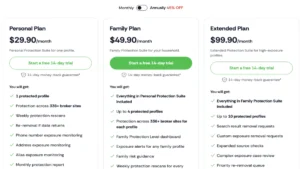
For households, PrivacyHawk offers family packages covering up to four individuals. The Premium Family package is priced at $200 annually, while the Platinum Family package costs $300 annually. Month-to-month billing for these family tiers is priced at $40 and $50 respectively, scaling up to $480 and $600 annually. Industry analysts and consumer advocates generally advise against utilizing the monthly billing cycles for family plans due to these elevated costs. Furthermore, PrivacyHawk does not offer a conventional free trial, a factor that may deter cautious consumers. Instead, the company relies on a 30-day money-back guarantee for dissatisfied subscribers, alongside limited complimentary scan capabilities available upon initial download.
Setup Process and Mobile-First Architecture
Unlike many desktop-centric competitors in the privacy sector, PrivacyHawk is built from the ground up as a mobile-first application, featuring dedicated, polished clients for both iOS and Android platforms. This design choice significantly streamlines the onboarding process.
To begin, users download the application from the Apple App Store or Google Play Store and authenticate their accounts using existing credentials from major identity providers such as Google or Apple. Once permissions are granted, the application initiates an onboarding scan. Users input basic identifying parameters, including their first name, last name, and age. The software then cross-references this input against a network comprising over one hundred U.S.-centric people-finder and data broker registries.
While the mobile integration is exceptionally smooth, certain onboarding requirements warrant scrutiny. To perform a comprehensive digital footprint scan—which evaluates email inboxes to identify commercial entities holding personal data and generates a list of persistent marketing newsletters—users must grant deep access to their email accounts. While PrivacyHawk utilizes this access strictly to audit data exposure and compile junk-sender lists for rapid unsubscription, privacy-conscious users may experience friction regarding the necessity of connecting their primary email inboxes. Furthermore, the platform’s broker scanning capabilities are strictly optimized for United States residents; international users can run digital footprint assessments but cannot deploy broker deletion requests.
Core Functionality and Deletion Workflow
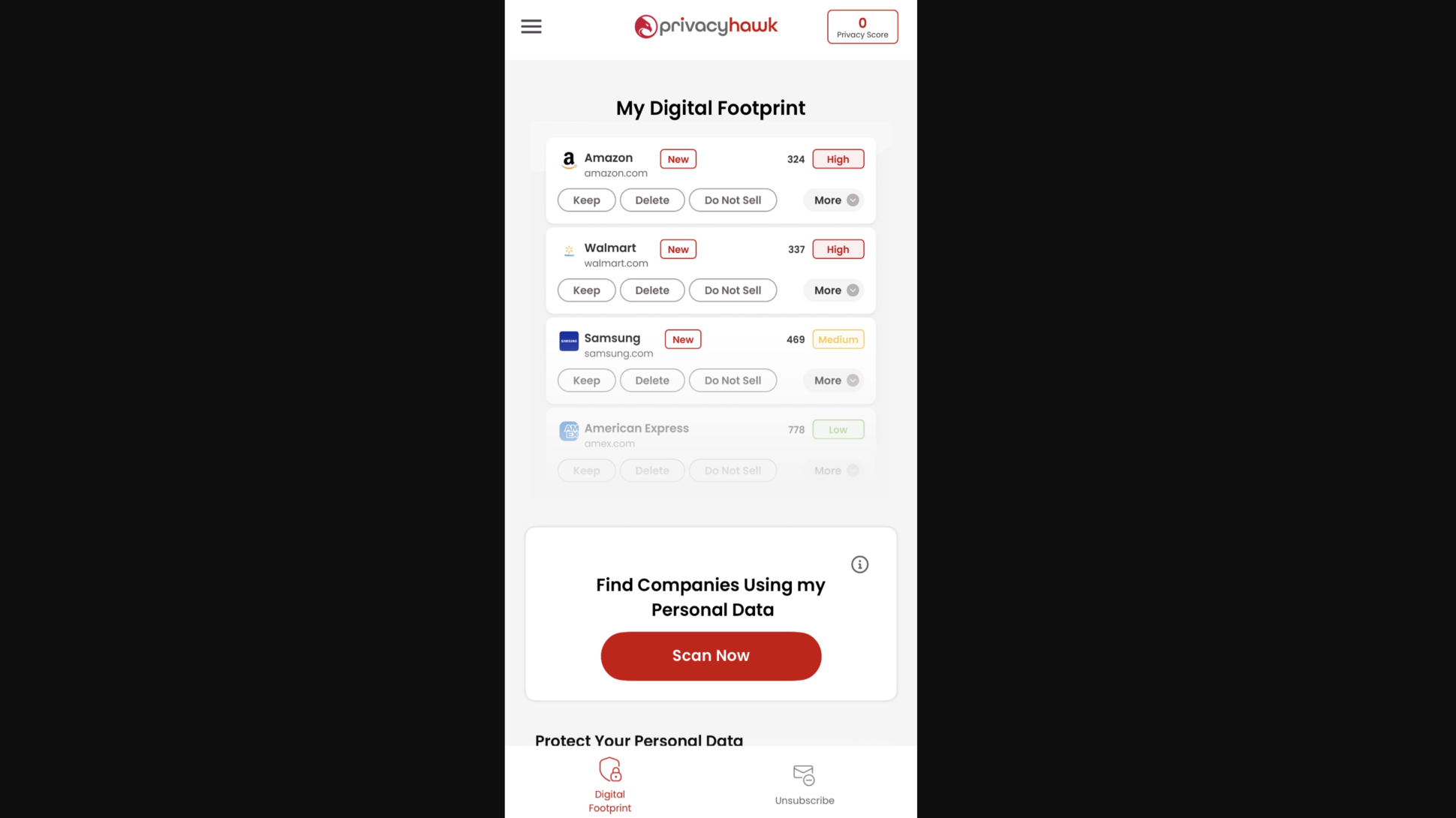
Once the initial automated scan concludes—a process that typically spans from several minutes to a few hours—users are presented with a detailed dashboard highlighting which data broker sites currently host their personal records.
PrivacyHawk manages these findings through a dual-mechanism approach. For covered entities within its network, the application dispatches automated removal requests. If automated protocols fail or encounter resistance from specific brokers, PrivacyHawk’s internal compliance team steps in to formulate and dispatch manually drafted legal removal notices. For listings discovered on brokers outside of PrivacyHawk’s standard directory, users retain the capability to initiate manual removal requests directly through the dashboard interface, which the company’s support personnel will subsequently track and manage.
The resolution timeline for these requests varies significantly based on regulatory frameworks and the responsiveness of individual brokers, frequently requiring anywhere from 30 to 90 days to achieve complete removal. To ensure ongoing protection, PrivacyHawk conducts automated monthly rescans of the user’s data profile, alerting them via push notifications or email if their information reappears on monitored platforms.
User Interface and Experience
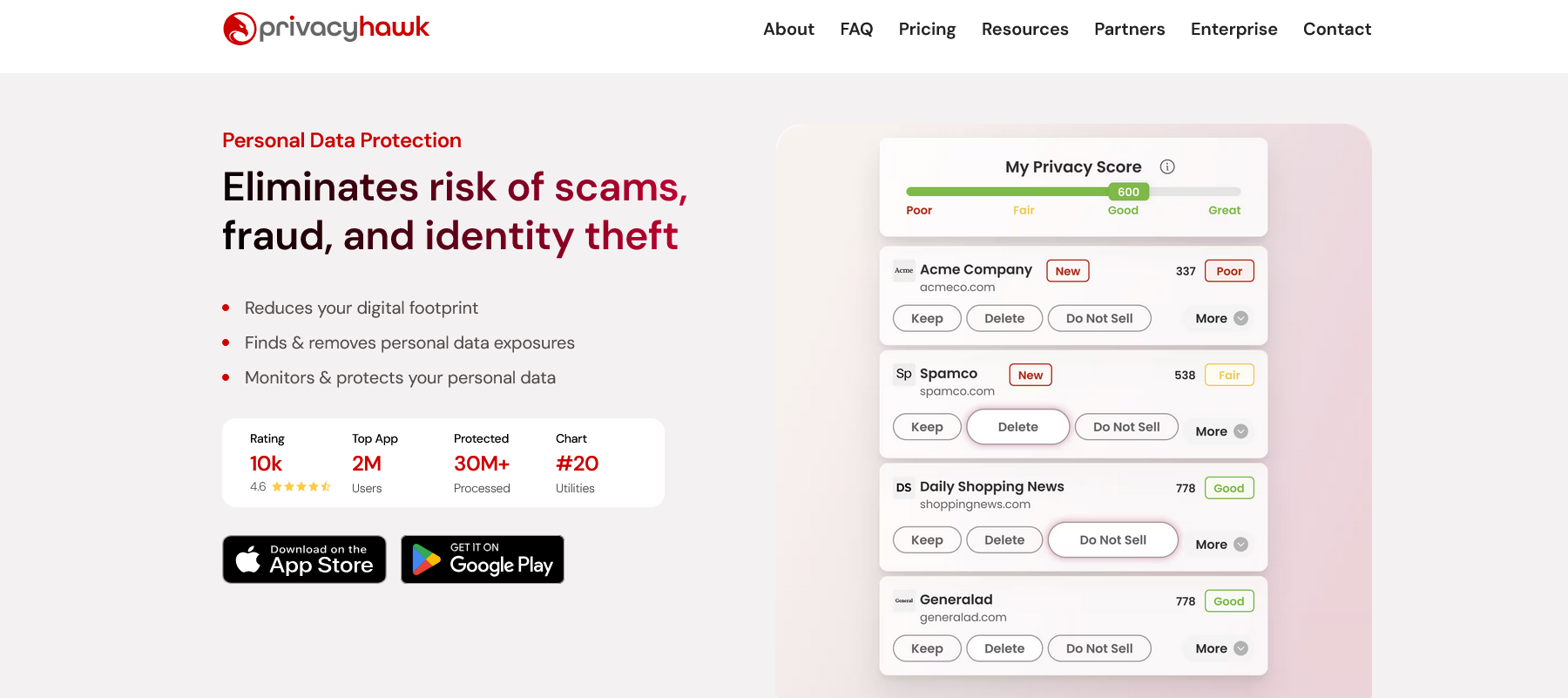
In terms of usability and interface design, PrivacyHawk performs exceptionally well. The mobile application features a clean, minimalist layout characterized by a stark white background punctuated by high-contrast red interactive elements. Navigation between the scanning modules, active removal tracking, and auxiliary security tools is fluid and intuitive.
The dashboard avoids the dense, overly technical jargon typical of enterprise security software, making it accessible to non-technical users. Monitoring the real-time status of individual deletion requests requires minimal cognitive overhead, allowing consumers to observe progress milestones clearly as records transition from active listings to confirmed removals.
Security Suite Extensions: Beyond Basic Data Removal
One of PrivacyHawk’s primary differentiators is its attempt to transcend single-purpose data removal by incorporating a suite of defensive cybersecurity features into a single application.
Beyond scouring people-search directories, the platform includes modules designed to mitigate contemporary digital nuisances and threats. These include dark web monitoring tools that scan credential-leak databases for compromised passwords, automated spam call and robocall blocking features, and inbox auditing utilities aimed at cutting down unsolicited marketing correspondence. By bundling these capabilities, PrivacyHawk functions less like a localized opt-out utility and more like a comprehensive consumer privacy suite, bolstering overall digital hygiene significantly beyond the baseline removal of public records.
Customer Support Infrastructure
Despite strong marks for software design and feature depth, customer support remains an area in need of enhancement. PrivacyHawk provides a comprehensive online Help Center filled with informative user guides, troubleshooting documentation, and instructional manuals that effectively orient new users through the intricacies of digital footprint audits.
However, direct human support channels are conspicuously limited. When users attempt to access real-time assistance through what appears to be an interactive live chat interface, they are met instead with an automated artificial intelligence chatbot. Direct engagement with human customer service representatives is restricted to asynchronous email ticketing. Industry observers note that given the premium subscription pricing—particularly at the Platinum level—consumers increasingly expect immediate access to human support channels, such as telephone hotlines or live chat agents, to resolve complex privacy disputes.
Competitive Landscape: PrivacyHawk Versus OneRep
To contextualize PrivacyHawk’s market position, it is instructive to compare its metrics against prominent competitors, most notably OneRep.
OneRep maintains a significantly larger operational footprint, boasting a network coverage exceeding 300 public data broker sites and over 500 non-public entities, dwarfing PrivacyHawk’s coverage of approximately 100 U.S.-centric brokers. Additionally, OneRep’s standard subscription models frequently undercut PrivacyHawk’s monthly and annual price points.
However, the divergence lies in feature ecosystems. While OneRep specializes heavily in high-volume data removal with minimal auxiliary features beyond basic email breach monitoring, PrivacyHawk positions itself as a broader defensive toolkit. Consumers prioritizing raw quantitative broker coverage and lower cost will likely find OneRep superior for data removal. Conversely, users seeking an integrated mobile application that combines targeted data removal with active robocall blocking, dark web surveillance, and spam reduction will find PrivacyHawk’s multi-layered approach more aligned with their needs.
Final Assessment and Market Implications
PrivacyHawk occupies a unique niche in the consumer privacy ecosystem. Its limitations are clear: a relatively narrow U.S.-centric broker network, an absence of live human customer support via chat or phone, and a lack of a traditional free trial period demand careful consideration from prospective buyers. Furthermore, the prohibitive cost of month-to-month billing structures makes the platform economically viable primarily for users willing to commit to annual subscriptions.
Yet, these drawbacks are counterbalanced by substantial strengths. The platform’s mobile-first architecture provides unparalleled convenience, its user interface is exceptionally polished, and its inclusion of auxiliary security tools—such as spam call blocking and dark web monitoring—transforms it into a versatile privacy utility. For consumers seeking an accessible, automated method to clean up their digital footprint while fortifying their mobile devices against everyday digital intrusions, PrivacyHawk stands as a capable, albeit imperfect, contender in the modern privacy landscape.
Related posts: