The Shift Toward Sovereign Evaluation
The industry has reached a critical juncture where off-the-shelf metrics are no longer the gold standard for enterprise deployment. Recent data from AI research groups suggests that while general-purpose models show steady improvements in reasoning, they often exhibit high variance when applied to niche datasets. Consequently, engineering teams are increasingly shifting toward custom evaluation harnesses—bespoke testing frameworks that simulate real-world usage.
A test harness acts as the primary scaffolding for an AI system, serving as the bridge between raw inputs and validated outputs. By feeding a suite of curated prompts into a model and programmatically scoring the resulting outputs against a known baseline, developers can quantify performance metrics, including latency, cost-per-request, and categorical success rates. This methodology allows for the tracking of regression trends, providing a vital safety net before new model versions are pushed to production environments.
The Four Modular Pillars of Evaluation
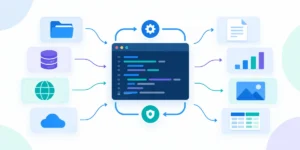
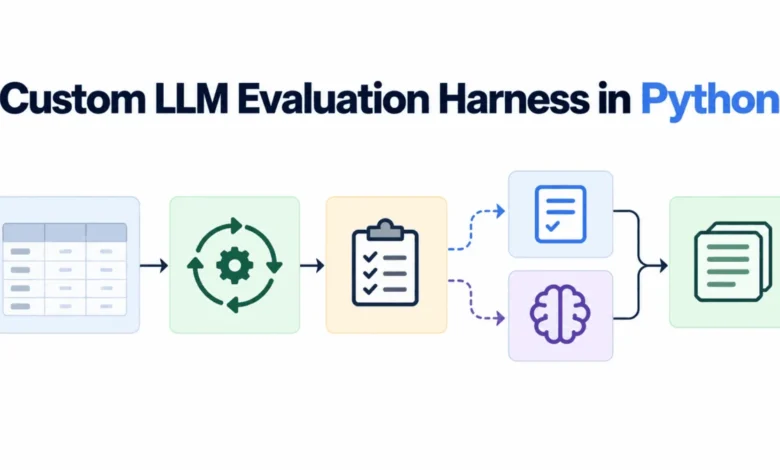
To construct a robust evaluation harness in Python, one must adopt a modular design philosophy. This ensures that the system remains maintainable, scalable, and independent of specific model providers. A high-functioning harness is composed of four distinct components: a golden dataset, an inference runner, a judge layer, and a structured logging mechanism.
1. The Golden Dataset: Defining the Ground Truth
The foundation of any evaluation system is the "golden dataset." Unlike synthetic test cases generated by other models—which often suffer from "happy path" bias—an effective golden dataset must be rooted in historical data. Experts recommend curating 20 to 50 initial test cases derived from actual production logs or documented failure scenarios.
Each entry in this dataset should contain a unique identifier for longitudinal tracking, the raw input prompt, and an unambiguous description of the expected concept or outcome. By using real-world data, developers capture the inherent messiness and edge-case ambiguity that AI models will face in live environments. Expanding this dataset with metadata such as difficulty tiers, category tags, or user intent classifications allows for granular analysis of where the model is currently underperforming.
2. The Inference Runner: Concurrency and Flexibility
The inference runner acts as the transport layer, facilitating the communication between the local environment and the target model. By leveraging libraries such as LiteLLM, developers can maintain a unified function signature regardless of whether they are querying OpenAI’s GPT-4o, Anthropic’s Claude 3.5 Sonnet, or an open-source model hosted via Ollama or vLLM.
Modern Python development necessitates the use of asyncio for these tasks. By utilizing concurrent execution, the runner can process hundreds of test cases simultaneously, significantly reducing the wall-clock time required for comprehensive testing. Implementing retries and request timeouts is not merely a best practice; it is a prerequisite for production-grade evaluation, ensuring that transient network failures do not invalidate the entire testing cycle.
3. The Judge Layer: Objective vs. Subjective Scoring
The judge layer is the intelligence of the harness, responsible for rendering a binary or qualitative verdict on the model’s performance. The choice of judge depends on the specific requirements of the test case:
- Deterministic Judges: These are best suited for tasks requiring exact matches or specific formatting, such as ensuring a response contains a mandatory legal disclaimer or a specific data format. They are computationally inexpensive and provide near-instant results.
- LLM-as-a-Judge: This approach utilizes a high-capability model to evaluate the output of the model under test. This is essential for semantic verification—where the meaning is more important than the literal phrasing. By using frameworks like Pydantic, developers can force the judge to return structured JSON, preventing the common issue of natural language "fluff" interfering with automated parsing.
4. Logging and Data Integrity
The final module involves persistent storage, typically in a line-delimited JSON format (.jsonl). This format is preferred for its "crash-safe" properties; if a test run is interrupted, the results accumulated up to that point remain intact. Decoupling the inference runner from the judge layer is a strategic design choice. By logging the raw model output, developers retain the flexibility to re-evaluate or "re-grade" historical results using updated rubrics or new judge logic without incurring the latency and cost of re-running the inference phase.
Technical Implementation and Best Practices
The prerequisite for this architecture is a Python 3.10+ environment, which provides the necessary asyncio features for non-blocking operations. The installation of minimal dependencies—specifically LiteLLM for model abstraction and Pydantic for data validation—keeps the codebase lightweight and focused.
A sample evaluation loop demonstrates the power of this modularity. By iterating through the golden dataset, the inference runner generates raw outputs, which are then passed to the judge. The judge, in turn, returns a boolean score and a reasoning string, which are then persisted by the logger. The final step involves a summary function that aggregates these logs to calculate the overall pass rate, providing stakeholders with clear, actionable insights into model health.
Broader Impact and Industry Implications
The adoption of internal evaluation harnesses has profound implications for AI governance and reliability. As companies move from experimental AI projects to mission-critical applications, the inability to quantify model drift or performance degradation presents a significant risk. By implementing a custom, repeatable testing framework, organizations can:
- Accelerate Deployment: Confidence in the evaluation framework allows for faster iteration cycles.
- Cost Management: By separating inference from scoring, teams can perform deeper analysis on existing data without re-calling expensive API endpoints.
- Compliance and Safety: A custom harness allows for the rigorous enforcement of refusal policies, which is essential for regulated industries like finance, healthcare, and legal services.
Conclusion and Future Outlook
Building a custom evaluation harness is a manageable yet transformative task. With roughly 60 lines of code, developers can transition from "guess-and-check" development to an empirical, evidence-based workflow. The four-module structure—golden dataset, inference runner, judge layer, and logger—provides a robust baseline that can be easily extended.
Future iterations of such harnesses may include integrating these tests into CI/CD pipelines, allowing every code commit or system prompt update to trigger an automatic evaluation. Additionally, as the field matures, we can expect to see the development of more complex grading rubrics that account for nuance, tone, and multi-step reasoning. By taking ownership of the evaluation process, developers ensure that their AI systems are not only intelligent but also reliable, predictable, and fully aligned with the specific needs of their users. This is not merely a tool for debugging; it is the fundamental infrastructure required to build trustworthy AI in a complex world.