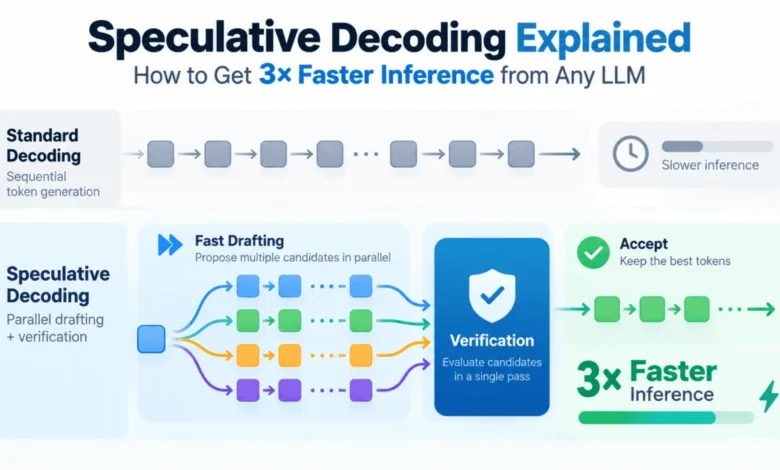
In the rapidly evolving landscape of generative artificial intelligence, the bottleneck of inference speed has become the primary obstacle to the widespread adoption of Large Language Models (LLMs). While models like GPT-4, Claude, and Llama 3 have demonstrated remarkable reasoning and creative capabilities, their utility in real-time applications—such as autonomous coding assistants, interactive customer service, and real-time translation—is often hampered by the agonizingly slow, token-by-token generation process. Speculative decoding has emerged as the industry’s most promising technical solution to this constraint, offering a mechanism to accelerate inference speeds by two to three times without sacrificing model fidelity or requiring costly retraining.
The Autoregressive Bottleneck: A Historical Context
To understand the necessity of speculative decoding, one must first examine the inherent architecture of the Transformer model, the backbone of modern generative AI. Since the publication of the seminal "Attention Is All You Need" paper by Google researchers in 2017, the industry has relied on autoregressive generation. This method dictates that a model predicts the next token in a sequence by looking at all preceding tokens.
The process is inherently serial. For a model with billions of parameters, every single token generation requires the model to load its entire set of weights from high-bandwidth memory (HBM) into the GPU’s compute units. Because the time taken to move data from memory to the processor significantly exceeds the time required to perform the mathematical operations themselves, the system is classified as "memory-bandwidth bound." Even as hardware manufacturers like NVIDIA release increasingly powerful GPUs, the fundamental physical limit remains: the sheer volume of data transfer required for every single token creates a ceiling on how fast an LLM can "speak."
The Chronology of Speculative Acceleration
The concept of speculative decoding gained significant academic traction around early 2023, as research teams from Google and various academic institutions began to seek ways to maximize GPU utilization. By mid-2023, the method moved from theoretical research to experimental implementation, with early benchmarks demonstrating that a smaller, faster "draft" model could predict tokens that a larger "target" model could verify in parallel.
The timeline of development accelerated toward the end of 2023 and into 2024, as the community shifted from using two distinct models toward more integrated approaches. The emergence of Medusa and Eagle, two pioneering frameworks, marked a shift in strategy. Instead of relying on a secondary, auxiliary model—which introduced its own memory overhead—researchers began designing methods where the target model itself could draft its own future tokens using specialized "heads" or hidden state extrapolation. This reduced the complexity of the deployment architecture, making the technology viable for enterprise-grade production environments.
Mechanics of the Parallel Verification Loop
At its core, speculative decoding relies on the probabilistic nature of language models. The process operates in a sophisticated loop that balances speed with mathematical rigor. First, a lightweight draft model—often a version of the main model pruned or distilled to a fraction of its size—generates a sequence of $K$ tokens. Because the draft model has fewer parameters, it performs this generation in a fraction of the time required by the main target model.
These candidate tokens are then fed into the target model in a single, parallel forward pass. Instead of checking each token individually, the target model evaluates the entire sequence at once. It compares its own probability distribution for each position against the predictions made by the draft model.
The genius of this approach lies in the "rejection sampling" mechanism. If the target model’s confidence in a candidate token matches or exceeds the draft model’s prediction, the token is accepted. If not, the token is rejected, and a new token is sampled based on the target model’s internal distribution. This ensures that the final output is statistically indistinguishable from the output the model would have produced had it been running in standard, serial mode. There is no approximation of quality; the result is mathematically identical.
Supporting Data and Efficiency Metrics
Industry benchmarks provide a clear picture of the performance gains associated with this technique. When properly configured, speculative decoding achieves an average speedup of 2x to 3x, though this is heavily dependent on the "acceptance rate"—the frequency with which the draft model’s guesses are confirmed by the target model.
- High-Predictability Scenarios: In tasks involving code completion or structured data entry, where the next tokens are highly constrained by syntax, acceptance rates can climb above 80%, pushing speedups toward the 3x-4x range.
- Low-Predictability Scenarios: In creative writing or abstract reasoning, where the model’s path is less deterministic, the acceptance rate may drop, potentially reducing the speedup to 1.5x.
However, a critical fact-based analysis reveals a caveat: this technique is optimized for low-batch, high-latency-sensitivity environments. In high-throughput scenarios where a server is processing hundreds of concurrent requests, the extra compute cycles dedicated to the draft model can actually compete for resources, potentially leading to a decrease in overall system throughput. Engineers must therefore carefully calibrate their inference pipelines based on their specific workload requirements.
Emerging Techniques: Medusa, Eagle, and Prompt Lookup
Modern implementations have evolved to address the overhead of running two separate models. Medusa, for instance, adds "Medusa heads" to the architecture of the LLM. These are additional layers trained on top of the existing model that predict multiple tokens simultaneously. Because these heads reside within the same model memory space, they eliminate the need to switch contexts between a draft model and a target model.
Similarly, Eagle utilizes the model’s internal hidden states to forecast future tokens, leveraging the deep contextual understanding the model has already developed during its initial processing steps. Perhaps the most accessible method for many developers is Prompt Lookup Decoding, which scans the user’s input for recurring phrases or patterns. By predicting that a model will likely repeat a specific sequence from a prompt—a common occurrence in technical documentation or long-form correspondence—it bypasses the need for a secondary model entirely.
Implications for the AI Ecosystem
The integration of speculative decoding into popular inference engines like vLLM, llama.cpp, and Hugging Face’s TGI (Text Generation Inference) signals a shift toward a more mature phase of AI deployment. It represents a move away from the "bigger is better" paradigm toward an "smarter is better" approach. By optimizing the way data moves through the hardware, developers are effectively extracting more value from existing GPU infrastructure.
From a business perspective, the implications are profound. For companies paying for cloud GPU time, a 3x increase in inference speed translates directly to a 60-70% reduction in compute costs per request. For the end-user, the reduction in latency—the time it takes for the first character to appear on the screen—transforms AI from a novelty tool into a seamless, conversational partner.
As the industry moves forward, the focus is shifting toward "speculative-native" model architectures. Future iterations of LLMs may be trained from the ground up to be more easily drafted by smaller components, potentially pushing the boundaries of inference speed even further. In the interim, speculative decoding stands as the definitive solution for bridging the gap between the computational weight of modern AI and the human expectation for instantaneous, real-time intelligence.