NASA Looks to Private Aerospace Industry to Save Aging Hubble Space Telescope from Fiery Re-Entry

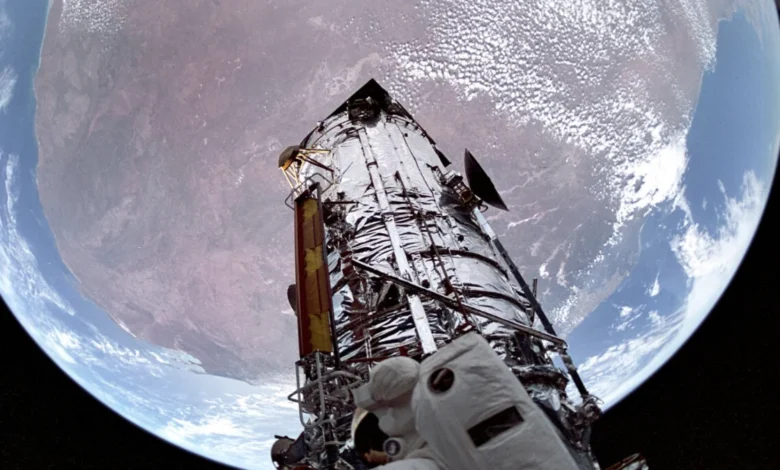
Launched into low-Earth orbit in April 1990 aboard the Space Shuttle Discovery, the Hubble Space Telescope has spent more than three decades redefining humanity’s understanding of the cosmos. Responsible for some of the most iconic, scientifically revolutionary imagery in the history of astronomy, Hubble has tracked the expansion of the universe, peered deep into the primordial epochs of galaxy formation, and captured jaw-dropping vistas of our own solar system. However, this legendary observatory is now on a slow, inexorable descent toward a fiery atmospheric re-entry.
Current orbital projections indicate that, absent external intervention, Hubble will re-enter Earth’s atmosphere sometime between 2033 and 2034. When it does, the friction of atmospheric descent will cause the massive telescope to break apart, raising concerns about potential debris impact risks on populated areas.
Faced with constrained federal budgets and strict fiscal priorities, the National Aeronautics and Space Administration (NASA) cannot afford to mount a dedicated, agency-funded servicing mission akin to the historic shuttle flights of the past. Instead, the space agency is turning outward. Through a formal Request for Information (RFI) issued to the commercial space sector, NASA is actively seeking private-sector solutions capable of either boosting the telescope into a higher, safer orbit to extend its operational lifespan or, alternatively, guiding its eventual descent to a controlled crash site in an uninhabited oceanic expanse.
The looming twilight of the Hubble era highlights both the engineering triumphs of the past and the evolving paradigm of modern space exploration, where government agencies increasingly rely on private enterprise to solve complex logistical and operational challenges in orbit.
The Engineering Challenge: Reaching Higher Ground
The technical parameters outlined in NASA’s Request for Information underscore just how difficult a rescue mission would be. A successful orbital boost would require lifting the multi-ton telescope by more than 370 miles (600 kilometers) to a significantly higher orbital altitude.
Unlike the International Space Station (ISS), which orbits at an average altitude of roughly 250 miles and frequently receives re-boosts from docked cargo spacecraft, Hubble orbits higher up—at approximately 330 miles (530 kilometers)—in a region of space that was intentionally chosen to avoid the atmospheric drag experienced at lower altitudes, but which remains entirely out of reach for standard resupply vehicles. Furthermore, Hubble was never designed to be grappled, refueled, or pushed by modern autonomous commercial spacecraft. Its exterior lacks standard docking fixtures, meaning any visiting vehicle would need to employ advanced robotics or custom-designed capture mechanisms to secure the telescope without damaging its delicate solar arrays, thermal blankets, or sensitive optical instruments.
From a purely technical perspective, executing a high-altitude rendezvous, securing a massive, non-cooperative target, and applying steady, precise propulsion to raise its orbit represents an astonishingly complex engineering hurdle. Yet, the rapid maturation of commercial aerospace capabilities over the past decade has convinced NASA leadership that such an ambitious feat may finally be within reach.
A Legacy of Servicing: How Space Shuttles Kept Hubble Alive
To understand why Hubble requires an external boost today, it is necessary to examine the unique maintenance philosophy that defined its early decades. Unlike most robotic satellites, Hubble was deliberately designed to be serviced, repaired, and upgraded by human astronauts.
During the active era of the Space Shuttle program, NASA executed five critical servicing missions (SM) to Hubble between 1993 and 2009:
- STS-61 (December 1993): The first servicing mission successfully corrected Hubble’s infamous initial optics flaw by installing the Corrective Optics Space Telescope Axial Replacement (COSTAR) package and replacing solar arrays.
- STS-82 (February 1997): Astronauts replaced aging scientific instruments with advanced infrared and ultraviolet spectrographs, expanding the telescope’s observational capabilities.
- STS-103 (December 1999): Following the failure of multiple gyroscopes, a hurried servicing mission replaced all six rate sensor units and upgraded the spacecraft’s central computer.
- STS-109 (March 2002): The mission referenced in modern recovery discussions, STS-109 successfully installed a new power control unit, advanced cooling systems, and the powerful Advanced Camera for Surveys (ACS), dramatically increasing the telescope’s survey speed.
- STS-125 (May 2009): The final Hubble servicing mission. Astronauts installed the Wide Field Camera 3 (WFC3) and the Cosmic Origins Spectrograph (COS), alongside repairing failing instruments on orbit. NASA declared Hubble to be at the peak of its scientific capability following this mission.
Following the retirement of the Space Shuttle fleet in 2011, however, humanity lost the heavy-lift, human-tended capability required to reach, service, or boost Hubble. Since then, the telescope has operated entirely autonomously, slowly losing altitude as residual atmospheric particles drag against its frame, particularly during periods of high solar activity when Earth’s atmosphere expands.
The Shift Toward Commercial Partnerships
With internal funding heavily committed to the Artemis program—NASA’s ongoing effort to return humans to the Moon and eventually journey to Mars—the agency lacks the discretionary budget to design and launch a dedicated government mission solely for Hubble’s upkeep. Recognizing this fiscal reality, NASA has leaned heavily into the thriving commercial space economy.
In a public statement detailing the RFI, Nicky Fox, associate administrator for NASA’s Science Mission Directorate, emphasized the remarkable growth of private enterprise in low-Earth orbit.
"Commercial industry has rapidly evolved in recent years to offer new capabilities for in-space satellite capture and servicing," Fox stated. "Given the time we have until Hubble’s anticipated re-entry, we are eager to explore the breadth of possibilities to boost Hubble to a higher orbit while we develop the flagship mission to follow."
This sentiment was echoed by agency leadership, including NASA Administrator Jared Isaacman, who noted a profound institutional duty to both American taxpayers and the global scientific community to exhaust every viable avenue for preserving the telescope’s utility.
The private sector has already demonstrated an extraordinary appetite for complex orbital operations. Companies such as SpaceX, which famously rescued stranded NASA astronauts Suni Williams and Butch Wilmore from the International Space Station using the Dragon spacecraft, and Rocket Lab, known for its precision orbital launches and pioneering reusable rocket recovery techniques, represent the vanguard of this new space economy. Industry analysts anticipate robust responses to NASA’s RFI from major commercial aerospace contractors eager to showcase their in-space logistics, robotic manipulation, and orbital maneuvering prowess.
Scientific Implications and the Future of Astronomy
The urgency behind saving or safely disposing of Hubble is rooted in its irreplaceable scientific output. Even as NASA’s revolutionary James Webb Space Telescope (JWST) peers deeper into the infrared universe, Hubble continues to provide unmatched observations in ultraviolet and optical light. The two instruments frequently operate in tandem, providing multi-spectral datasets that have deepened our comprehension of dark matter, cosmic expansion rates (the Hubble Constant), exoplanetary atmospheres, and the lifecycle of stars.
If a commercial partner successfully executes an orbital boost, Hubble could potentially remain operational well into the 2030s, overlapping with the operational lifespans of JWST and the upcoming Nancy Grace Roman Space Telescope. Such an overlap would grant astronomers an unprecedented continuous baseline of multi-wavelength observational data.
Conversely, should private solutions prove economically or technically unviable, a managed de-orbit plan will become paramount. Guiding Hubble into an unpopulated sector of the ocean will ensure public safety while closing the book on one of the most successful scientific instruments in human history.
For now, the astronomical community watches and waits. The telescope that fundamentally transformed our view of the cosmos now looks to the ingenuity of private enterprise to secure its legacy among the stars.