Amazon S3 Tables Introduces Managed Migration Capabilities for Apache Hive to Apache Iceberg Data Lakes

Data lake architecture has reached a significant milestone as Amazon Web Services announces a streamlined, automated migration pathway for organizations transitioning legacy analytics environments. Amazon S3 Tables now natively supports the managed migration of Apache Hive tables directly into Apache Iceberg, eliminating the historic friction, complex infrastructure provisioning, and extensive pipeline engineering that typically accompanied such enterprise-scale database overhauls.
The newly introduced feature targets Parquet-formatted tables housed within Amazon Simple Storage Service and registered inside the AWS Glue Data Catalog. By shifting the operational burden of conversion onto fully managed services, enterprises can modernize their data repositories while maintaining uninterrupted access for production workloads. This development addresses long-standing challenges in the big data ecosystem, offering a predictable route toward open-format analytics standards without demanding massive upfront engineering investments.
Background Context of the Analytics Evolution
For over a decade, Apache Hive served as a foundational data warehousing software built on top of Apache Hadoop, providing data summarization, ad-hoc querying, and analysis of large datasets stored in compatible file systems. However, as enterprise data volumes expanded into petabyte and exabyte scales, the architectural limitations of traditional Hive tables became increasingly apparent. Issues surrounding atomic operations, slow metadata planning, and the lack of robust time-travel capabilities prompted the data engineering community to seek more advanced alternatives.

Enter Apache Iceberg, an open-source, high-performance table format designed specifically for massive analytic datasets. Iceberg introduced critical innovations, including hidden partitioning, advanced schema evolution, and instantaneous transactional rollback capabilities. These features allowed organizations to decouple physical storage layouts from logical table views, ensuring that query engines—ranging from Presto and Trino to Apache Spark—could interact with data efficiently and reliably.
Despite the clear technical advantages of Iceberg, migrating petabytes of historical data from legacy Hive catalogs presented a daunting operational barrier. Engineering teams typically had to spend weeks or months designing custom data pipelines, writing complex scripts to handle data type transformations, ensuring backward and forward compatibility, and orchestrating zero-downtime cutovers. These projects frequently ran over budget and exposed production environments to significant risks of data corruption or prolonged downtime. The introduction of managed migration by Amazon S3 Tables fundamentally changes this equation by transforming a manual, error-prone engineering project into an automated, API-driven administrative operation.
Mechanics of the Managed Migration Workflow
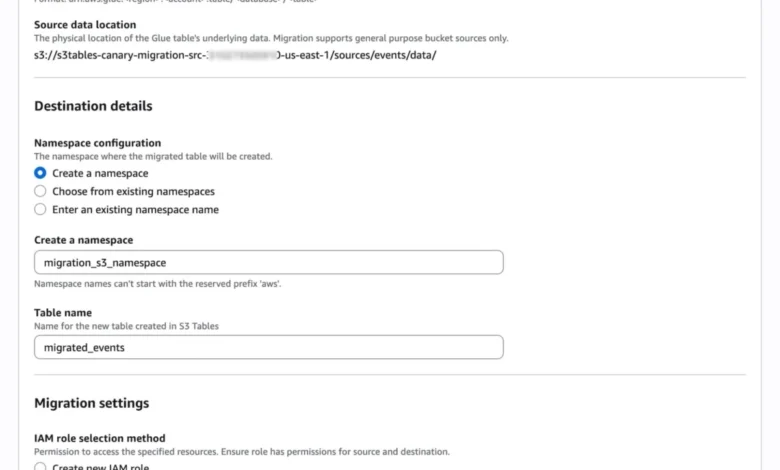
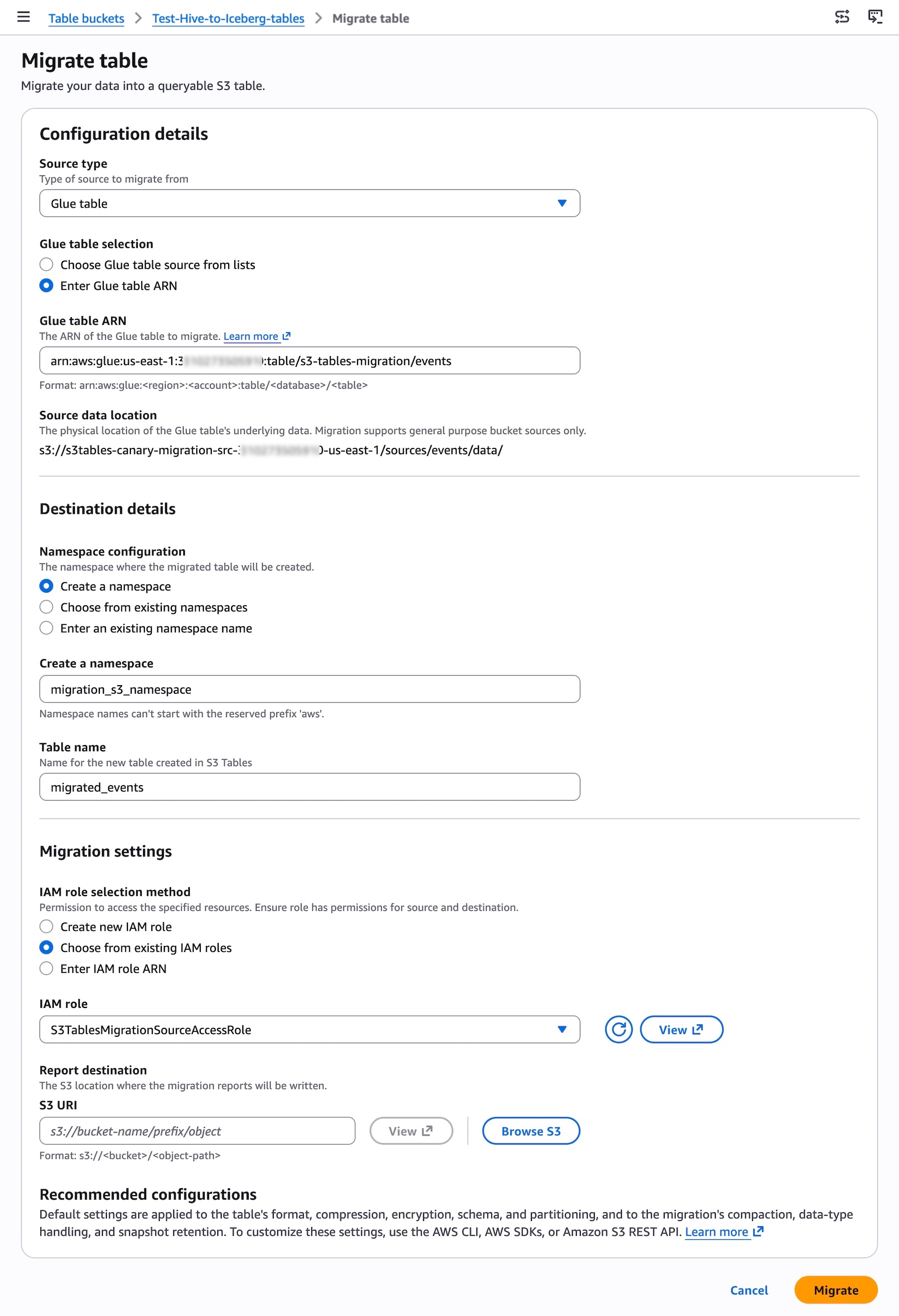
The newly deployed migration utility is engineered to handle the entire lifecycle of a table transition with minimal human intervention. When an administrator initiates a migration via the Amazon S3 console, the AWS Command Line Interface, or programmatic SDKs, S3 Tables execute a rigorous sequence of validation and transformation steps behind the scenes.
Initially, the service inspects the source Apache Hive table in the AWS Glue Data Catalog, scanning all target objects to generate a comprehensive compatibility report. This report flags potential data type discrepancies, schema conflicts, or unhandled structural anomalies before any actual data movement begins. Once validated, S3 Tables take over the heavy lifting of copying, file recompression, compaction, and datatype conversion.

A critical feature of this architecture is its ability to support continuous synchronization. Organizations can initiate a migration while production write operations continue against the source table. Administrators can invoke synchronization commands repeatedly to catch the destination Iceberg table up with ongoing modifications made to the source. The actual cutover window—during which the destination table must transition from read-only to read-write mode—is compressed to a matter of minutes, effectively neutralizing the downtime risks that traditionally plagued major database migrations.
Furthermore, cost efficiency has been a core design tenet of the feature. Customers incur charges solely for the volume of data explicitly copied during the migration process, with zero additional fees assessed for the Hive-to-Iceberg conversion computations. Additionally, source objects stored in S3 Intelligent-Tiering retain their current access tiers throughout the operation, preventing unexpected cost spikes associated with automated data tier re-evaluations.
Technical Implementation and Developer Tooling
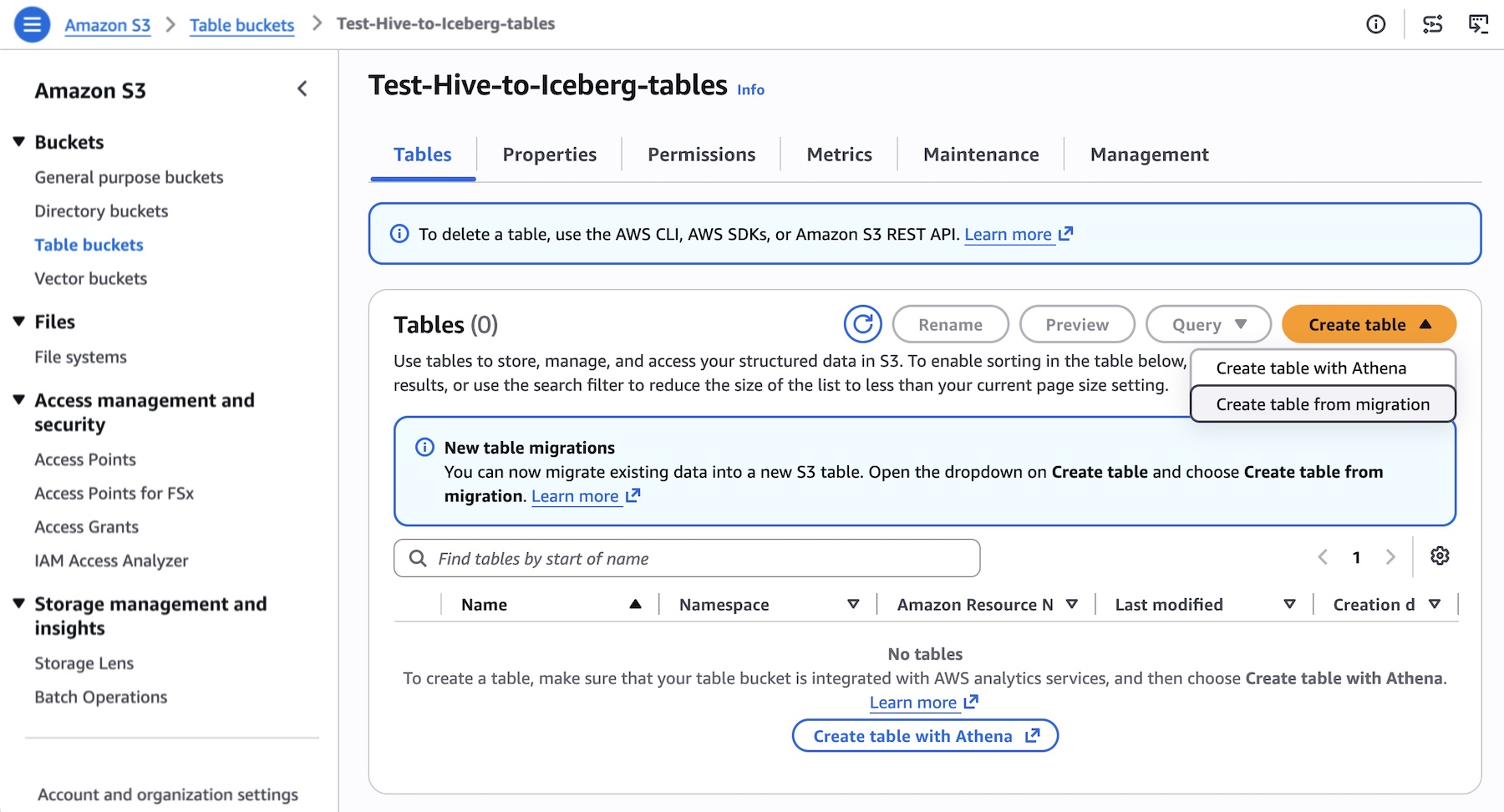
To accommodate diverse enterprise workflows, AWS has integrated the migration capabilities across multiple administrative interfaces. Beyond the visual Amazon S3 console, developers and platform engineers can orchestrate migrations using the AWS CLI, AWS SDKs, or through specialized AI coding assistants using the Agent Toolkit for AWS.
The integration with modern developer toolsets allows automation scripts to be embedded directly into CI/CD pipelines or infrastructure-as-code deployments. For instance, platform engineers can define sophisticated migration parameters via JSON configuration files. These configurations allow precise control over encryption standards, storage classes, data compression codecs—such as zstd—and specific schema definitions, including primary keys and partition specifications.
  "roleArn": "arn:aws:iam::123456789012:role/S3TablesMigrationRole",
  "destinationTable":
    "tableBucketARN": "arn:aws:s3tables:us-east-1:123456789012:bucket/my-destination-bucket",
    "namespace": "mynamespace",
    "name": "my_destination_table",
    "encryptionConfiguration":
      "sseAlgorithm": "aws:kms",
      "kmsKeyArn": "arn:aws:kms:us-east-1:123456789012:key/1234abcd-12ab-34cd-56ef-1234567890ab"
    ,
    "storageClassConfiguration":  "storageClass": "INTELLIGENT_TIERING" ,
    "tags":  "team": "s3tables", "purpose": "migration" ,
    "properties":
      "writeFormat": "parquet",
      "icebergFormatVersion": 2,
      "compressionCodec": "zstd",
      "dictionaryEncoding": true
    ,
    "schema":
      "type": "struct",
      "schema-id": 0,
      "identifier-field-ids": [1],
      "fields": [
         "id": 1, "name": "id",      "type": "long",   "required": true, "doc": "primary key" ,
         "id": 2, "name": "payload", "type": "string", "required": false
      ]
    ,
    "partitionSpec":
      "spec-id": 0,
      "fields": [  "source-id": 1, "transform": "identity", "name": "id", "field-id": 1000  ]

  ,
  "source":
    "sourceType": "glueTable",
    "glueTable":
      "catalogId": "123456789012",
      "databaseName": "my_glue_database",
      "tableName": "my_source_table",
      "lastModifiedTime": "2026-09-01T00:00:00.000Z"

  ,
  "dataMigration":
    "maintenanceSettings":
      "icebergCompaction":
        "targetFileSizeMB": 512,
        "strategy": "sort",
        "icebergSortOrder":
          "order-id": 1,
          "fields": [  "source-id": 1, "transform": "identity", "direction": "asc", "null-order": "nulls-first"  ]

      ,
      "icebergSnapshotManagement":  "minSnapshotsToKeep": 1, "maxSnapshotAgeHours": 168
    ,
    "dataTypeTransforms":
      "conflictPolicy": "FAIL",
      "typeConversion":  "int96":  "type": "timestamp", "sourceTimezone": "UTC"

  ,
  "reviewMigrationPlan": false,
  "completeWorkflowOnSuccess": false,
  "output":
    "compatibilityReportConfiguration":
      "bucket": "arn:aws:s3:::my-report-bucket",
      "prefix": "reports/compat/",
      "scope": "AllSourceObjects"
    ,
    "migrationReportConfiguration":
      "bucket": "arn:aws:s3:::my-report-bucket",
      "prefix": "reports/migration/",
      "scope": "FailedSourceObjects"
Once the synchronization and cutover phases are complete, the newly minted Apache Iceberg tables become immediately accessible to modern query engines and analytics services. Direct integrations with Amazon Athena and Amazon SageMaker Unified Studio allow data scientists and business analysts to query the modernized datasets without altering existing downstream applications or reporting dashboards. Furthermore, because the underlying storage adheres strictly to open standards, any query engine possessing Apache Iceberg REST API compatibility can interface with the data seamlessly.
Broader Industry Implications and Market Analysis
The release of managed Hive-to-Iceberg migration tools reflects a broader industry consensus: open table formats have officially won the architectural debate for large-scale data analytics. Proprietary and tightly coupled data storage formats are rapidly giving way to open standards that prevent vendor lock-in and enable multi-engine analytics strategies.
Industry analysts observe that by lowering the barrier to entry for table format upgrades, cloud providers are accelerating the deprecation of legacy Hadoop ecosystem components. Organizations that previously delayed modernizing their data lakes due to the prohibitive labor costs of manual data engineering can now justify the transition. The reduction in migration friction directly translates to lower operational overhead, improved query performance, and enhanced cost optimization through automated file compaction and intelligent storage tiering.
At launch, the managed migration feature is available across a broad footprint of global AWS Regions, including US East (N. Virginia, Ohio), US West (Oregon), Asia Pacific (Mumbai, Singapore, Sydney, Tokyo), and Europe (Frankfurt, Ireland, Stockholm). Initial support is constrained to AWS Glue-registered Hive tables stored in Parquet format within the same AWS account and region, though enterprise architects anticipate expanded scope in future updates.
As enterprises continue to ingest staggering volumes of structured and semi-structured data, the ability to effortlessly transition between architectural generations will remain a critical competitive advantage. By abstracting the complex mechanics of data lake modernization into managed cloud primitives, AWS has positioned Apache Iceberg as the undeniable default standard for enterprise data lakes moving forward.