Amazon Web Services Unveils AWS Emulator to Streamline Local Development and AI-Driven Coding Workflows

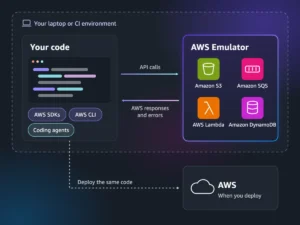
Amazon Web Services has officially announced the general availability of AWS Emulator, a lightweight, locally executed emulation environment designed to replicate core AWS services directly on developers’ machines. Offered at no additional service charge, the tool allows software engineers, development teams, and autonomous coding agents to interact with simulated cloud infrastructure via the standard AWS Command Line Interface and official AWS SDKs. By enabling local execution of complex workflows—such as interacting with Amazon DynamoDB tables and Amazon S3 buckets—the release addresses a long-standing bottleneck in cloud-native software development: the friction and latency associated with remote cloud deployments during the iterative testing phase.
Main Facts and Core Functionality
The newly released utility operates by hosting a local HTTPS endpoint—defaulting to 127.0.0.1:9297—that speaks the same API protocols used in production cloud environments. Developers configure their local environments using specialized environment variables, directing SDK calls to the local instance rather than remote cloud regions. Engineered primarily in Rust to minimize CPU and memory overhead, the software is packaged for distribution via RPM and Debian formats on Linux distributions, while macOS and Windows users can deploy the service within Docker containers.
Crucially, the tool utilizes official API models sourced from public repositories shared with the AWS SDK ecosystem. This architectural choice ensures that requests, error codes, status codes, and response payloads mirror production cloud behavior closely. Furthermore, AWS Emulator ships with an embedded mode tailored for the Rust ecosystem, allowing automated test suites to instantiate isolated in-memory instances directly within test processes. This capability ensures complete data isolation between parallel tests, eliminating race conditions and significantly accelerating test execution speeds.
Chronology and Development Paradigm
The introduction of AWS Emulator marks a paradigm shift in how cloud providers address the modern developer experience, which is increasingly dominated by automated coding agents like Claude Code and Kiro. Historically, local development of cloud-hosted applications required third-party emulators—such as LocalStack—or mandatory connections to live cloud sandboxes, which introduced latency, network dependency, and potential cost overruns.
To maintain synchronization with the rapidly evolving cloud ecosystem, Amazon constructed and maintains AWS Emulator using an autonomous internal pipeline. The system relies on Amazon Bedrock AgentCore Runtime Instances, AWS CodePipeline, and AWS CodeCommit. Dedicated agent groups continuously monitor gaps by comparing local emulator outputs against live cloud responses and published Smithy API models. Once discrepancies are identified, automated systems draft, test, and implement corrections. Before any patch is pushed to the public GitHub repository, it undergoes rigorous fidelity evaluations and adversarial security reviews conducted by independent automated security agents.
Supporting Data and Fidelity Metrics
To quantify reliability, Amazon has introduced a public evaluation framework housed in the aws-emulator-evaluation-suite GitHub repository. The company measures accuracy using "fidelity tests"—comprehensive transactional scripts that execute end-to-end workflows (such as object creation, reading, and deletion) against both the local emulator and live cloud infrastructure.
A fidelity score is expressed as a fractional ratio indicating how many standard tests successfully pass with identical behaviors, covering response bodies, headers, and specific error conditions. Because the test suite expands continuously alongside the software, scores may occasionally fluctuate downward as more rigorous validation parameters are introduced, providing a transparent, metrics-driven view of product maturity. Unimplemented operations yield an explicit HTTP 501 (Not Implemented) status code, failing fast to prevent silent runtime discrepancies during development cycles.
Technical Architecture and Integration
Setting up the environment involves initializing the binary, which automatically generates localized cryptographic credentials, configuration profiles, and self-signed certificates stored locally in standard directory structures. Access key identifiers generated by the runtime explicitly carry the prefix EMULATOR to prevent accidental leaks or misconfigurations against production environments, and requests lacking proper Signature Version 4 (SigV4) signing are summarily rejected.
For continuous integration and deployment pipelines, the service exposes an administrative health endpoint (/__admin/health) to halt execution scripts until the local server is fully responsive. Developers utilizing terminal interfaces configure their sessions by setting variables such as AWS_ENDPOINT_URL and disabling metadata services, allowing standard CLI commands—such as aws s3 mb or aws dynamodb put-item—to execute instantly on local hardware without incurring cloud resource charges.
Official Responses and Strategic Implications
Industry analysts and software engineering leaders have highlighted the strategic necessity of the tool in the age of generative AI-assisted development. Coding agents frequently execute hundreds of iterative API calls while attempting to scaffold, debug, and test cloud architectures. Requiring these agents to query remote cloud regions introduces prohibitive latency, network rate-limiting risks, and unnecessary operational expenditures.
By shifting this feedback loop to the local machine, development velocity increases exponentially. Autonomous agents can rapidly provision resources, evaluate execution outcomes, and refine code logic within milliseconds. This local-first approach aligns with broader industry trends favoring decoupled, highly efficient developer tooling that minimizes friction without sacrificing parity with production environments.
Broader Impact, Limitations, and Security Boundaries
While the utility significantly enhances local development workflows, Amazon has emphasized clear security boundaries and functional limitations. Most notably, the emulator does not replicate the complex evaluation logic of AWS Identity and Access Management (IAM) policies or resource-based access controls. Consequently, permission configurations that would typically be rejected by production cloud policies may succeed locally. Engineers are explicitly advised not to rely on the tool for security compliance testing.
Furthermore, the runtime operates within a single-account paradigm, lacking cross-account federation, cross-region replication, and service-to-service integration depths characteristic of a live multi-tenant cloud environment. Developers must continue to validate security postures, IAM permissions, and holistic application behaviors against live AWS environments prior to production promotion.
Despite these constraints, the removal of service fees for local emulation, combined with open-source transparency via GitHub, positions AWS Emulator as a cornerstone component for modern cloud engineering teams seeking to optimize productivity, reduce operational costs, and seamlessly integrate AI coding assistants into their daily workflows.