Oracle and Microsoft Unveil Deep Agentic AI Integration at Microsoft Ignite 2026 to Transform Enterprise Operations


At Microsoft Ignite 2026, a pivotal shift in enterprise computing occurred as Oracle and Microsoft announced a comprehensive expansion of their multicloud partnership, centering on the integration of agentic AI into the core of business operations. By leveraging the infrastructure of Oracle AI Database@Azure, the two technology giants are enabling AI agents to traverse the divide between structured enterprise data—such as financial records, supply chain logistics, and HR systems—and the unstructured work context captured by Microsoft Work IQ, including emails, meeting transcripts, and collaborative documents. This integration aims to move beyond simple automation, providing organizations with intelligent systems capable of reasoning across their entire digital estate to drive actionable insights.
The Evolution of a Strategic Partnership
The collaboration between Oracle and Microsoft has evolved rapidly since its inception. Initially designed to bridge the gap between OCI’s database capabilities and Azure’s application-rich environment, the partnership has systematically removed technical barriers for enterprise customers. By deploying Oracle Database services directly within Azure data centers, the companies have addressed the long-standing challenge of latency, allowing applications hosted on Azure to interact with Oracle databases as if they were co-located on the same physical infrastructure.
Chronologically, the momentum began in late 2023 when the companies first announced their intent to provide direct access to Oracle database services on Azure. Throughout 2025, the scope expanded significantly, reaching a milestone at Oracle AI World 2026, where the companies introduced advanced capabilities such as Proximity Placement Groups (PPGs). These groups reduced VM-to-Exadata network round-trip latency by approximately 50%, a critical factor for high-frequency transactional workloads. Now, with the announcements at Microsoft Ignite 2026, the focus has shifted from mere connectivity to "intelligence-first" architecture, where AI agents act as the primary interface between data and decision-makers.
Operational Intelligence: The Azure Workload Center for Oracle
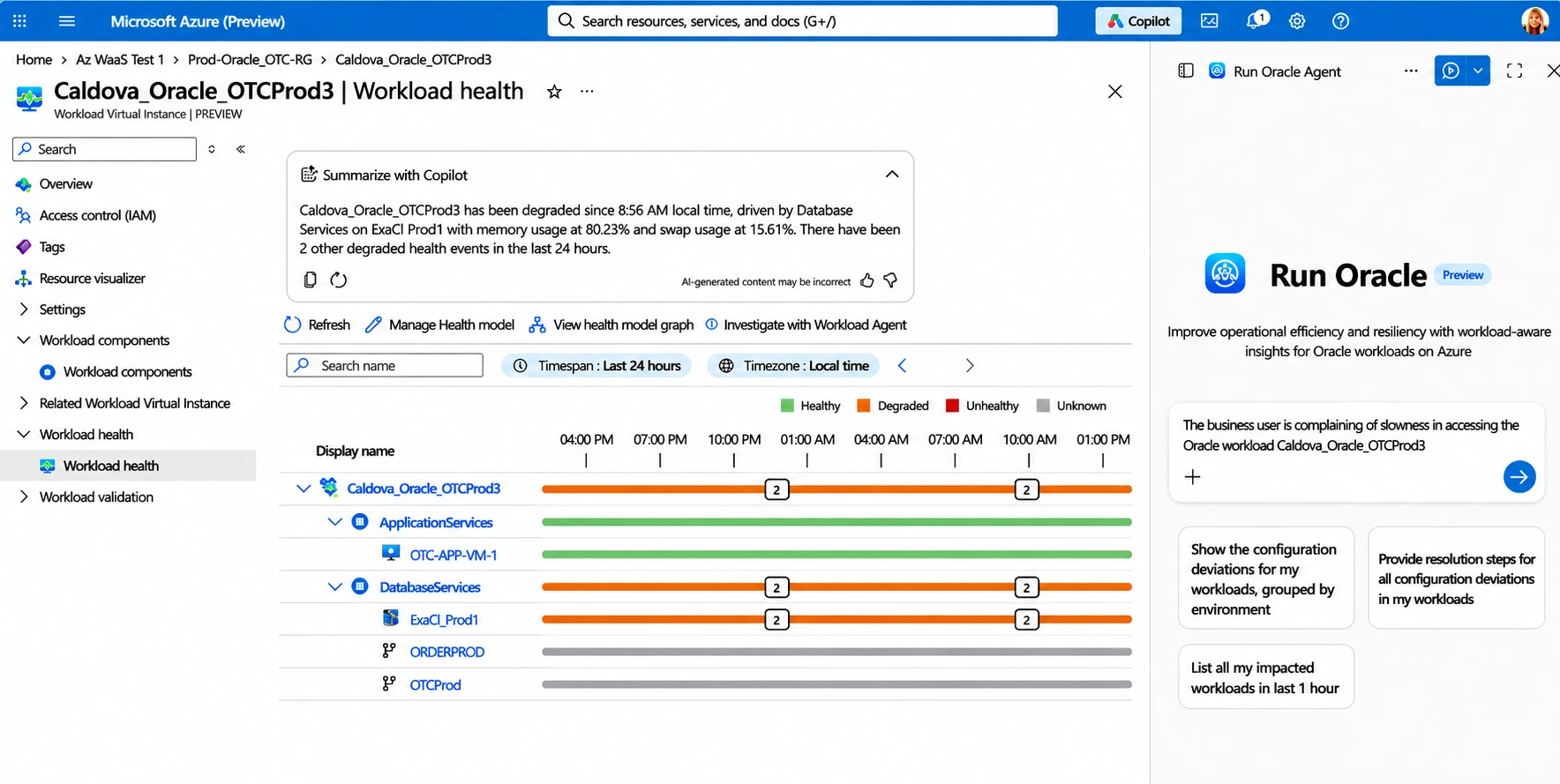
A significant highlight of the current announcement is the introduction of the Azure Workload Center for Oracle, currently in limited preview. For IT operations teams, the primary hurdle has traditionally been the fragmentation of monitoring tools across the application, database, and infrastructure layers. The Workload Center addresses this by introducing the Workload Virtual Instance (WVI).
The WVI serves as a centralized construct that aggregates resources, dependencies, and architectural metadata for specific business applications. By integrating this with Azure Monitor Health Models and the Microsoft Azure Copilot Run Oracle agent, administrators can now obtain a unified, holistic view of system health. In practical terms, this allows an administrator to move from identifying a performance bottleneck in an order-processing application to diagnosing the specific database service failure in a single, streamlined interface. The system utilizes Microsoft Entra for identity management and Oracle Deep Data Security for access control, ensuring that AI agents operate strictly within the bounds of a user’s existing permissions. Every action performed by an agent is logged, providing a transparent audit trail essential for heavily regulated industries.
Empowering End Users with Direct Data Access
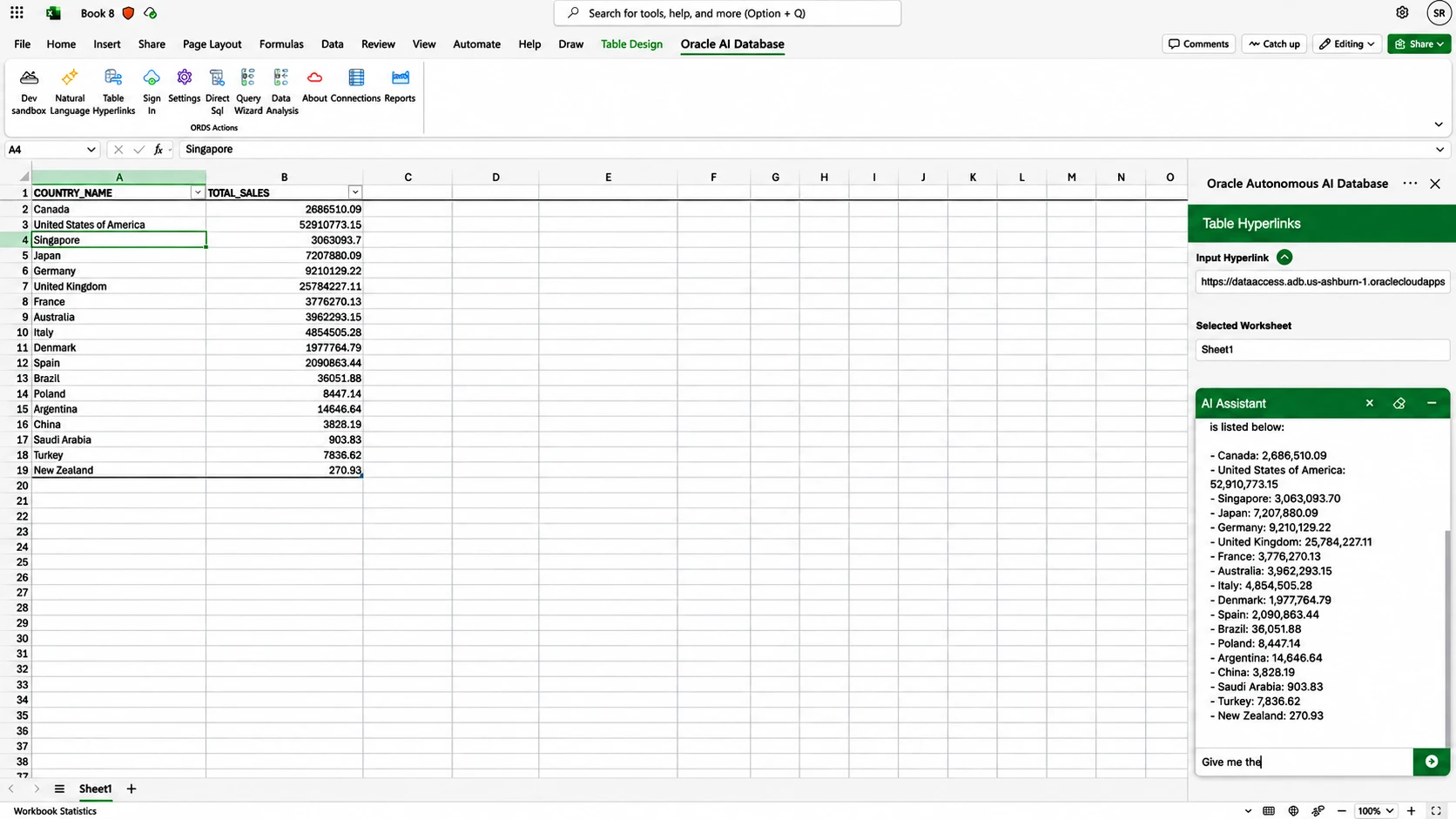
Perhaps the most tangible change for the non-technical workforce is the launch of the Oracle AI Database plug-in for Excel. Historically, business analysts, financial planners, and supply chain controllers have relied on IT departments to extract data, clean it, and format it into reports—a process often fraught with delays and data silos.
With the new plug-in, users can query Oracle databases directly from within Excel. Once the data is populated, Microsoft Copilot can be employed to perform complex analysis, trend forecasting, and reconciliation without the user ever leaving the spreadsheet environment. By enriching this transaction data with context from Microsoft Work IQ, the AI can cross-reference, for example, a spike in supply chain costs with recent email communications or meeting notes regarding vendor negotiations. This synthesis provides a "grounded" AI experience, where the responses are based on the definitive systems of record maintained in the Oracle database, rather than speculative or hallucinatory AI outputs.
Developer Capabilities and the Role of Microsoft Foundry
For the developer community, the challenge of transitioning from prototype to production has often centered on data governance and integration complexity. Microsoft is addressing this through Microsoft Foundry, which now supports Managed Model Context Protocol (MCP) servers and A2A (Agent-to-Agent) protocols to facilitate secure, governed connections to Oracle AI Database.
These integrations allow developers to build specialized agents that perform specific business functions. A developer can now orchestrate a multi-agent system where a "finance agent" validates account health, a "product agent" suggests cross-sell opportunities, and a "sales agent" compiles the data into a cohesive brief. Because these agents operate via MCP servers, they are restricted to approved SQL and PL/SQL operations, ensuring that the AI never accesses sensitive data outside the scope of its defined role. This "bring the AI to the data" approach mitigates the risks associated with data replication, keeping the primary source of truth within the Oracle estate.
Data-Driven Performance and Global Scale
The technical underpinnings of these innovations are supported by the expanding footprint of Oracle AI Database@Azure, which now spans 33 Azure regions globally. This makes it the most widely available Oracle database service on any hyperscaler. The expansion of regions, combined with the upcoming FedRAMP Class D certification, signals a clear intent to capture the government and public-sector markets, where strict compliance and data sovereignty requirements often impede the adoption of cloud-native AI solutions.
Industry analysts observe that this partnership represents a unique defensive and offensive strategy. For Oracle, it secures its database dominance within the Azure ecosystem, preventing customer migration to alternative cloud-native database solutions. For Microsoft, it provides a "moat" around the Azure cloud, making it the most attractive destination for enterprises that are unwilling to abandon their deep-rooted investment in Oracle software.
Implications for the Enterprise Landscape
The implications of these developments are broad. By moving beyond dashboards and disconnected chatbots, the integration of Oracle data into Microsoft’s productivity suite effectively commoditizes complex enterprise analytics. The "flow of work" paradigm implies that the future of enterprise software is not a series of siloed applications, but a continuous stream of intelligent, data-driven interactions facilitated by agents.
However, this reliance on agentic AI requires a fundamental shift in how organizations perceive security and data governance. While the use of Entra and managed MCP servers provides a robust framework, the responsibility for defining "authorized access" rests with the enterprise. As these systems become more autonomous, the clarity of the audit trail—as emphasized by the Oracle and Microsoft teams—will become the most critical component of IT governance.
As the industry moves toward 2027, the success of these integrations will likely be measured by the reduction in "time-to-insight" for business users and the stability of these complex, agent-orchestrated environments. The upcoming on-demand sessions at Microsoft Ignite, specifically BRK435 regarding workload intelligence and THRSP1082 on the Azure Workload Center, provide the technical roadmap for organizations looking to pilot these capabilities.
In conclusion, the partnership between Oracle and Microsoft has reached a state of deep technical maturity. By aligning the structural integrity of Oracle’s database estate with the conversational and contextual intelligence of Microsoft’s AI ecosystem, the two companies are attempting to redefine the modern workplace. Whether this leads to a new standard in enterprise productivity will depend on how effectively organizations can integrate these agents into their existing workflows while maintaining the rigorous governance standards their operations require.