The rapid evolution of generative artificial intelligence has shifted the primary engineering bottleneck from raw model capability to rigorous system reliability. As enterprises transition from simple, single-turn conversational prompts to autonomous AI agents capable of multi-step reasoning, tool execution, and extended problem-solving, traditional software testing paradigms are proving inadequate. A common challenge plaguing modern AI development is unpredictable performance regression: an agent’s behavior degrades following seemingly minor updates—such as a refined system prompt, an altered tool description, or a base model version bump—leaving development teams scrambling to identify the root cause through tedious manual trial and error. To combat this uncertainty, AI engineering teams increasingly rely on systematic evaluations, or "evals," to quantify changes, isolate failure points, and ensure that autonomous systems operate within predictable boundaries.
Understanding Why Agent Evals Demand a Paradigm Shift
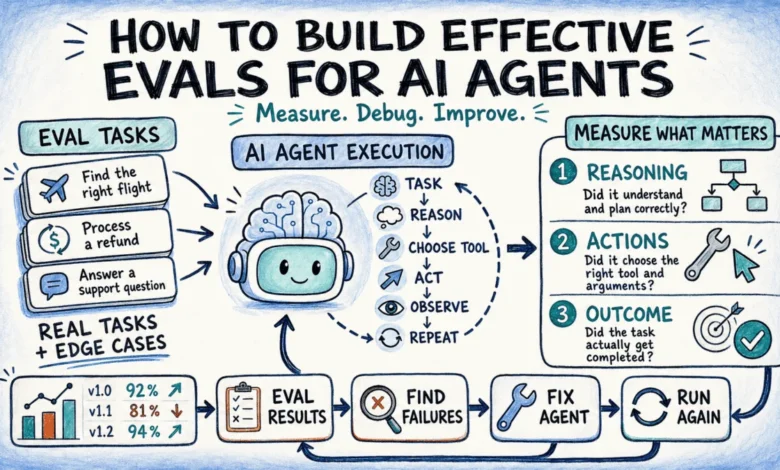
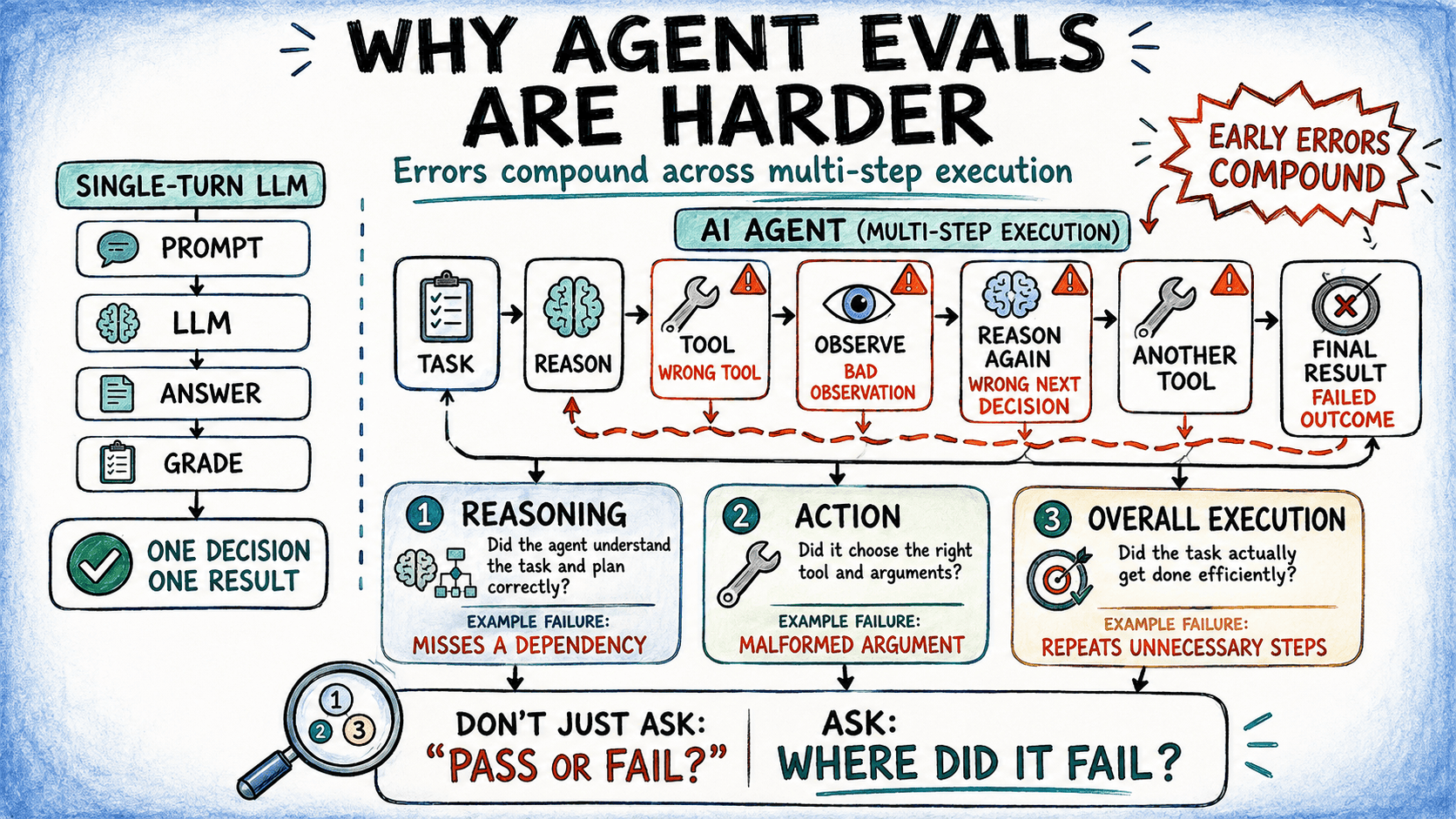
Unlike traditional single-turn applications where a single prompt yields a single response that can be trivially benchmarked against a static gold-standard answer, AI agents introduce complex execution loops. An autonomous agent must ingest a user directive, formulate a multi-step plan, select and invoke external tools, observe API outputs, and dynamically adapt its strategy across dozens of consecutive turns.
This multi-turn architecture creates a compounding error rate. A minor misstep in the initial reasoning phase alters the subsequent system state, causing downstream errors to cascade rather than remain isolated. Industry research from organizations like Anthropic highlights that agent evaluations must therefore be disaggregated into distinct analytical layers rather than treated as a monolithic pass-or-fail metric. Experts generally categorize these failure domains into three critical tiers: reasoning, action, and overall execution.
The reasoning layer encompasses the agent’s ability to comprehend the user’s overarching objective, break it down into logical sub-tasks, and sequence operations correctly. For instance, a travel-booking agent fails at the reasoning layer if it attempts to secure flight reservations before verifying real-time seat availability. The action layer dictates whether the agent selects the appropriate software tool, formats the correct arguments, and executes the API call at the proper juncture. A typical failure here involves utilizing a valid flight-search tool but passing an unrecognized airport code that causes the downstream API to reject the request. Finally, overall execution measures whether the task was ultimately completed and evaluates systemic efficiency—such as whether the agent redundantly queried the same database three times to retrieve data it had already cached.
Furthermore, frontier foundation models introduce a high degree of non-determinism and creative autonomy. Given sufficient latitude, an agent may discover a completely valid, highly efficient solution to a user problem that the original prompt author never anticipated. A rigid, primitive testing suite might flag this unorthodox path as a failure, whereas human operators would view it as a success. Consequently, modern evaluation frameworks must judge the ultimate outcome and the conceptual validity of the approach rather than demanding a strict, predetermined sequence of steps.
Sourcing Tasks and Establishing Clear Test Harnesses
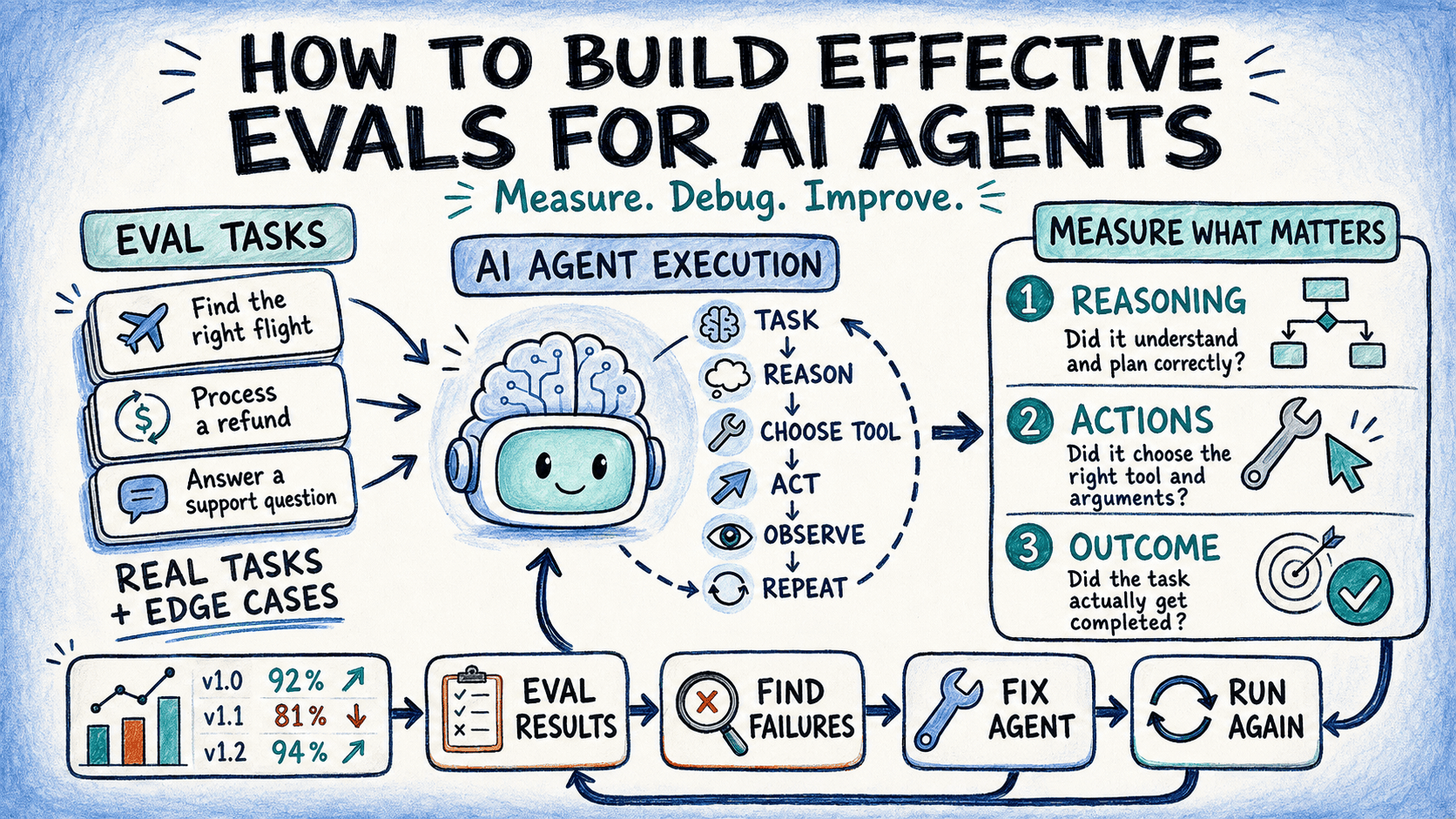
Engineering teams initiating their first evaluation pipelines often struggle with scope creep, believing they need hundreds of complex test cases to achieve statistical significance. However, industry best practices indicate that a curated, high-signal set of baseline tasks is vastly superior. The most efficient bootstrapping method involves translating existing manual quality assurance practices into automated workflows—converting known edge cases, historical bug reports, and pre-release checklists into repeatable test assets.
This initial test corpus must maintain a balanced distribution of positive and negative test cases. For example, a semantic search agent evaluation should incorporate queries that explicitly demand external information retrieval alongside queries that can be definitively answered using the model’s internal parametric memory. This differentiation ensures that the evaluation suite measures the agent’s contextual judgment rather than its propensity to blindly fire tools.
To ensure repeatability, the test harness must execute in a pristine, isolated environment. Leftover scratchpad files, unpurged database caches, or leaked session history can artificially inflate or deflate an agent’s performance score. Moreover, binary passing criteria frequently obscure subtle performance improvements or regressions. Implementing partial credit scoring allows developers to distinguish between an agent that completely misunderstood a customer service request and one that correctly diagnosed the issue and verified identity, but simply failed to execute the final refund transaction.
Because autonomous agents rarely produce identical outputs across multiple runs, non-determinism must be explicitly factored into the metrics. Engineering teams generally rely on two distinct mathematical formulations: pass@k, which measures the probability of at least one successful execution across $k$ independent attempts (ideal for open-ended exploratory tasks where eventually finding a solution is sufficient), and pass^k, which measures the strict probability that all $k$ attempts succeed consecutively (crucial for customer-facing production systems where consistency is paramount).
Choosing the Right Grader Taxonomy
Matching the evaluation mechanism to the specific layer under review remains one of the most critical architectural decisions in agent design. Industry frameworks typically leverage four distinct grader categories, each tailored to specific operational requirements.
Deterministic graders—such as exact string matching, regex assertions, and database state checks—offer rapid, cost-effective, and unambiguous validation for structured outputs. However, they lack the flexibility to recognize valid semantic variations outside their rigid programming.
Code-based graders utilize custom assertions, API response validations, and state-change scripts to evaluate functional behaviors and tool usage. While highly effective, they require robust test logic and tightly controlled staging environments.
Model-based graders employ secondary, highly capable large language models to evaluate execution transcripts against a predefined evaluation rubric. These are indispensable for subjective, open-ended tasks, though they require periodic calibration against human judgment to prevent drift or evaluation bias.
Finally, human review serves as the gold standard for high-stakes edge cases and nuanced judgment calls that automated scripts cannot safely arbitrate. While prohibitively expensive and slow to run at enterprise scale, periodic human auditing of agent transcripts is vital for maintaining evaluation integrity.
Broader Industry Implications and Continuous Workflow Integration
As artificial intelligence deepens its penetration into enterprise operations, the maturation of agent evaluation frameworks signals a broader professionalization of AI engineering. Moving away from anecdotal testing and qualitative "vibe checks" toward rigorous, software-engineering-grade test suites is a prerequisite for deploying autonomous agents in high-risk domains such as healthcare, finance, and legal tech.
Organizations that successfully wire their evaluation suites directly into continuous integration and continuous deployment (CI/CD) pipelines can treat AI regressions with the same urgency as traditional software bugs. By automatically executing evaluation suites on every pull request—blocking code merges if agent performance dips below established thresholds—engineering teams can innovate rapidly without sacrificing system stability.
Ultimately, constructing a robust evaluation harness transforms AI development from an exercise in speculative trial and error into a disciplined engineering lifecycle. By establishing clear task definitions, deploying multi-layered grading schemas, isolating testing environments, and maintaining a continuous feedback loop of transcript review and metric refinement, enterprises can harness the full power of autonomous AI agents while systematically mitigating operational risk.