A significant data exposure vulnerability recently discovered within Cloudflare’s infrastructure permitted authenticated, paying customers to read residual data left behind by other tenants on shared server hardware. The security flaw, which impacted Cloudflare Containers and Cloudflare Sandboxes—a product specifically marketed as a secure environment for executing untrusted workloads, including code generated by artificial intelligence agents—highlights the immense architectural challenges cloud service providers face when isolating multi-tenant storage environments.
According to joint disclosures released on Thursday by Cloudflare and the security researchers who uncovered the bug, the vulnerability originated from misconfigured shared disk spaces utilizing standard Linux virtualization features. Although the incident did not involve active cross-tenant data tampering or live workload interference, the capability to harvest residual sensitive information from newly allocated storage blocks underscores the critical necessity of robust disk-wiping protocols in enterprise-grade cloud computing.
The Technical Mechanics of the Vulnerability
The core of the security vulnerability lay in how Cloudflare managed storage provisioning for its containerized services. Cloudflare Containers dynamically deploys customer applications across a vast, centralized pool of shared servers, with the provider dynamically selecting the underlying host hardware.
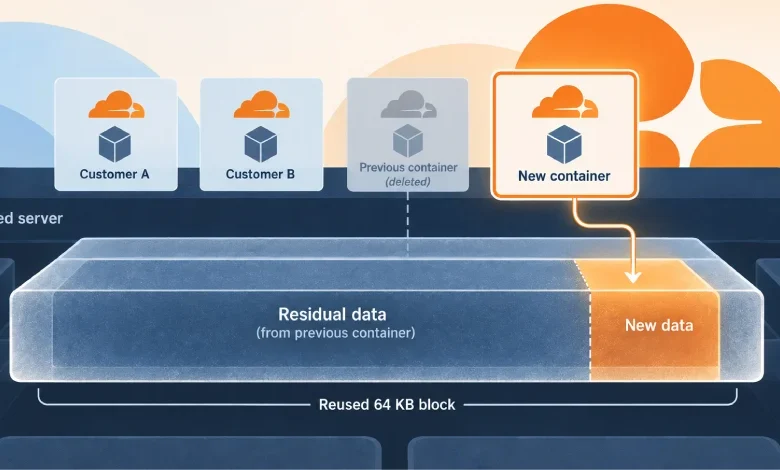
To manage storage efficiently, the architecture relied on a Linux kernel feature known as thin provisioning, implemented via the device-mapper subsystem. Thin provisioning allows storage administrators to allocate virtual disk spaces dynamically, parceling out physical storage in fixed blocks—in this case, measuring 64 kilobytes—only as they are actively required by a running container.
When a customer terminated a container instance, the storage blocks it had utilized were theoretically unmapped and returned to a shared global pool to be repurposed for other customer accounts on the same machine. Under standard Linux thin-provisioning configurations, the operating system kernel enforces a zero-fill or block-wiping procedure before handing a previously used block over to a new tenant. This ensures that no remnants of historical data persist across allocation boundaries.
However, a misconfiguration in Cloudflare’s shared disk pool caused the system to bypass this vital block-wiping step. Consequently, when a newly provisioned container wrote a small fraction of data into a reused storage block—such as a localized four-kilobyte write operation—the remaining 60 kilobytes of the block retained the raw binary data written by the preceding tenant.
To exploit this architectural oversight, the discovering security researchers devised a targeted proof-of-concept method. By intentionally writing small blocks into newly allocated, uninitialized storage regions and subsequently reading the entire 64-kilobyte block back at the raw disk level, they were able to extract unredacted fragments of historical data left behind by entirely unrelated customer accounts.
Discovery and Verification
The vulnerability was formally brought to Cloudflare’s attention on September 4, when security researcher Oren Yomtov, operating on behalf of the security firm Accomplish, reported the flaw through Cloudflare’s private bug bounty program.

Prior to notifying the cloud provider, the researchers conducted controlled verification tests across live production environments to gauge the systemic prevalence of the misconfiguration. During their empirical evaluations, they discovered leftover material on 18 out of 24 distinct attempts on servers proactively chosen by Cloudflare’s orchestration systems. Furthermore, testing across broader baseline infrastructure revealed persistent data leakage on 20 out of 22 underlying host machines distributed across four distinct global continents.
An analysis of the recovered data blocks revealed a concerning array of sensitive structural information. According to technical disclosures published by both Cloudflare and the researchers, the extracted fragments included complete directory structures, database page files, functional SQLite databases, Chromium browser user profiles, local environment configuration files (.env), and various authentication credential files originating from other customer environments.
To maintain strict ethical boundaries, the researchers engineered their automated analysis scripts to output strictly statistical counts, format validations, and structural metadata rather than raw file contents. The minimal diagnostic material transmitted to Cloudflare during the disclosure process contained zero third-party names, distinct identifiers, active credentials, or recovered proprietary files. Cloudflare subsequently verified that all diagnostic data submitted by the researchers was handled with strict confidentiality and securely purged following the validation of the bug.
Crucially, both investigating parties confirmed that the vulnerability was strictly passive. The flaw did not provide any mechanism for an attacker to actively modify, corrupt, or interact with another customer’s live data streams, nor did it permit threat actors to disrupt, hijack, or take offline active container workloads running on the shared infrastructure.
Chronology of Mitigation and Remediation
Upon receiving the vulnerability report on September 4, Cloudflare initiated a comprehensive incident response protocol to isolate and remediate the underlying architectural flaw. The mitigation process required a delicate, multi-tiered technical intervention to ensure that both newly allocated storage blocks and pre-existing cached layers were comprehensively scrubbed.
On the server configuration level, Cloudflare immediately re-enabled the kernel-level block-wiping requirement for all newly distributed storage allocations. This foundational patch effectively neutralized the specific attack vector identified in the proof of concept. By September 14, the discovering researchers empirically confirmed that their exploit scripts were entirely ineffective against the updated infrastructure.
However, engineers quickly recognized that simply turning block-wiping back on was insufficient to secure the entire fleet. While new allocations were henceforth sanitized, blocks that were already statically mapped into running container disks—as well as individual server caches containing pre-prepared container image layers—remained populated with legacy data that newly instantiated containers could potentially inherit and read.
To eliminate this latent risk, Cloudflare executed a sweeping infrastructure-wide remediation campaign. The company systematically retired every active container disk across its global network, flushed local image layer caches, and performed controlled server drains and reboots during scheduled off-peak, low-traffic hours. This extensive sanitation process was fully completed on September 19, effectively purging all lingering historical data remnants from active operational memory and storage pools. Five days following the successful conclusion of the remediation efforts, Cloudflare published a public security advisory detailing the incident.
Forensic Analysis and Historical Scope
In the wake of the patch deployment, Cloudflare security teams launched an exhaustive forensic investigation to determine whether the vulnerability had been exploited maliciously prior to its discovery by Accomplish.

Using telemetry data, Cloudflare engineers constructed precise detection signatures derived from the researchers’ proof-of-concept code and internal validation tests. These behavioral signatures were subsequently executed against extensive historical disk-activity audit logs retained by the organization.
According to Cloudflare’s official transparency statement, the forensic review identified zero indicators of unauthorized exploitation. The only recorded executions of the exploit method matched authorized testing performed by Accomplish researchers and internal validation runs conducted by Cloudflare engineers. Consequently, the company concluded there was no empirical evidence suggesting the vulnerability had been weaponized by external threat actors in the wild.
Despite these reassuring forensic findings, industry analysts noted lingering questions regarding the temporal scope of the exposure. While Cloudflare’s disclosure confirmed the thoroughness of its post-patch log analysis, the company did not publicly disclose the exact historical timeline of when the faulty thin-provisioning configuration was initially introduced into production, leaving the precise duration of customer exposure unquantified in public statements.
Broader Implications for AI Sandboxing and Cloud Security
The disclosure of the Cloudflare Containers vulnerability arrives amid an escalating industry-wide focus on the security boundaries of cloud-based code execution environments, particularly those engineered to support autonomous artificial intelligence agents.
The security firm Accomplish noted that the Cloudflare incident represents the sixth distinct "sandbox escape" or structural isolation flaw published by their researchers since July alone. Previous disclosures attributed to the research team highlighted similar boundary weaknesses in notable AI and development platforms, including Anthropic’s Claude Cowork and Claude Code interfaces, Cursor’s command-line utility, Docker container architectures, and OpenAI’s Codex environments.
Although Cloudflare’s specific advisory narrowed the scope of affected services to Cloudflare Containers and Cloudflare Sandboxes—omitting explicit references to related edge products like Browser Run, which the researchers asserted was similarly impacted—the clustering of these vulnerabilities underscores a systemic industry trend. As enterprises increasingly deploy automated AI agents capable of generating and executing arbitrary, untrusted code within shared cloud fabrics, the traditional isolation guarantees provided by multi-tenant containerization are facing unprecedented stress tests.
Security analysts emphasize that multi-tenant cloud providers must adopt rigorous, defense-in-depth methodologies. Relying solely on default operating system configurations for shared disk pools—such as assuming kernel-level block wiping is universally active—introduces unacceptable operational risks. The Cloudflare incident serves as a stark reminder that even minor low-level storage misconfigurations can inadvertently compromise tenant isolation, reinforcing the critical importance of continuous cryptographic sanitization, rigorous automated auditing, and proactive third-party security research partnerships in modern cloud architecture.