Navigating the Agentic Shift: Five Essential Strategies for Enterprise AI Integration


The landscape of enterprise artificial intelligence is undergoing a profound structural evolution, shifting rapidly from passive, question-answering conversational models to autonomous agentic systems capable of executing complex, multi-step workflows from conception to completion. Over the past several years, deployment data compiled by enterprise technology consultants reveals a distinct pivot in corporate digital transformation strategies. While early adopters focused primarily on Large Language Models (LLMs) for localized content generation and information retrieval, modern organizations are increasingly investing in software agents designed to manage end-to-end operational projects.
However, enterprise technology leaders are discovering that procuring advanced computing infrastructure, securing adequate budgets, and deploying sophisticated developer tools represent only the initial hurdles of digital modernization. True enterprise-wide adoption requires deep, intentional cultural engineering. Employees must feel psychologically safe and sufficiently empowered to experiment with autonomous systems, while executive leadership must articulate a clear vision regarding how agentic integration reshapes traditional corporate roles. Drawing from extensive implementation partnerships across diverse corporate environments, technology consultants have identified five foundational lessons designed to guide modern enterprises through this critical operational paradigm shift.
The Evolution from Generative AI to Autonomous Agency
To understand the current corporate push toward agentic systems, it is necessary to examine the rapid technological trajectory of the past half-decade. Following the mainstream breakthrough of generative AI tools in late 2022, businesses rushed to integrate chatbots and automated assistants into customer service, marketing, and software development departments. These initial deployments primarily functioned on a prompt-and-response basis, requiring continuous human oversight for every individual task.
By 2024 and into 2025, advancements in reasoning capabilities, memory persistence, and tool-use integration enabled developers to construct autonomous agents. Unlike their predecessors, these agents can evaluate a broad objective, formulate a multi-step execution plan, utilize external application programming interfaces (APIs), evaluate their own intermediate results, and dynamically correct errors before finalizing a deliverable.
Despite these remarkable technical leaps, industry analysts note that organizational productivity gains have frequently lagged behind technological potential. The bottleneck is no longer capability; it is integration. Organizations that treat agents merely as faster plugins for legacy processes routinely encounter friction, employee resistance, and structural bottlenecks. Successfully navigating this transition demands a fundamental redesign of how work itself is conceptualized and executed within the modern enterprise.
1. Transitioning from Relay-Race Workflows to Agent-Executed, Human-Directed Models
Historically, enterprise workflows have mirrored a corporate relay race. A functional task is completed by an individual, reviewed through quality assurance checkpoints, and physically or digitally handed off to the next specialist in the chain, who repeats the sequence.
When organizations attempt to layer an autonomous AI agent into this legacy model without structural modification, the results are frequently counterproductive. While the agent may execute its assigned leg of the race at unprecedented speeds, the traditional handoff mechanisms inevitably stall, creating administrative traffic jams and neutralizing the speed advantages of the technology.
To unlock the true value of agentic systems, organizations must move away from linear, siloed handoffs and adopt a hub-and-spoke or parallel processing model. In this optimized framework, agents handle the heavy lifting of data synthesis, preliminary drafting, and cross-system synchronization, while human workers act as directors, setting overarching parameters, evaluating strategic alignment, and making final qualitative judgments. This structural redesign eliminates administrative friction, reduces latency between departments, and allows human talent to focus exclusively on high-value cognitive and creative endeavors.
2. Overcoming Cultural Hesitation by Fostering Employee Ownership
The single greatest barrier to enterprise-wide AI adoption is not technical complexity, but human hesitation rooted in psychological safety and job security. Market surveys and workplace studies indicate that a significant percentage of corporate employees harbor anxieties regarding their professional relevance if autonomous agents absorb the majority of their routine daily responsibilities. Furthermore, workers frequently express deep concern over liability: if an autonomous system executes a flawed calculation or makes a poor operational decision, who ultimately bears the professional blame?
Industry experts argue that overcoming this apprehension requires shifting the organizational narrative surrounding AI. Rather than positioning agents as replacements or infallible digital overlords, enterprises must encourage teams to treat software agents with the exact same developmental framework applied to human junior staff members.
Under this mentorship model, an agent is viewed as a capable but inexperienced assistant that requires clear instructions, constructive feedback, and gradual delegation of authority. When employees are empowered to act as mentors and supervisors to AI agents, hesitation transforms into a sense of professional ownership. Workers transition from fearing automation to managing it, reclaiming their status as indispensable orchestrators of technological output.
3. Managing Hybrid Workforces Comprising Humans and Software Agents
As autonomous systems assume greater operational responsibilities, the modern corporate ecosystem is evolving into a hybrid workforce where human employees and software agents operate side by side. Managing this dynamic requires reimagining team structures, communication protocols, and accountability metrics.
In a hybrid team environment, workflows must be documented with absolute clarity so that both human participants and autonomous agents understand their respective mandates. For example, in software development or financial auditing, an agent might continuously monitor compliance logs and flag anomalies, while human engineers or analysts investigate the root causes and determine corrective policy changes.
Establishing effective collaboration protocols prevents the fragmentation of institutional knowledge. Enterprises must implement shared digital repositories and transparent logging systems so that human team members can audit the actions taken by agents during off-hours. This transparency builds collective trust and ensures that the hybrid team functions as a cohesive, synchronized unit rather than two disjointed operational tracks.
4. Cultivating Agentic Literacy Through Structured Experimentation
Technology integration fails when users do not understand the underlying mechanics of the tools at their disposal. In the context of enterprise AI, organizations must foster what experts term "agentic literacy"—a deep, practical understanding of how autonomous systems analyze problems, process constraints, and generate outcomes.
Employees who develop agentic literacy are uniquely positioned to recognize where an agent’s algorithmic logic breaks down, why hallucinations or errors occur, and how to refine prompts and parameters to prevent future failures. This literacy cannot be acquired exclusively through theoretical training seminars or corporate slide decks; it requires dedicated, hands-on experimentation within safe, sandboxed environments.
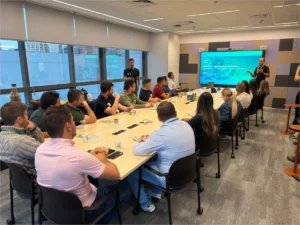
Organizations leading the adoption curve often establish internal innovation hubs or hackathons where cross-functional teams can test low-code and no-code agents on low-stakes projects. By observing firsthand how an agent interprets instructions and where it struggles, workers build a nuanced intuition for the technology’s boundaries, enabling them to guide, critique, and leverage agentic outputs with absolute confidence.
5. Implementing Scalable Governance via a Hub-and-Spoke Model
Scaling artificial intelligence across a multinational enterprise presents a classic organizational dilemma: centralized IT and compliance teams want strict guardrails to mitigate security, privacy, and regulatory risks, while localized business units demand the speed and autonomy necessary to innovate rapidly in their respective markets.
To resolve this tension, leading enterprises are increasingly adopting a hub-and-spoke governance model. In this framework, a central administrative "hub"—often managed by a specialized Center of Excellence or enterprise architecture team—establishes foundational security protocols, data privacy standards, compliance checks, and approved toolkits. Meanwhile, individual business units operate as "spokes," utilizing these shared guardrails to build, customize, and deploy agents tailored to their immediate operational needs.
This decentralized yet controlled approach ensures that innovation is not stifled by bureaucratic bottlenecks, nor is security compromised by rogue deployments. Within forward-thinking organizations, internal platforms—such as curated agent catalogs and low-code repositories—are deployed to facilitate the sharing of verified agent skills and workflows across disparate departments. This cross-pollination drives enterprise-wide learning, eliminates redundant development efforts, and accelerates overall operational efficiency.
Broader Economic and Industry Implications
The transition toward agentic enterprise architectures carries significant macroeconomic and competitive implications. According to recent economic analyses from major global consultancy firms, widespread adoption of autonomous agentic workflows is projected to unlock trillions of dollars in global economic value over the coming decade through compressed cycle times, optimized resource allocation, and enhanced predictive decision-making.
Industries characterized by heavy data processing, regulatory reporting, supply chain logistics, and customer relationship management are experiencing the most rapid transformations. Financial institutions are deploying agents to streamline compliance auditing and fraud detection; healthcare organizations are utilizing autonomous systems to manage patient scheduling and administrative billing; and manufacturing giants are integrating agentic loops to monitor predictive maintenance schedules across global factory floors.
However, market researchers emphasize that the realization of these economic benefits is not guaranteed. Companies that fail to address the cultural, structural, and governance dimensions of the agentic shift risk investing heavily in advanced technology while achieving marginal productivity gains. The competitive divide in the modern digital economy will increasingly separate organizations that view AI as a collection of isolated software features from those that holistically embrace agentic transformation.
Conclusion: Embracing a People-First Philosophy
Ultimately, the journey toward becoming a fully agentic organization is fundamentally about human empowerment. Technology, no matter how advanced, remains merely an instrument in the pursuit of enterprise objectives.
Guiding an enterprise through this profound operational shift requires giving teams the technical systems and security guardrails necessary to move with speed, the organizational permission to experiment and learn from failure, and executive leadership that actively promotes accountability and continuous improvement.
By treating software agents as collaborative extensions of human capability rather than disruptive threats, businesses can construct resilient operational ecosystems. The ultimate objective of the agentic shift is not the displacement of human labor, but the creation of an empowered corporate culture where human ingenuity and autonomous systems amplify one another, unlocking unprecedented levels of productivity, creativity, and strategic growth.