Five Practical Python Scripts to Automate Everyday CSV Data Processing Workflows

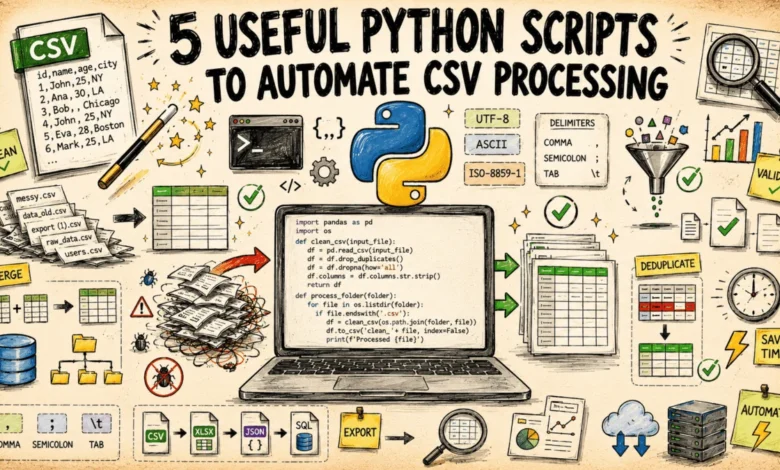
Comma-separated values, universally known as CSV files, remain the foundational bedrock of modern data pipelines, serving as the universal exchange format for relational databases, enterprise resource planning systems, and batch data processing jobs. Despite their ubiquity and simplicity, CSV files frequently present a myriad of operational challenges for data engineers and analysts alike. Inconsistent delimiters, unexpected character encoding schemes, sudden schema drift, and duplicate or corrupted rows routinely disrupt downstream data consumption. Traditionally, data practitioners resort to writing ad-hoc scripts or performing manual inspections in spreadsheet applications—processes that are repetitive, highly susceptible to human error under tight production deadlines, and rarely justified for the deployment of custom, enterprise-grade software infrastructure.
Addressing this persistent operational bottleneck, developer and technical writer Bala Priya C. has released a comprehensive suite of five self-contained, open-source Python scripts designed to automate routine CSV data processing tasks. Crucially, each script relies exclusively on Python’s standard library, allowing developers, database administrators, and data scientists to execute them immediately within any standard environment without the administrative overhead of managing external third-party packages or configuring complex dependency trees. All source code and documentation are publicly available on GitHub as part of an ongoing open data science tutorial repository.
The introduction of these standardized scripts comes at a critical time for organizations handling large volumes of unstructured or semi-structured batch data. Industry benchmarks indicate that data professionals spend upwards of 60 to 80 percent of their working hours on data preparation and cleaning tasks rather than actual modeling or business intelligence generation. By automating low-level maintenance chores—such as schema validation, file normalization, differential auditing, structural transformation, and secure anonymization—engineering teams can significantly mitigate the risk of pipeline failures while recovering valuable hours for high-value analytical work.
Automated Schema Validation as a Pipeline Quality Gate
The first utility in the newly released suite is a robust schema validator designed to intercept data corruption before it infiltrates core analytical pipelines. A CSV file that appears structurally sound during a preliminary spreadsheet review can easily harbor hidden defects, such as missing mandatory columns, date fields corrupted by textual anomalies, or numeric columns contaminated with unexpected blank strings. Historically, these irregularities surface only after the data has traveled deep into downstream consumption layers, resulting in expensive debugging processes and corrupted operational reports.
The schema validator script evaluates target CSV files against a predefined configuration file written in JSON. Administrators can explicitly map column headers to expected data types—including integers, floating-point numbers, dates, standard strings, and email addresses—while enforcing secondary constraints such as regular expression pattern matching and null-value restrictions. Unlike traditional binary pass-or-fail validation tools, this script processes data streams row by row utilizing Python’s built-in csv.DictReader module. This design guarantees high memory efficiency, enabling the script to process massive multi-gigabyte datasets without exhausting available system RAM. Upon completion, the script generates a granular, row-by-row error report detailing exact cell locations and violated rules, terminating with a non-zero exit code if validation failures are detected. This makes it an ideal pre-flight gatekeeper for automated extract, transform, load (ETL) pipelines.
Row-Level Differential Auditing for Data Snapshots
Maintaining historical visibility across evolving datasets presents another persistent challenge for data management teams. Comparing two temporal snapshots of the same CSV file—such as a daily database export or an incremental batch feed—traditionally requires side-by-side spreadsheet reviews. As row counts scale into the hundreds of thousands, visual inspections become entirely unfeasible, drastically increasing the likelihood that critical data insertions, deletions, or silent modifications will go unnoticed.
To solve this operational friction, the row-level diff tool automates the comparison of two CSV files based on user-designated unique identifier columns or composite keys. The script ingests both files into memory-efficient dictionary structures, calculates set differences to immediately isolate added and removed primary keys, and performs a field-by-field evaluation of intersecting rows. Crucially, the script filters out entirely unchanged rows, focusing exclusively on modified data points. It outputs a structured CSV audit report detailing the exact change type, key identifier, column name, legacy value, and updated value. This structured output empowers compliance officers, auditors, and data engineers to rapidly review modifications without parsing extraneous data.
Encoding and Delimiter Normalization for Legacy Systems
Data interoperability remains a persistent obstacle when integrating files originating from disparate software ecosystems, legacy mainframes, or internationalized applications. Contrary to standard conventions, not all files bearing a .csv extension utilize standard comma delimiters or UTF-8 character encoding. Legacy enterprise systems frequently export data utilizing semicolons, horizontal tabs, or pipe characters, alongside byte-order marks (BOM) that corrupt initial column headers and break standard parsing algorithms.
The encoding and delimiter normalizer script addresses this friction by automatically inspecting an input file’s raw byte structure to detect its native character encoding and delimiter configuration. Utilizing Python’s csv.Sniffer module alongside systematic fallback heuristics, the script analyzes file samples to accurately identify commas, semicolons, tabs, or custom separators. It then rewrites the file into a pristine, standardized format utilizing UTF-8 encoding, standard comma delimiters, and Unix-style line endings (n). A summary log is printed directly to the console, providing a complete audit trail of the original file parameters and the normalization adjustments applied.
Configurable Column Reshaping and Data Derivation
Data transformation workflows often require repetitive modifications, including column renaming, structural reordering, column purging, and the derivation of new attributes from existing fields—such as concatenating first and last names or converting raw currency strings into numerical floating-point values. While trivial for isolated files in spreadsheet applications, executing these transformations consistently across dozens of routine batch exports demands programmatic automation.
Priya’s column transformer utility introduces a declarative, configuration-driven approach to data reshaping. Operations are defined sequentially within a JSON configuration file, separating transformation logic from execution code. Column renaming and dropping are handled via standard mapping structures, while derived columns utilize a safe expression syntax rather than arbitrary code execution, safeguarding system security. Utilizing csv.DictReader and csv.DictWriter, the script streams data through these transformation pipelines with flat memory consumption, outputting reshaped files that precisely match the column ordering specified in the administrative configuration.
Secure Data Sampling and Field Anonymization
Data privacy regulations, including the European Union’s General Data Protection Regulation (GDPR) and the California Consumer Privacy Act (CCPA), place stringent legal obligations on organizations sharing production datasets with internal engineering teams, third-party contractors, or external auditors. Manually redacting sensitive personally identifiable information across massive spreadsheets is both inefficient and prone to catastrophic oversights.
The final script in the toolkit combines reservoir sampling with deterministic field anonymization. Reservoir sampling enables the extraction of a statistically random, uniform sample of rows from massive CSV files without necessitating the prior loading of the entire dataset into memory. Simultaneously, for columns designated as sensitive in the configuration file, the script applies a keyed cryptographic hash function, replacing original values with consistent, irreversible pseudonymous tokens. Because the hashing process is deterministic within a given execution run, identical input values consistently yield identical masked outputs, preserving vital referential integrity and inter-row relationships while completely shielding underlying sensitive data from unauthorized exposure.
Broader Industry Implications and Best Practices
The release of these lightweight, standardized automation utilities highlights a broader evolutionary trend in modern software and data engineering: the growing preference for modular, dependency-free code over bloated, monolithic software solutions. As organizations increasingly adopt decentralized data mesh architectures and localized data processing pipelines, the ability to execute secure, predictable, and auditable file transformations using native language libraries significantly reduces system vulnerabilities and maintenance overhead.
Industry analysts note that while enterprise-scale data lakes and cloud data warehouses handle massive analytical workloads, the operational periphery of modern businesses remains heavily reliant on flat-file data exchanges. Vendors, financial institutions, healthcare providers, and public sector agencies exchange millions of CSV files daily. Equipping data practitioners with standardized, open-source utility scripts not only accelerates organizational productivity but also establishes a higher baseline of data hygiene and regulatory compliance across the broader technology sector.
Ultimately, by lowering the barrier to entry for robust data validation, auditing, normalization, transformation, and anonymization, these Python scripts empower technical and non-technical teams alike to streamline their daily operations. Developers and data analysts seeking to implement these workflows can access the complete, documented source code repository directly through GitHub, integrating them immediately into their local development environments and automated enterprise data pipelines.