Google and OpenAI Duel for Audio Supremacy: A Comprehensive Analysis of Gemini 3.5 Transcribe and GPT-Transcribe

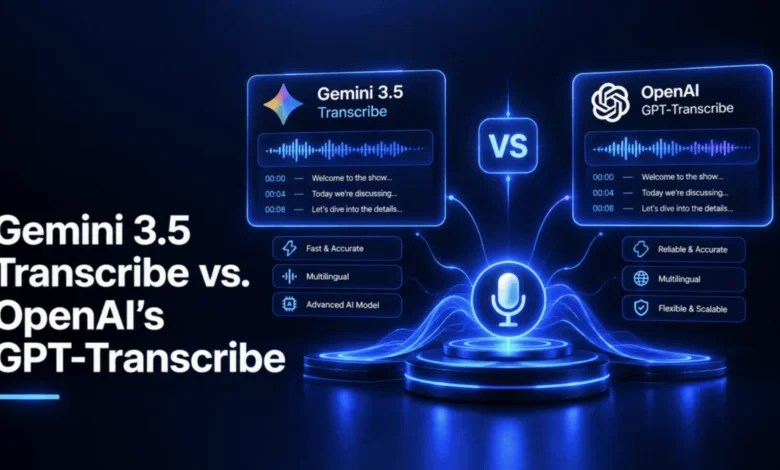
The artificial intelligence landscape witnessed a significant escalation in the battle for voice and audio dominance during the summer of 2026. Within a span of four weeks, the two leading forces in generative AI—Google and OpenAI—each unveiled their flagship audio-to-text transcription architectures. This rare, near-simultaneous product rollout has allowed enterprise developers, researchers, and product managers to conduct an unprecedented, direct evaluation of two competing paradigms in speech recognition.
OpenAI fired the opening salvo on July 28, 2026, with the commercial release of GPT-Transcribe, designed to supersede its legacy Whisper models and the transitional GPT-4o-transcribe iterations. Just under a month later, on August 26, 2026, Google countered with the official release of Gemini 3.5 Transcribe, a generational leap over its predecessor, Chirp 3. Because these platforms were developed and launched during the exact same technological window, they represent a true apples-to-apples comparison of contemporary AI capabilities, bypassing the generational performance gaps that typically skew benchmark analysis.
A Synchronized Race: Chronology of the 2026 Audio Rollouts
To understand the strategic positioning of both companies, one must examine the timeline leading up to their respective releases. For years, OpenAI’s Whisper served as the open-source backbone for audio transcription across the developer community. However, latency constraints, high compute requirements for edge deployment, and structural limitations in handling complex, multi-speaker environments necessitated a fundamental architectural redesign.
By March 2025, OpenAI introduced early iterations built on the GPT-4o framework, culminating in the July 28, 2026 deployment of GPT-Transcribe. This new model family explicitly restructured how audio is processed natively within OpenAI’s transformer architecture, focusing heavily on cost reduction, multi-language processing, and speed. Furthermore, OpenAI segmented the product line into a standard file-transcription endpoint (gpt-transcribe) and a low-latency real-time variant (gpt-live-transcribe).
Google, facing mounting competitive pressure in enterprise productivity tools and real-time voice assistants, accelerated its multimodal audio roadmap. Building on the foundational success of its Gemini architecture, Google developed Gemini 3.5 Transcribe to integrate seamlessly into its broader ecosystem, including the macOS Gemini application and enterprise cloud APIs. Shipped on August 26, 2026, the model split its offerings into gemini-3.5-transcribe for asynchronous file processing and gemini-3.5-transcribe-live for sub-second streaming via the Live API. This structural parity between the two competitors highlights an industry-wide consensus: modern speech-to-text infrastructure must simultaneously master high-throughput pre-recorded transcription and ultra-low-latency real-time streaming.
Architectural Deep Dive and Performance Metrics
When evaluating raw performance, both models present impressive benchmarks, though they optimize for fundamentally different engineering priorities.
Google’s Gemini 3.5 Transcribe places its primary emphasis on velocity and contextual intelligence. According to independent evaluations by Artificial Analysis cited in Google’s launch documentation, the model achieves a remarkable time-to-final-transcription speed improvement of 70% over its predecessor, Chirp 3. In terms of error rates, Gemini 3.5 Transcribe records a 4.0% word error rate (WER) for streaming applications and an exceptionally low 2.6% WER for non-streaming file processing. On the highly rigorous FLEURS multilingual benchmark—a standardized dataset designed to test speech recognition across diverse languages and accents—Google reported a 5.50% WER for streaming and 5.04% for non-streaming workflows.
Crucially, Google has integrated native multi-speaker attribution (diarization) and word-level timestamps directly into the base file model. Without requiring secondary models or complex post-processing pipelines, the system can reliably distinguish up to three distinct speakers out of the box, with experimental support for larger panels. Coupled with support for over 85 languages, custom vocabulary recognition, and native function calling—allowing the model to delegate subsequent tasks like data visualization or file analysis to other Gemini variants—the platform functions more as an audio intelligence suite than a simple transcription tool.
OpenAI’s GPT-Transcribe approaches the benchmark challenge from a cost-efficiency and raw-accuracy improvement angle. Built as the direct successor to whisper-1 and gpt-4o-transcribe, OpenAI’s offering demonstrates substantial gains over legacy infrastructure. On OpenAI’s internal Common Voice evaluation across 22 languages, GPT-Transcribe nearly halved the word error rate of the original Whisper model, dropping from 40.37% down to 19.27%.
Priced aggressively at $0.0045 per minute for file transcription and $0.017 per minute for session audio in its streaming configuration (gpt-live-transcribe), OpenAI offers a 25% cost reduction compared to previous iterations. The model supports extensive keyword and language hints to assist with domain-specific jargon, technical terminology, and code-switching scenarios. However, an objective examination of its architecture reveals a notable functional gap: plain GPT-Transcribe does not natively execute speaker diarization or output word-level timestamps. Enterprise users requiring speaker attribution must still route their data through a separate pipeline, such as gpt-4o-transcribe-diarize, or revert to legacy whisper-1 models for granular timestamp generation.
Practical Implementation: Developer Workflows
To evaluate how these theoretical advantages translate into practical application, developers must examine the integration patterns required for each platform. The following use cases highlight the distinct operational characteristics of Gemini and OpenAI in production environments.
Implementing Gemini 3.5 Transcribe for Multi-Speaker Meetings
For enterprise workflows involving corporate boardrooms, customer service call logs, or multi-party podcasts, identifying individual speakers is non-negotiable. Gemini 3.5 Transcribe simplifies this workflow by consolidating transcription, diarization, and timestamping into a single API call.
from google import genai

client = genai.Client(api_key="YOUR_GOOGLE_API_KEY")

with open("meeting_recording.mp3", "rb") as f:
    audio_bytes = f.read()

response = client.models.generate_content(
    model="gemini-3.5-transcribe",
    contents=[
        "text": "Transcribe this meeting with speaker labels and timestamps.",
        "inline_data": "mime_type": "audio/mp3", "data": audio_bytes,
    ],
)
print(response.text)
In this implementation, raw audio bytes are transmitted alongside natural language instructions. Because the underlying model natively understands conversational context, the resulting output automatically demarcates individual participants—labeling them as Speaker 1, Speaker 2, and Speaker 3—complete with precise temporal markers. This eliminates the multi-stage engineering overhead traditionally required to clean and parse audio data before feeding it into a Large Language Model for summarization.
Implementing GPT-Transcribe for Live Captioning
Conversely, applications demanding instantaneous feedback—such as real-time broadcast captioning, live event translation, or interactive voice bots—prioritize latency and streaming stability over multi-speaker separation. OpenAI’s WebSocket-based architecture is purpose-built for these scenarios.
import asyncio
import websockets
import json

async def stream_captions(audio_chunks):
    uri = "wss://api.openai.com/v1/realtime?intent=transcription"
    headers = "Authorization": "Bearer YOUR_OPENAI_API_KEY"

    async with websockets.connect(uri, extra_headers=headers) as ws:
        await ws.send(json.dumps(
            "type": "transcription_session.update",
            "session": "input_audio_transcription": "model": "gpt-live-transcribe",
        ))

        for chunk in audio_chunks:
            await ws.send(json.dumps(
                "type": "input_audio_buffer.append",
                "audio": chunk,
            ))
            message = await ws.recv()
            event = json.loads(message)
            if event.get("type") == "conversation.item.input_audio_transcription.delta":
                print(event["delta"], end="", flush=True)
This streaming protocol establishes a persistent, low-latency connection. As audio buffers are continuously appended, gpt-live-transcribe returns incremental text fragments via delta events while the speaker is actively talking. This allows client-side interfaces to update live captions dynamically without waiting for audio file finalization.
Comparative Overview
| Feature / Metric | Gemini 3.5 Transcribe | OpenAI GPT-Transcribe |
|---|---|---|
| Release Date | August 26, 2026 | July 28, 2026 |
| Direct Predecessor | Chirp 3 | gpt-4o-transcribe / Whisper |
| Streaming Endpoint | gemini-3.5-transcribe-live |
gpt-live-transcribe |
| File Endpoint | gemini-3.5-transcribe |
gpt-transcribe |
| Word Error Rate (WER) | 4.0% streaming / 2.6% non-streaming | ~19.27% on Common Voice (vs 40.37% legacy) |
| Language Support | 85+ languages | 22+ benchmarked languages with keyword hinting |
| Speaker Diarization | Native (up to 3 speakers reliably) | Requires separate diarization model |
| Word-Level Timestamps | Native / Built-in | Requires legacy whisper-1 integration |
| File Pricing | Enterprise tier dependent | $0.0045 per minute |
| Streaming Pricing | Enterprise tier dependent | $0.017 per minute of session audio |
Broader Industry Implications and Market Impact
The introduction of Gemini 3.5 Transcribe and GPT-Transcribe signals a mature phase in the commercialization of speech AI. No longer treated as an auxiliary feature, transcription is now recognized as a vital multimodal entry point for artificial intelligence systems.
The divergence in architectural strategy between Google and OpenAI highlights two distinct market philosophies. Google’s approach favors vertical integration and feature consolidation. By baking diarization, timestamping, and cross-model function calling directly into the core transcription engine, Google is targeting enterprise customers seeking turn-key solutions for legal depositions, medical consultations, and corporate conferencing. The ability to bypass secondary microservices reduces total cost of ownership and architectural complexity for developers operating within the Google Cloud ecosystem.
OpenAI, meanwhile, continues to champion modular efficiency and raw economic accessibility. By offering highly competitive per-minute pricing ($0.0045 for files and $0.017 for streaming) alongside flexible keyword hinting, OpenAI positions GPT-Transcribe as an ideal engine for high-volume, cost-sensitive applications such as customer support call-center transcription, media localization, and high-speed live captioning. While developers must occasionally stitch together complementary endpoints for advanced attribution tasks, the sheer speed and affordability of OpenAI’s streaming models maintain their strong appeal for agile engineering teams.
Ultimately, the choice between Gemini 3.5 Transcribe and OpenAI’s GPT-Transcribe depends entirely on the operational constraints of the deployment. Organizations managing complex, multi-party conversations will find Google’s native diarization and low error rates a compelling differentiator. Conversely, projects requiring high-speed, cost-effective single-speaker transcription or real-time streaming interfaces will continue to find immense value in OpenAI’s streamlined architecture. As the technology continues to evolve, this intense competition guarantees that the barriers separating human auditory comprehension from machine intelligence will continue to dissolve at an unprecedented pace.