The Tiny Language Model: Demystifying the Inner Workings of AI Language Generation

The creation of a diminutive yet remarkably transparent language model, built entirely in JavaScript without the aid of popular deep learning frameworks like TensorFlow or PyTorch, offers a rare glimpse into the fundamental mechanics of modern artificial intelligence. This project, accessible via the GitHub repository tiny-language-model-neuro-js, strips away the layers of abstraction typically found in complex AI systems, revealing each mathematical operation and computational step in stark clarity. The developer, Maksim Sekretov, aimed to create a scenario where "every scalar is visible," allowing observers to witness the transformation from incorrect, random outputs to accurate, learned responses.
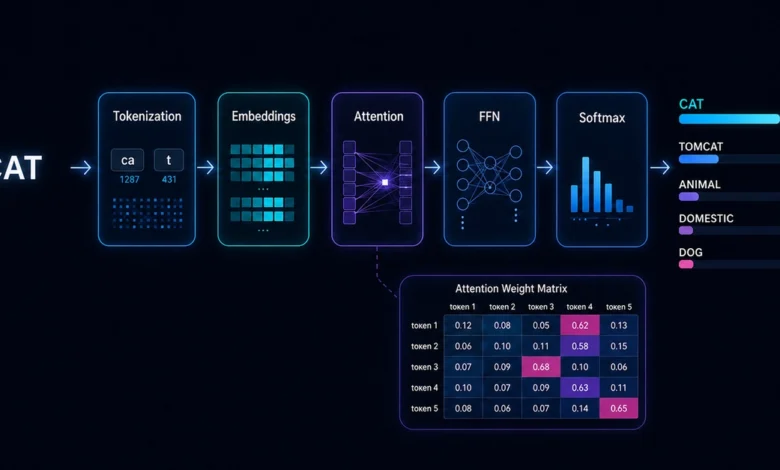
At its core, the project tackles the intricate processes involved in language modeling, from the initial tokenization of text to the final probability distribution of the next word. The journey involves a series of sophisticated concepts, including tokenization, embeddings, causal Transformers, language model heads, softmax functions, loss calculations, and backpropagation. By eschewing established frameworks, Sekretov forces an examination of each component, demonstrating that the sophisticated behaviors of large language models (LLMs) are built upon a foundation of elementary mathematical operations and carefully orchestrated data flows.
The command-line interface for the project, node src/train.js --generalize --adaptive-teach, initiates a training process that culminates in observable improvements in the model’s predictive capabilities. When queried immediately after random initialization, the model exhibits outputs that are largely nonsensical. For instance, when asked "can human read?", it might produce gibberish like "? …", far removed from the expected "human can read." Similarly, questions about a fish’s ability to swim or a cat’s capacity to read are met with equally inaccurate predictions.
However, after undergoing a multi-phase training regimen—comprising pre-training, supervised fine-tuning (SFT), and adaptive SFT—the same model demonstrates a remarkable grasp of the learned relationships. The previously random queries now yield correct answers: "human can read.", "fish can swim.", "bird can fly.", and crucially, "cat cannot read." This dramatic shift underscores the power of iterative learning and the ability of neural networks to discern and encode patterns from data. The project highlights that these learned behaviors are not inherent but are the result of the training process adjusting the model’s internal parameters.
Unpacking the Core Components: A Modular Approach
Sekretov’s deliberate choice to eliminate familiar frameworks was driven by a desire for pedagogical clarity. The project’s architecture, stripped of extraneous modes and debug functionalities, presents a streamlined pipeline: text is first broken down into word tokens and then converted into token IDs. These IDs are then transformed into numerical representations through token and position embeddings, which capture both the identity of the word and its placement within a sequence.
These embedded representations then feed into two causal Transformer blocks. Each block is a sophisticated mechanism comprising multi-head self-attention and a feed-forward network (FFN) with two hidden layers. The self-attention mechanism allows the model to weigh the importance of different tokens in the input sequence when generating a prediction, while the FFN further processes these contextualized representations. Following the Transformer blocks, an LM head transforms the processed information into probabilities for the next token using a softmax function. The entire process is then optimized through a cross-entropy loss function, with gradients calculated via backpropagation and applied using the Adam optimizer.
The foundation of this entire computational graph is the Value class. Each numerical value involved in the learning process—whether it’s an input, a weight, a gradient, or an intermediate calculation—is encapsulated as a Value object. This object stores not only its numerical data but also its gradient, children (the Value objects from which it was derived), and a backward function. This backward function is crucial; it defines how the gradient should flow from this Value to its children during the backpropagation phase, effectively building the computational graph dynamically.
For instance, when two Value objects, a and b, are multiplied to produce y (i.e., y = a * b), the Value object for y stores the information that its gradient with respect to a is b, and its gradient with respect to b is a. This local derivative information, along with the chain rule, allows the backward() method to traverse the graph from the final loss to the initial parameters, calculating the gradient for every weight and bias.
Neurons and Layers: Building Blocks of Intelligence
The concept of a neuron, often abstracted within tensor operations, is here presented as a concrete object. The fundamental formula for a neuron’s output—output = activation(sum(input[i] * weight[i]) + bias)—is directly translated into code. The forward method of a neuron object takes an array of input Value objects, performs the weighted sum with its internal weights, adds the bias if applicable, and then applies an activation function like ReLU.
A Linear layer, a common component in neural networks, is then simply represented as an array of these neuron objects, all receiving the same input. While this approach is computationally less efficient than optimized matrix multiplication found in production systems, it offers unparalleled transparency. This modularity allows developers and learners to trace the flow of data and gradients through each individual neuron, demystifying the complex interplay of weights and activations.
Embeddings and the Emergence of Meaning
Embeddings are pivotal in language models, converting discrete tokens into dense numerical vectors that capture semantic relationships. In this project, each token’s representation is a combination of its tokenEmbedding and its positionEmbedding. Initially, these embeddings are populated with random values. It is through the iterative process of training, driven by gradient descent, that these random values evolve to represent meaningful relationships between words. The model doesn’t "know" that "cat" is an animal; rather, the gradients from training examples teach it to associate the "cat" embedding with certain contexts and subsequent words. This process illustrates that meaning in LLMs is an emergent property of statistical correlations learned from vast amounts of data.
Self-Attention: The Power of Contextual Understanding
The Transformer architecture, the backbone of most modern LLMs, relies heavily on the self-attention mechanism. For each token in a sequence, self-attention computes three vectors: Query (Q), Key (K), and Value (V), derived by multiplying the token’s representation with learned weight matrices (Wq, Wk, Wv). The "score" is calculated by taking the dot product of the Query vector with the Key vectors of all other tokens, scaled by the square root of the headSize (a hyperparameter).
This score is then passed through a softmax function to produce attention weights, indicating how much attention each token should pay to every other token. Finally, these attention weights are used to compute a weighted sum of the Value vectors, producing the output of the self-attention layer. A critical aspect of causal language models, like the one developed here, is the implementation of a causal mask. This ensures that during the attention calculation, a token can only attend to itself and preceding tokens in the sequence, preventing it from "seeing" future words it is supposed to predict.
Following the self-attention mechanism, each token’s representation is further processed by a feed-forward network, typically consisting of two layers with ReLU activations. Residual connections and layer normalization are employed around both the attention and FFN layers to ensure stable information flow and prevent vanishing or exploding gradients during training.
The Learning Loop: From Loss to Prediction
The entire learning process is orchestrated by the learnOneToken function. This function orchestrates the core steps of a training iteration: calculating the loss, performing backpropagation to compute gradients, and updating the model’s parameters using an optimizer. The loss function used is the standard cross-entropy loss, which quantifies the difference between the model’s predicted probability distribution for the next token and the actual target token. A high loss indicates that the model assigned a low probability to the correct next word, signaling a need for parameter adjustment.
Backpropagation then takes this loss signal and propagates it backward through the computational graph, calculating the gradient of the loss with respect to each parameter (weights and biases). The Adam optimizer then uses these gradients to update the parameters, nudging them in a direction that minimizes the loss. This iterative cycle of forward pass, loss calculation, backpropagation, and parameter update is the engine that drives the model’s learning.
A Phased Approach to Learning
The project employs a three-phase training strategy to build the model’s capabilities:
Phase 1: Pre-training
This initial phase focuses on learning basic language structure and common factual relationships. The model is trained on a small corpus containing 14 explicit ability relations, such as "human can read." Notably, a specific relation ("cat cannot read") is intentionally omitted from the initial dataset. The model’s task is to predict the next token in sequences drawn from this corpus, learning the statistical regularities of language.
Phase 2: Supervised Fine-Tuning (SFT)
In this phase, the model is exposed to prompt-answer pairs derived from the pre-training data. For example, a statement like "fish can swim." might be transformed into questions like "can fish swim?", "is fish able to swim?", and "does fish know how to swim?". The SFT phase trains the model to generate correct answers to these specific questions. Crucially, only the answer tokens contribute to the SFT loss, focusing the learning on generating coherent and accurate responses.
Phase 3: Adaptive SFT
This advanced phase addresses the missing "cat cannot read" fact. Six different question variants are presented, all expecting the same target answer: ['cat', 'cannot', 'read', '.']. This is direct supervision, where the model is explicitly taught this specific piece of information. The training continues until the model not only learns this new fact but also consistently demonstrates high confidence (over 95% probability for target tokens) and maintains this performance over multiple evaluation cycles.
Mitigating Catastrophic Forgetting
A significant challenge in sequential learning is catastrophic forgetting, where a model trained on new data loses its ability to perform tasks it learned previously. An early implementation of this project demonstrated this phenomenon starkly: after training on the "cat cannot read" prompts, the model began to output this answer even for unrelated questions about humans or fish.
The solution implemented is "rehearsal." During the adaptive SFT phase, the model is also periodically presented with the original 14 "can … ?" examples. This ensures that the model continuously reinforces its knowledge of established facts while learning new ones. The final evaluation criterion requires correctness across both the newly learned facts and the previously established ones, preventing the model from sacrificing old knowledge for new.
Transparency in Logging and Analysis
The project generates a comprehensive training-log.txt file, providing an unprecedented level of detail about the training process. This log is not a mere dump of raw data but a narrative record of every forward pass, loss calculation, backward pass, and parameter update. It captures the state of all model matrices at three key checkpoints: initial random state, post-pre-training/SFT, and final adaptive SFT.
For each transition between these checkpoints, the log records the resulting matrices and their exact delta (the change from the previous state). This granular view allows for a deep analysis of how specific layers and parameters are modified during training. For example, it highlights the largest concrete changes in weights and biases, pinpointing the specific layer, neuron, and weight that underwent the most significant adjustment. This level of transparency is invaluable for understanding the inner workings of neural networks and debugging learning processes.
The Road Ahead: Scale vs. Understanding
While the architecture and learning principles of the tiny-language-model-neuro-js are directly applicable to production LLMs, the scale is intentionally minuscule. The project features a vocabulary of only 24 word tokens, around 2,160 parameters, and just two Transformer blocks. In contrast, production LLMs boast massive subword or byte vocabularies, billions of parameters, and tens or hundreds of Transformer layers. Furthermore, while this project uses a scalar JavaScript graph, production models leverage highly optimized, batched tensor operations on specialized hardware like GPUs and TPUs.
The goal of this project is not to compete with state-of-the-art LLMs but to serve as an educational tool. By reducing the complexity to its bare essentials, it offers a clear, mental model of the entire language generation pipeline: from token to embedding, through attention and FFN layers, to probability, loss, gradient, and updated weights. This detailed view demystifies the "magic" of LLMs, revealing them as sophisticated but ultimately understandable computational systems. The repository serves as a testament to the power of understanding fundamental principles, offering a valuable resource for anyone seeking to grasp the mechanics behind artificial intelligence’s most impactful advancements.