Google Cloud Unveils Self-Learning Context Enrichment and Reimagined Knowledge Studio to Supercharge Enterprise AI Agents

In an era where artificial intelligence agents are rapidly shifting from experimental pilot projects into foundational pillars of enterprise operations, the primary bottleneck facing organizations is no longer algorithmic capability, but contextual accuracy. Recognizing this critical challenge, Google Cloud has officially announced the preview launch of self-learning context enrichment and a fully reimagined Knowledge Studio experience within its flagship Knowledge Catalog platform. Designed to act as a centralized context engine for enterprise agents, these new features aim to solve a pervasive problem in modern software deployment: ensuring that large language models and autonomous agents possess accurate, up-to-date, and organization-specific definitions, rules, and data relationships.
For years, the development of enterprise AI has been hamstrung by the labor-intensive nature of context curation. Historically, data stewards and context engineers have had to manually write prompts, map schemas, and update database definitions agent by agent. While this handcrafted approach is manageable when an organization deploys a handful of conversational tools, it rapidly breaks down as enterprises scale their agentic capabilities to thousands—and eventually millions—of distinct interactions. Outdated definitions, misaligned metric calculations, and scattered documentation frequently lead to hallucinations, lowered user trust, and operational inefficiencies. Google Cloud’s latest release addresses this scaling wall head-on by automating the lifecycle of enterprise knowledge through advanced artificial intelligence.
The Evolution of Enterprise Context Management
To understand the significance of Google Cloud’s announcement, one must examine the rapid evolution of enterprise artificial intelligence over the past several years. Initially, organizations focused heavily on model selection, debating the merits of proprietary versus open-source architectures and optimizing inference costs. However, as generative AI matured, enterprises quickly realized that a model is only as reliable as the data and rules it reasons over. Without a unified corporate vocabulary, an AI agent queried about financial performance might conflate gross revenue with net revenue, leading to costly compliance and reporting errors.
Static data catalogs and manual knowledge management systems have historically failed to bridge this gap. Subject matter experts simply do not have the time to document every table, column, and business logic modification across corporate repositories. Consequently, the moment a finance team revises partner credit policies or an engineering group updates a database schema, static definitions fall out of sync. Agents relying on hardcoded formulas inevitably begin outputting incorrect answers.
Google’s Knowledge Catalog, powered by Gemini technology, seeks to transform this static inventory into a dynamic, living ecosystem. By shifting from manual upkeep to a continuous feedback loop, the platform promises to redefine how organizations govern and supply context to their automated systems.
Mechanics of Gemini-Powered Self-Learning Enrichment
At the heart of the new release is self-learning context enrichment, a capability engineered to scour an organization’s dispersed knowledge repositories—including documents, code repositories, and structured databases—and synthesize them into governed, reusable context sets.
The system operates by connecting simultaneously to first-party and third-party structured data sources alongside unstructured repositories such as Google Cloud Storage, Google Workspace, GitHub, Confluence, and SharePoint. When deployed, the enrichment engine automatically extracts, assembles, and maintains business knowledge. It links unstructured sources, such as policy wikis and financial playbooks, directly to structured metadata within the Knowledge Catalog, drastically improving the discoverability and operational utility of enterprise databases.
Crucially, the system does not rely solely on initial ingestion. It continuously analyzes interaction traces from Gemini agents, Conversational Analytics in BigQuery, and custom-built enterprise agents. By parsing these traces—while ensuring the strict redaction of personally identifiable information (PII)—the enrichment engine identifies friction points. Whether an agent struggles with ambiguous column lookups, ungrounded metrics, or recurring user rephrasings of the same query, the tool pinpoints the root cause, retrieves the authoritative answer from underlying repositories, and stages a verified fix.
According to internal benchmarks cited by Google Cloud, this level of automated context grounding yields dramatic performance improvements. Organizations leveraging Knowledge Catalog report making AI agents nearly four times more accurate, achieving up to 33 percent lower latency, and consuming up to 75 percent fewer tokens during inference. By sparing agents from processing bloated prompts and raw, unstructured schemas, businesses can significantly reduce computational overhead while enhancing response reliability.
Balancing Automation with Strict Governance
While automation is vital for scaling enterprise AI, enterprise IT leaders remain fiercely protective of data governance, security, and compliance. Recognizing that full autonomy without oversight introduces unacceptable risks, Google Cloud has built granular controls into the self-learning enrichment framework.
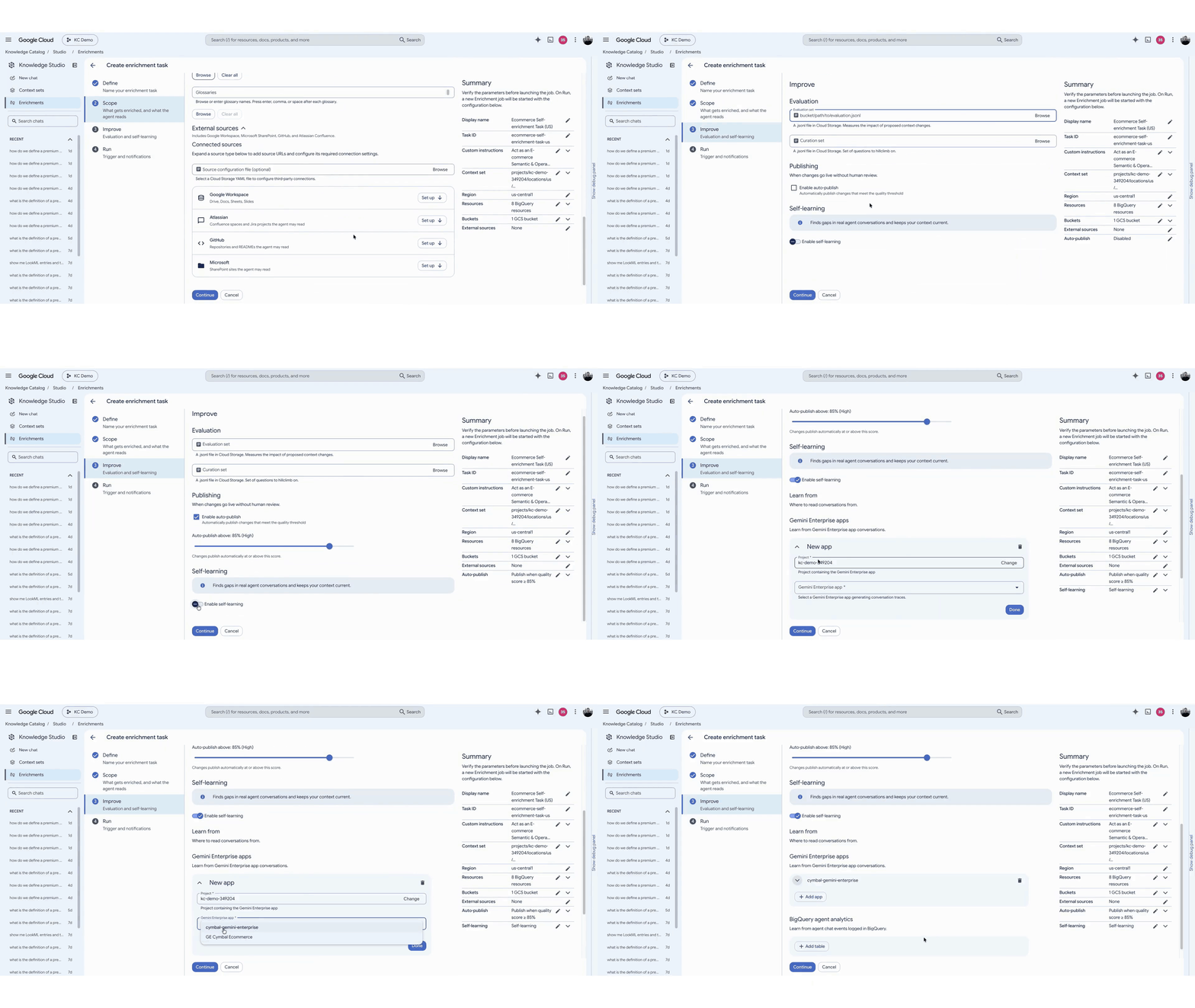
Administrators retain absolute authority over how proposed changes are published. Organizations can enable or disable auto-publishing at will and establish precise confidence score thresholds—such as an 85 percent certainty requirement—before any proposed change is automatically approved. Any alteration falling below the established threshold, as well as sensitive modifications like deletions, is automatically routed as a Change Request. Data stewards can then review, edit, or reject these proposals within an intuitive interface.

Furthermore, enterprises can supply their own evaluation sets to rigorously test proposed updates end-to-end prior to deployment. Every modification made within the catalog is logged with full provenance, ensuring that changes can be audited or rolled back instantaneously if unexpected behavior occurs. True to Google’s enterprise security commitments, customer data and interaction traces are never used to train foundational Google models, safeguarding proprietary intellectual property.
Context Sets: Tailoring Information for Diverse Audiences
Within a large enterprise, a single, monolithic context graph can quickly become unwieldy. Different departments—such as sales, marketing, engineering, and finance—often require entirely different interpretations of the same business terms. To resolve this, Knowledge Catalog introduces context sets, which are curated, governed subsets of the overarching context graph.
Context sets contain the specific definitions, metrics, join logic, and golden queries tailored to a particular domain, team, agent, or user group. For example, a sales-oriented agent can be bound exclusively to the Sales context set, ensuring it reasons over sales-specific pipelines and definitions, while a financial analyst’s assistant operates within the Finance context set. This architecture allows conflicting or specialized definitions—such as varying regional interpretations of net revenue—to coexist peacefully within the same centralized catalog.
Access to these context sets is strictly managed via Identity and Access Management (IAM) protocols, ensuring that agents and users only retrieve context they are explicitly authorized to access. Underlying data permissions remain completely intact. Moreover, because context sets are built on the Open Knowledge Format (OKF), organizations maintain complete data portability, allowing them to import and export OKF bundles seamlessly across platforms.
Knowledge Studio: The Command Center for Context Engineering
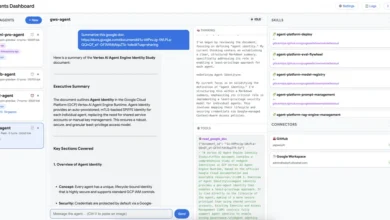
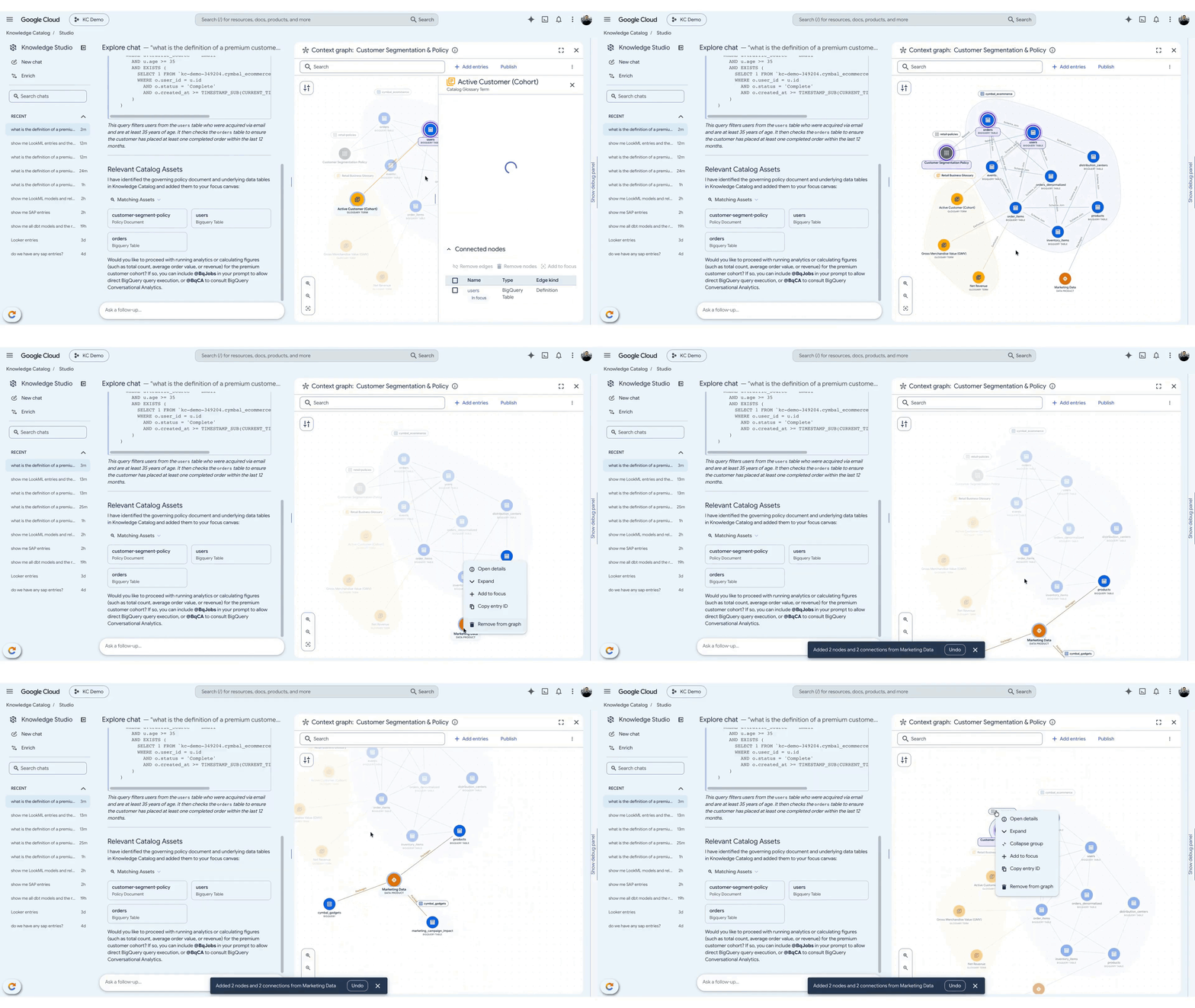
To manage this intricate web of data, definitions, and automated enrichments, Google Cloud has introduced a reimagined Knowledge Studio. Acting as the command center for context engineers and data stewards, Knowledge Studio transforms the Knowledge Catalog from a passive data repository into an interactive, visual workspace.
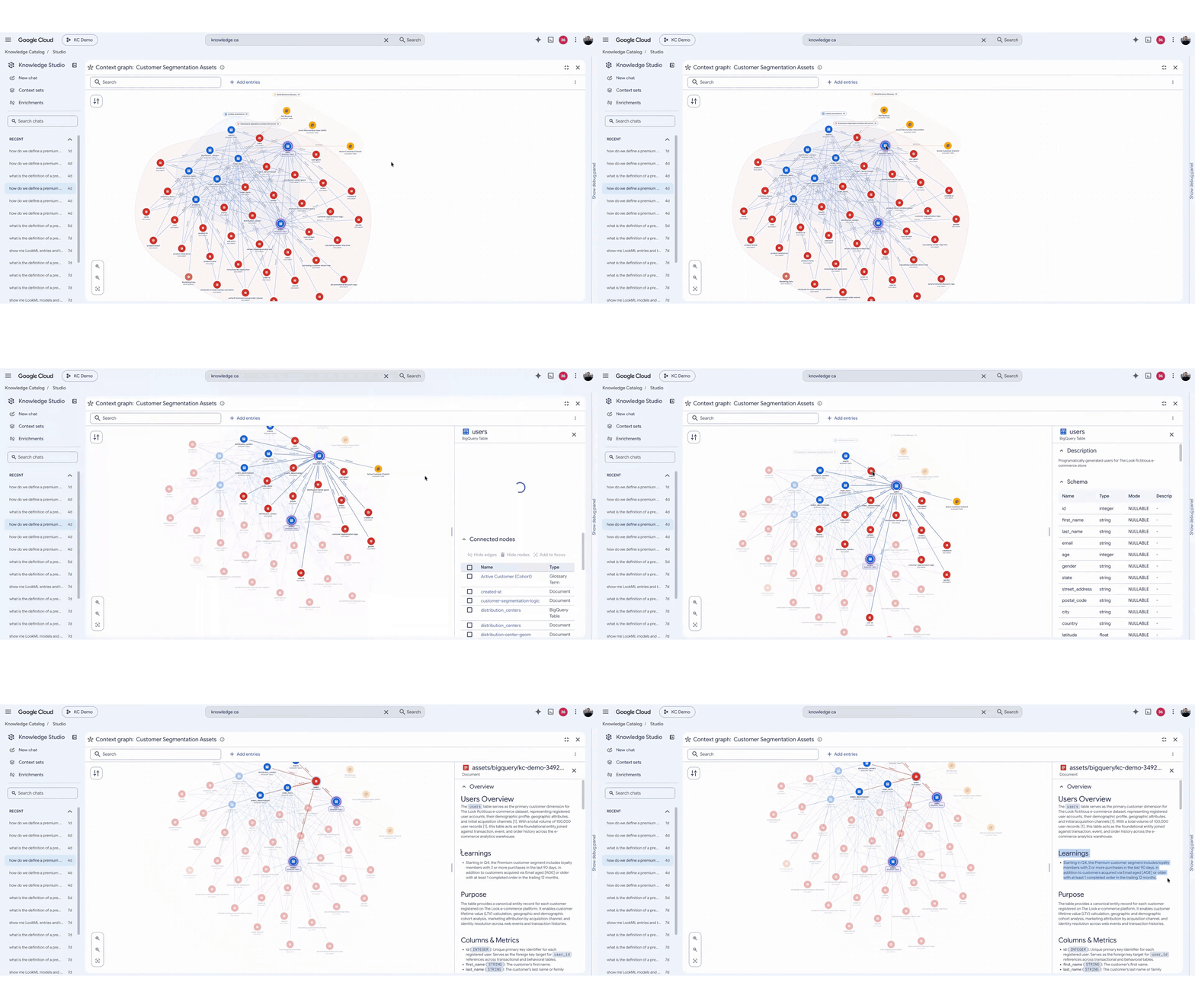
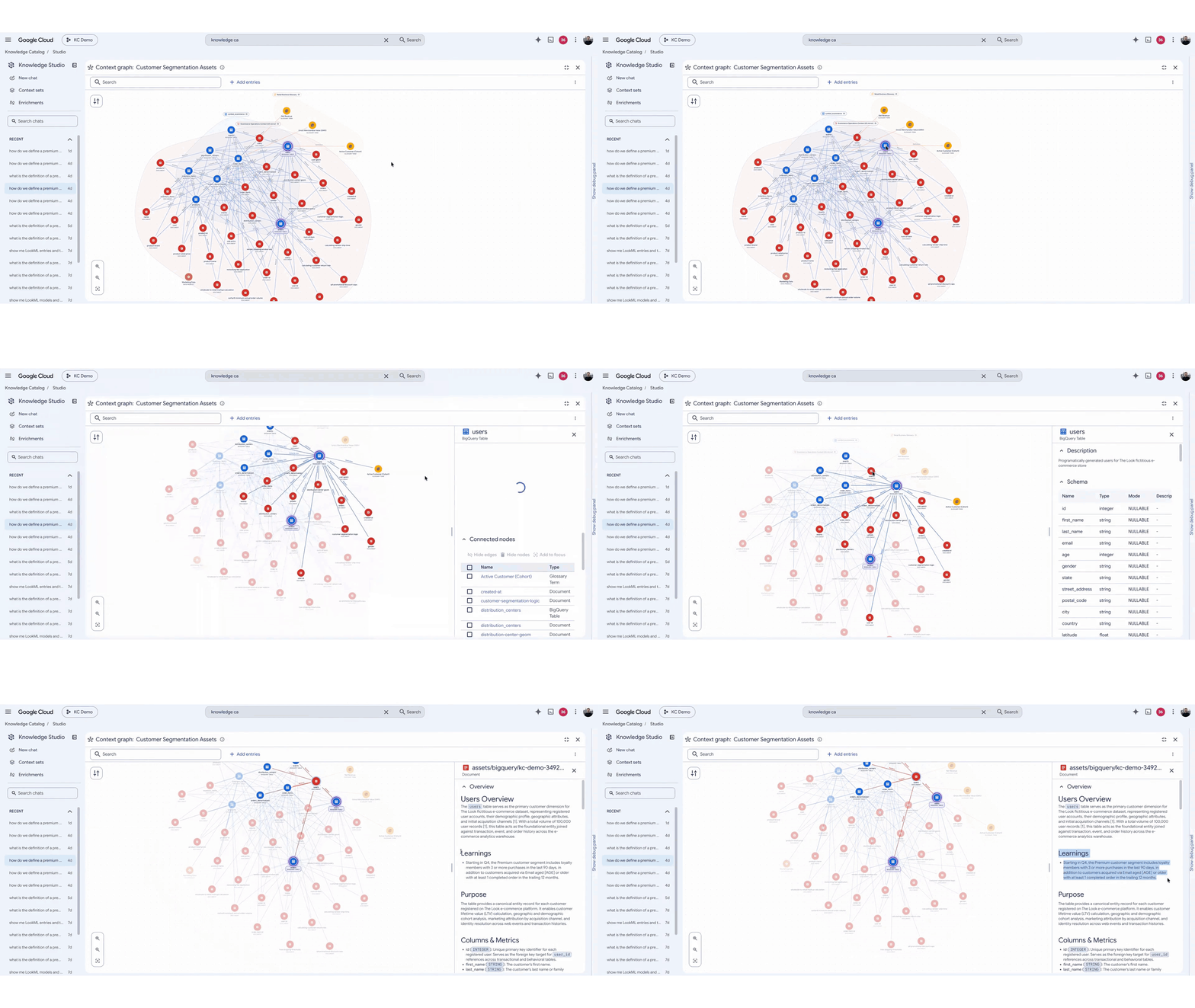
Through Knowledge Studio, data professionals can explore their organization’s data estate conversationally, navigate a dynamic visual context graph, and review detailed change diffs and confidence scores before publishing updates. The interface is designed to democratize context engineering, moving the discipline away from writing complex prompts and manual mapping files toward a supervisory role where experts evaluate, refine, and approve AI-generated insights.
Industry Implications and Future Outlook
The launch of self-learning context enrichment and Knowledge Studio arrives at a pivotal juncture in the enterprise adoption of artificial intelligence. As corporate boards demand measurable return on investment from their AI initiatives, the focus has shifted firmly toward production-grade reliability, security, and scalability.
By addressing the foundational layer of AI reasoning—the contextual environment—Google Cloud is positioning Knowledge Catalog as a critical infrastructure component for the agentic enterprise. Industry analysts note that as companies scale their deployment of autonomous agents to handle complex, multi-step workflows, the ability to maintain dynamic, self-healing knowledge bases will separate successful AI deployments from stalled pilot projects.
Rollout and Availability
Google Cloud has announced that these new features will begin rolling out to customers globally over the coming weeks. Organizations eager to test the capabilities can sign up for immediate access via Google’s designated preview program, while comprehensive documentation and step-by-step implementation guides are available on the official Google Cloud documentation portal. As enterprises increasingly transition toward agent-driven workflows, tools like Knowledge Catalog and Knowledge Studio are poised to become standard infrastructure for managing the complex interplay between human knowledge and machine intelligence.