The Digital Land Rush Meets Environmental Justice: Why American Communities Are Drawing the Line on AI Data Centers

Across the United States, an intense civic debate is unfolding over the rapid physical expansion of the artificial intelligence boom. As tech giants and specialized infrastructure developers race to secure real estate for massive data centers, they frequently pitch their projects to local municipalities with promises of high-tech jobs, substantial tax revenues, and broad economic revitalization. However, this optimistic messaging has failed to convince a majority of Americans. Recent national polling indicates that most citizens oppose the construction of data centers in their immediate geographic areas, driven largely by mounting anxieties over severe environmental degradation, excessive water consumption, and overstressed electrical grids.
For grassroots organizers like Shawmar Pitts, these worries are far from theoretical abstract concepts. Pitts, who serves as the managing co-director of the Philadelphia-based environmental justice organization Philly Thrive, understands intimately what it means to live in the shadow of heavy American industrialization. Born and raised in the Grays Ferry neighborhood of Southwest Philadelphia, Pitts spent his formative years residing directly adjacent to the East Coast’s largest oil refinery—a massive industrial footprint that fundamentally shaped the health and landscape of the local community.
The Legacy of Heavy Industry in Grays Ferry
The industrial reality of Grays Ferry became starkly personal for Pitts long before the current wave of technological expansion. For decades, the Philadelphia Energy Solutions (PES) refinery dominated the local skyline, processing up to 335,000 barrels of crude oil daily. While many of Pitts’s friends, family members, and neighbors suffered from chronic respiratory illnesses, cancers, and other severe health conditions, the systemic root causes remained obscured until 2018. That year, activists from Philly Thrive set up a neighborhood information table warning residents about a proposed expansion of the oil refinery.

Pitts recalled reviewing the literature detailing how toxic emissions and industrial proximity correlate with specific chronic ailments. Scanning the provided lists, he experienced a jarring realization. His mother, his sister, and his next-door neighbor all suffered from afflictions explicitly cataloged in the environmental health reports. In nearly every household on his block, a family member was battling a serious illness. That moment of clarity transformed Pitts into a dedicated environmental justice advocate, locking him into a lifelong fight against industrial encroachment.
The dangers of that industrial proximity were underscored tragically in June 2019, when a catastrophic series of explosions ripped through the PES refinery, sending massive fireballs into the sky and releasing toxic hydrogen fluoride into the atmosphere. Although the disaster thankfully resulted in no fatalities, the facility was forced to shut down permanently, transforming the sprawling industrial wasteland into a focal point for future redevelopment debates.
A New Industrial Threat: The AI Infrastructure Boom
Today, the battlegrounds have shifted from traditional petroleum extraction to the insatiable power demands of the digital age. City planners and real estate developers in Philadelphia have begun evaluating potential sites for a new wave of industrial infrastructure: AI data centers. While municipal officials have not yet received formal construction proposals, planning documents have highlighted two primary locations under consideration—one in Northeast Philadelphia and another directly in Pitts’s home neighborhood of Grays Ferry.
This local friction is part of a nationwide phenomenon. Communities across the United States are increasingly pushing back against data center proposals, particularly in municipalities where historical infrastructure has already depleted local resources. The pushback is especially fierce in historically marginalized neighborhoods that have borne the brunt of past industrial pollution.

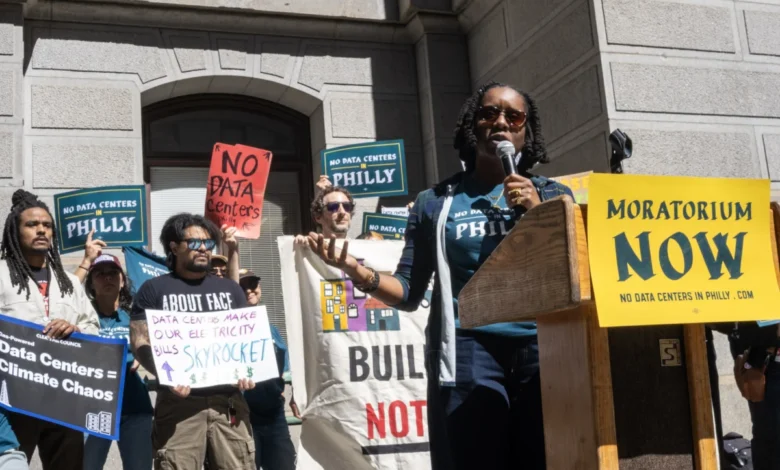
During a spirited rally held outside Philadelphia’s City Hall, Philly Thrive board president Sonya Sanders voiced the community’s collective outrage. Sanders, who also grew up alongside the Grays Ferry refinery, lost her husband to a rare bone cancer in 2020. A lifelong non-smoker and non-drinker, her husband’s untimely death cemented her conviction that toxic industrial emissions are lethal. Addressing the crowd gathered at City Hall, Sanders pulled no punches regarding the human cost of corporate profit-seeking. In her view, the persistent pollution of her neighborhood acted as a silent executioner, cutting short the life of a man she believes would be alive today if not for the pursuit of industrial expansion at the expense of human health.
The Staggering Resource Footprint of Modern Computing
While proponents argue that a modern data center does not emit the same volume of toxic crude oil processing byproducts as a defunct petroleum refinery, the sheer scale of the artificial intelligence boom introduces unprecedented environmental challenges. The international race among tech conglomerates to achieve dominance in artificial intelligence has triggered an unprecedented demand for computational power, which directly translates into astronomical energy consumption.
According to long-term projections published by BloombergNEF, U.S. data centers are on track to consume more natural gas than the combined national totals of Germany and Japan by the year 2035. This revised forecast nearly doubles the research firm’s own projections issued just nine months prior, illustrating how rapidly the AI infrastructure landscape is expanding.
Although natural gas burns more cleanly than traditional heavy petroleum, it remains a potent driver of climate change. Combustion of a single cubic foot of natural gas releases approximately 60 grams of carbon dioxide. Analysts estimate that surging data center power demands will generate an additional one million metric tons of greenhouse gas emissions daily—accounting for roughly 12 percent of all contemporary U.S. greenhouse gas output. These emissions exacerbate global warming and accelerate climate instability, directly feeding into more frequent and severe extreme weather events, such as prolonged summer heatwaves.

Furthermore, environmental legal experts note that modern data centers rely heavily on massive arrays of backup diesel generators to maintain uninterrupted uptime. Annie Fox, an attorney with the Clean Air Council, highlighted the local air quality risks during the Philadelphia City Hall rally. Fox pointed out that standard data center blueprints in Pennsylvania incorporate hundreds of heavy diesel engines designed to emit localized air pollution. Under stress-tested grid conditions, local and regional authorities have increasingly pressured operators to utilize these fossil-fueled generators during peak heatwaves to prevent regional blackouts, directly worsening local air pollution burdens in surrounding neighborhoods.
A National Wave of Moratoriums and Pushback
Philadelphia is far from an isolated case. Across the United States, a growing wave of municipal and state governments is pumping the brakes on data center development, responding directly to coordinated community activism.
In New York, Governor Kathy Hochul signed a high-profile executive order temporarily halting the state’s authorization of new permits for large-scale data center projects. Emphasizing the need for sustainable growth, Hochul stated during a press briefing that technological progress should never arrive at the expense of inflated utility bills, depleted local water supplies, or unbearable noise pollution, asserting that such facilities must only be built in communities that actively welcome them.
Similar policy interventions have swept across the country. Municipalities including Denver, Indianapolis, Asheville, Charlotte, and Reno have enacted formal moratoriums or temporary zoning pauses on new data center developments. These legislative pauses are generally designed to afford local governments adequate time to conduct comprehensive impact studies regarding water usage, electrical grid stability, and noise mitigation before committing to long-term zoning approvals.

Community Resilience and the Road Ahead
Back in Philadelphia, the "No Data Centers in Philly" campaign kicked off with a mobilization of more than 100 residents, activists, and legal advocates gathered outside City Hall. Chanting slogans and carrying informational banners, the demonstrators sought to ensure that city council members inside the municipal building heard their unified opposition to placing high-consumption infrastructure within residential zones.
Local residents like Donna Greenberg voiced multifaceted concerns, pointing not only to environmental pollution and greenhouse gas emissions, but also to secondary risks such as intensive water extraction, localized noise pollution from cooling fans, and data privacy implications tied to large-scale computational infrastructure.
For leaders like Shawmar Pitts, the turnout and collective solidarity represent a powerful testament to grassroots organizing. Reflecting on the mobilization, Pitts emphasized that standing up against corporate-driven industrial projects requires sustained collective effort and deep community trust. As the artificial intelligence industry continues its aggressive physical expansion, the friction between technological ambition and environmental justice will undoubtedly remain a defining domestic policy challenge for years to come.