Data professionals spend the vast majority of their working hours inside web browsers. Whether they are reading complex technical documentation, dissecting peer-reviewed research papers on arXiv, reviewing model cards, analyzing GitHub repositories, or synthesizing sprawling industry reports, the modern analytical workflow is fundamentally web-driven. In recent years, artificial intelligence assistants have integrated seamlessly into this environment, promising to streamline everything from code debugging to executive summaries. However, this convenience has come with a hidden operational cost: user privacy.
Mainstream browser AI tools—such as Google Chrome integrated with Gemini, standalone engines like Perplexity, or OpenAI’s ChatGPT embedded in pinned browser tabs—offer remarkable capabilities. Yet, their underlying data governance models frequently clash with the security requirements of enterprise environments. Consumer-grade Gemini implementations reserve the right to use conversational inputs to train and improve Google’s broader service ecosystem, with select interactions subject to human reviewer audits. Perplexity routes active page content and user queries directly to cloud-based servers for real-time processing. Similarly, ChatGPT defaults to utilizing user prompts for ongoing model training unless explicit opt-out measures are taken.
For casual web browsing or generic tasks, these concessions represent an acceptable trade-off. For data scientists, machine learning engineers, and quantitative analysts handling proprietary datasets, unreleased model architectures, client-confidential research, or sensitive business intelligence, however, these data-handling policies introduce significant compliance and security risks.
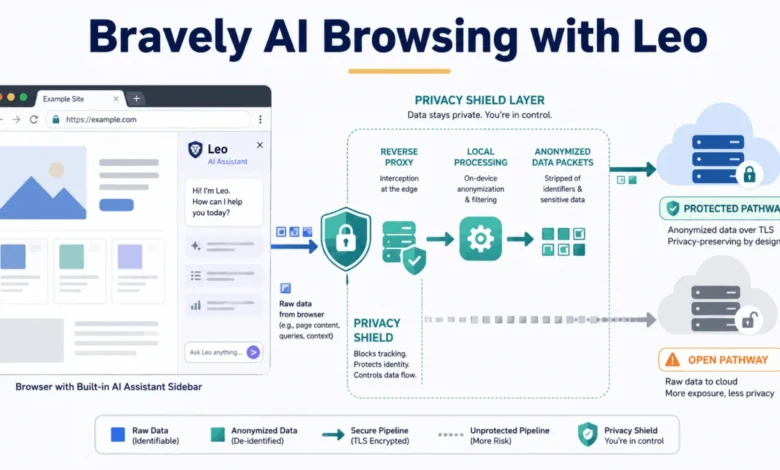
Enter Brave Leo, an alternative privacy-first AI assistant integrated natively into the Brave web browser. Rather than operating as a fragmented third-party extension or requiring a separate tab, Leo functions as a sidebar tool capable of parsing active web pages while enforcing strict data minimization standards. The free tier requires no account creation or formal user sign-up, offering a model lineup that bridges the gap between utility and confidentiality.
The Structural Privacy Deficit in Mainstream AI
To understand the market positioning of privacy-centric browsers, one must examine the divergent architectural approaches taken by major technology firms regarding user telemetry and data retention.
When deploying Chrome’s Gemini, Google’s official developer and consumer documentation explicitly cautions users against inputting sensitive corporate data or information they would not want external human reviewers to access. While on-device models like Gemini Nano attempt to mitigate this by executing locally, they often download silently in the background without granular consent frameworks. Standard consumer tiers default to harvesting inputs for machine learning refinement.
Conversely, Perplexity has established itself as an exceptional exploratory research engine, celebrated for its citation-backed, synthesis-driven search results. Yet, its operational framework remains staunchly cloud-first. Queries, contextual prompts, and scraped page data leave the user’s local machine for processing across remote server clusters. Apple’s Safari integration with Apple Intelligence presents a more privacy-respectable paradigm by emphasizing local hardware processing, but its walled-garden ecosystem restricts its utility to Apple hardware, effectively locking out enterprise environments running Windows or Linux distributions.
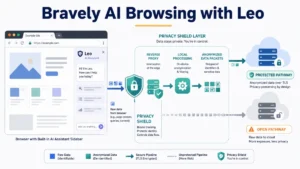
Brave Leo subverts this paradigm through a privacy-preserving reverse proxy architecture. When a user queries Leo, the system strips incoming IP addresses before requests reach the underlying large language models. Furthermore, conversational sessions are purged immediately after a response is generated, ensuring no persistent logs are maintained on Brave’s infrastructure. Because no account linkage is required for basic usage, and no user inputs are funneled into model training pipelines, the system establishes a stateless environment. Consequently, data professionals can paste proprietary code bases, analyze internal dataset schemas, or query unpublished academic pre-prints without fear of data leakage.
Evolution and Feature Architecture of the Brave AI Ecosystem
Brave has systematically expanded Leo’s capabilities since its initial rollout, evolving from a basic sidebar summarizer into a sophisticated, multi-model assistant. Available across Windows, macOS, Linux, Android, and iOS, Leo inherits the Chromium engine’s extension compatibility, making migration frictionless for Chrome power users.
The platform relies on a dual-tier structure. The free tier provides access to reliable open-source and efficient models capable of executing everyday documentation reviews, code explanations, and basic paper summaries without requiring financial or data commitments. For advanced computational tasks, Brave Leo Premium—priced at $14.99 monthly or approximately $12.50 monthly on an annual commitment—expands device coverage up to five terminals. Premium unlocks frontier architectures including variants of Anthropic’s Claude Sonnet, DeepSeek R1, and specialized domain models, alongside elevated rate limits during periods of high network traffic.
Crucially, the monetization model decouples payment credentials from chat telemetry. Brave utilizes a cryptographic token-based validation system that separates billing information from active browsing sessions, preserving user anonymity even for paying subscribers. Furthermore, local-first innovations such as the Brave Ocelot summarization model enable on-device inference for sensitive document reviews, ensuring that select workloads never leave the host machine. The platform also incorporates a Bring Your Own Model (BYOM) interface, allowing advanced engineers to connect local weights or proprietary API keys directly to the browser sidebar.
Core Analytical Workflows and Technical Capabilities
Leo’s defining technical characteristic is its native page-awareness. Unlike standalone chatbots that necessitate manual copy-pasting of text blocks, the assistant reads active browser tabs in real-time, functioning as an interactive document parser.
For researchers navigating lengthy arXiv preprints or dense technical documentation, Leo extracts evaluation metrics, training methodologies, and known limitations via structured prompt commands without persisting the source text. Similarly, the assistant natively processes PDFs opened within the browser, along with cloud-hosted Google Docs and Google Sheets. This capability allows analysts to interrogate third-party data dictionaries, assess sample size biases, or evaluate data collection parameters simply by querying the open document.
Media parsing represents another operational efficiency. By ingesting the transcript streams of open video tabs—such as academic conference presentations or technical tutorials—Leo can isolate core experimental setups, architectural breakthroughs, or final conclusions, allowing engineers to bypass lengthy playback in favor of targeted review. Code generation and architectural debugging are similarly streamlined, with the assistant capable of referencing surrounding documentation context to output compatible programming logic.
Advanced iterations of the platform have introduced multi-tab context integration, allowing the assistant to synthesize information across multiple open reference pages simultaneously. Tab Focus Mode restricts the model’s analytical scope to specific authoritative sources, while "Skills"—saved multi-step prompt chains—automate repetitive auditing and extraction tasks across disparate web assets. Early access iterations of agentic browsing further extend these capabilities, enabling autonomous multi-step execution within isolated browser environments.
Industry Implications and Strategic Integration
The emergence of privacy-first browser assistants underscores a broader maturation phase in enterprise artificial intelligence adoption. As organizations enforce stricter compliance mandates regarding data sovereignty and intellectual property protection, the reliance on ad-hoc cloud chatbots is facing institutional pushback.
Security analysts note that while general-purpose search engines like Perplexity remain unrivaled for public-domain exploratory research and real-time web citation gathering, they introduce unacceptable compliance exposure for internal proprietary workflows. Conversely, local execution models and zero-retention architectures like Brave Leo fill a critical operational niche, offering frontier-model capabilities without compromising data governance frameworks.
Nevertheless, industry observers emphasize that Leo is not a universal replacement for all AI tooling. The assistant lacks autonomous web-crawling capabilities equivalent to dedicated search engines, meaning it relies primarily on active page context and foundational weights rather than live web scraping for rapidly shifting current events. Furthermore, its session-based memory architecture requires manual configuration for projects requiring persistent context over extended periods.
Ultimately, the proliferation of privacy-centric AI tools signals a market correction against data harvesting models. By demonstrating that high-performance inference can coexist with strict user anonymity, platforms like Brave Leo are redefining the baseline expectations for enterprise and professional software tooling, proving that data professionals no longer need to choose between computational power and absolute confidentiality.