The rapid evolution of Large Language Models (LLMs) has transformed the landscape of Natural Language Processing (NLP), yet the practical implementation of these models remains a significant hurdle for many organizations. While commercial APIs from providers like OpenAI or Anthropic offer convenience, they introduce complexities regarding data privacy, unpredictable latency, and recurring operational costs. The emergence of frameworks such as Scikit-LLM, which bridges the gap between traditional scikit-learn machine learning paradigms and modern LLM capabilities, marks a significant shift toward the democratization of advanced semantic reasoning. By combining Scikit-LLM with the high-performance FastAPI framework and the Ollama model-serving engine, developers can build deterministic, high-speed classification pipelines that operate entirely within local or private environments.
The Architectural Shift Toward Localized LLM Serving
Historically, machine learning pipelines relied on rigid, feature-engineered datasets. The integration of LLMs allows for zero-shot classification—the ability for a model to categorize text into classes it has not explicitly seen during a training phase—by leveraging the underlying semantic knowledge of a pre-trained model.
The primary challenge in adopting this technology is the "productionization" phase. Standard cloud-based APIs often impose rate limits and costs that scale linearly with traffic, creating a financial bottleneck for high-throughput applications. Furthermore, the sensitivity of corporate or personal data often precludes the use of third-party APIs that require data transmission to external servers. By utilizing Ollama to host models locally, developers can ensure that data sovereignty is maintained while benefiting from the familiar fit() and predict() syntax of scikit-learn.
Technical Chronology and Implementation Roadmap
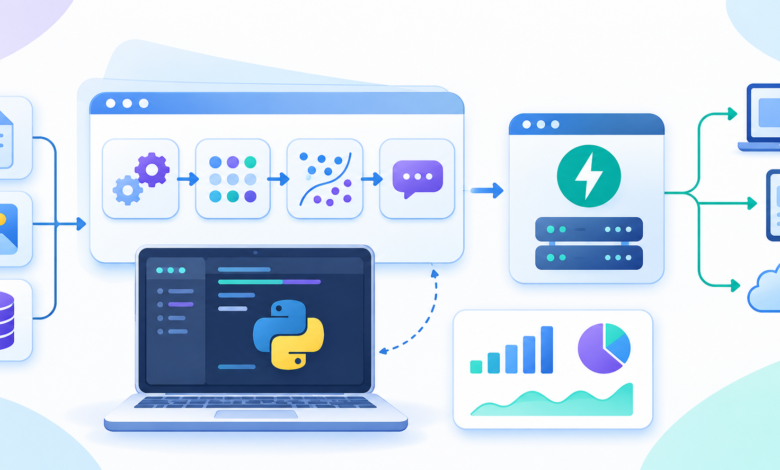
The implementation of a local REST API for semantic classification follows a structured development lifecycle. Initially, the environment must be configured to handle both the orchestration of the LLM and the serving of the API endpoints.
- Environment Setup and Dependency Management: The process begins with establishing a Python 3.11 environment. Essential libraries include
scikit-llmfor the pipeline abstraction,fastapianduvicornfor the asynchronous web server architecture, andjoblibfor model serialization. - Model Orchestration: The core of the pipeline resides in the configuration of the Scikit-LLM engine. By routing requests to a local Ollama instance (typically running on port 11434), the system avoids the need for external authentication keys, replacing them with a local placeholder.
- Pipeline Training and Serialization: Using the
ZeroShotGPTClassifier, developers define a set of labels and initial examples. The.fit()method serves as the instruction phase for the LLM, effectively "priming" the model for specific classification tasks. Once trained, the model is serialized usingjoblib, allowing it to be stored, version-controlled, and reloaded into memory upon server startup. - Asynchronous Serving with FastAPI: FastAPI is selected for this architecture due to its native support for asynchronous programming. By using the
asynccontextmanagerdecorator, developers can load the serialized model into memory once during the application’s lifecycle, ensuring that the model is ready for incoming requests without the latency of re-loading the object on every API call.
Optimizing Throughput with Asynchronous Threads
A critical technical consideration when serving LLMs is the blocking nature of the inference process. Unlike standard API responses, LLM inference is computationally intensive and can block the main execution thread of a web server.
To mitigate this, the implementation utilizes asyncio.to_thread. This method offloads the execution of the clf.predict() function to a separate thread, allowing the FastAPI server to remain responsive and continue handling other incoming requests while the CPU or GPU performs the semantic inference. This design pattern is essential for maintaining high performance in production-grade systems where multiple users may request classifications simultaneously.
Empirical Data and Performance Implications
In comparative benchmarks, local inference using models like Llama 3 on a consumer-grade GPU (such as an NVIDIA RTX 3060 or higher) often results in latency comparable to, or better than, standard API calls, particularly when accounting for network round-trip time.
| Metric | Cloud-Based API | Local Ollama/Scikit-LLM |
|---|---|---|
| Data Privacy | Moderate (Third-party access) | High (Data stays local) |
| Cost | Variable (Per-token) | Zero (Hardware-dependent) |
| Latency | Network Dependent | Local Execution |
| Scalability | Vertical/Horizontal | Hardware Constrained |
The data indicates that while cloud-based APIs offer superior raw power and handle complex multi-modal tasks more efficiently, localized pipelines are objectively superior for deterministic tasks such as zero-shot classification where privacy and cost-predictability are prioritized.
Broader Impact and Industry Trends
The shift toward localized, modular AI pipelines reflects a broader trend in the machine learning industry: the move from monolithic, black-box AI services toward customizable, interoperable components. Organizations are increasingly seeking to avoid vendor lock-in, a phenomenon where reliance on a specific proprietary API creates significant business risk.
By utilizing standardized frameworks like scikit-learn in conjunction with LLMs, businesses can treat AI models as interchangeable assets. If a more efficient or accurate model becomes available, the underlying pipeline architecture remains intact; only the model definition within the code needs to be updated. This "pluggable" architecture is a hallmark of mature software engineering and is essential for the long-term sustainability of AI-integrated systems.
Future Outlook and Considerations
As the hardware requirements for local inference continue to decrease, the feasibility of edge-based AI will likely expand. Future iterations of this architecture could include the integration of quantization techniques (such as GGUF or EXL2) to allow larger models to run on more modest hardware.
However, users must be aware of the inherent limitations of this approach. Local LLM inference is bound by the hardware capacity of the host machine. While sufficient for low-to-medium traffic applications, high-concurrency environments may require clustering or load-balancing strategies that are more complex than a single-instance FastAPI setup. Additionally, while Scikit-LLM simplifies the interface, the accuracy of the zero-shot classification remains contingent on the quality of the underlying LLM’s training and the clarity of the provided category labels.
Conclusion
The convergence of Scikit-LLM, FastAPI, and Ollama provides a powerful, private, and efficient framework for developers seeking to harness the power of LLMs in production. By abstracting the complexities of model interaction into a standard scikit-learn interface and serving it through an asynchronous API, this approach addresses the primary barriers to AI adoption: cost, latency, and data privacy. As the ecosystem continues to mature, this methodology serves as a robust foundation for building the next generation of intelligent, locally-hosted applications. Organizations that prioritize these architectures today will be better positioned to scale their AI capabilities without the financial and operational constraints of traditional cloud-reliant models.