The landscape of LLM inference is currently defined by a "memory wall." Because modern LLMs require massive amounts of VRAM to store weights and the Key-Value (KV) cache, hardware utilization often plateaus long before compute units are fully saturated. When traffic grows, requests queue behind long-generation cycles, leading to significant degradation in user experience. To navigate this, engineers must adopt a rigorous, evidence-based methodology to match specific optimization techniques to their unique workload bottlenecks.
The Evolution of Inference Optimization
The history of LLM deployment has moved through distinct phases over the last three years. In 2022, the focus was primarily on model size—simply getting a model to run on a single consumer GPU. By 2023, the industry shifted toward efficiency and throughput, driven by the release of high-performance serving frameworks like vLLM and TensorRT-LLM.
The current era, beginning in late 2024, is defined by "traffic-aware optimization." It is no longer sufficient to merely compress a model; operators must now account for the temporal dynamics of request arrivals, the structure of prompt prefixes, and the interplay between prefill and decode stages. This evolution reflects the transition from academic research to mission-critical enterprise infrastructure, where a 10% improvement in latency can represent millions of dollars in annual cloud compute savings.
The Six-Question Diagnostic Framework
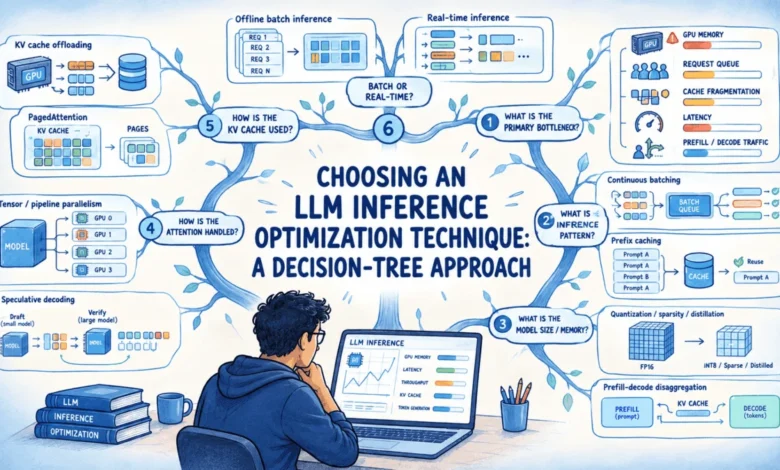
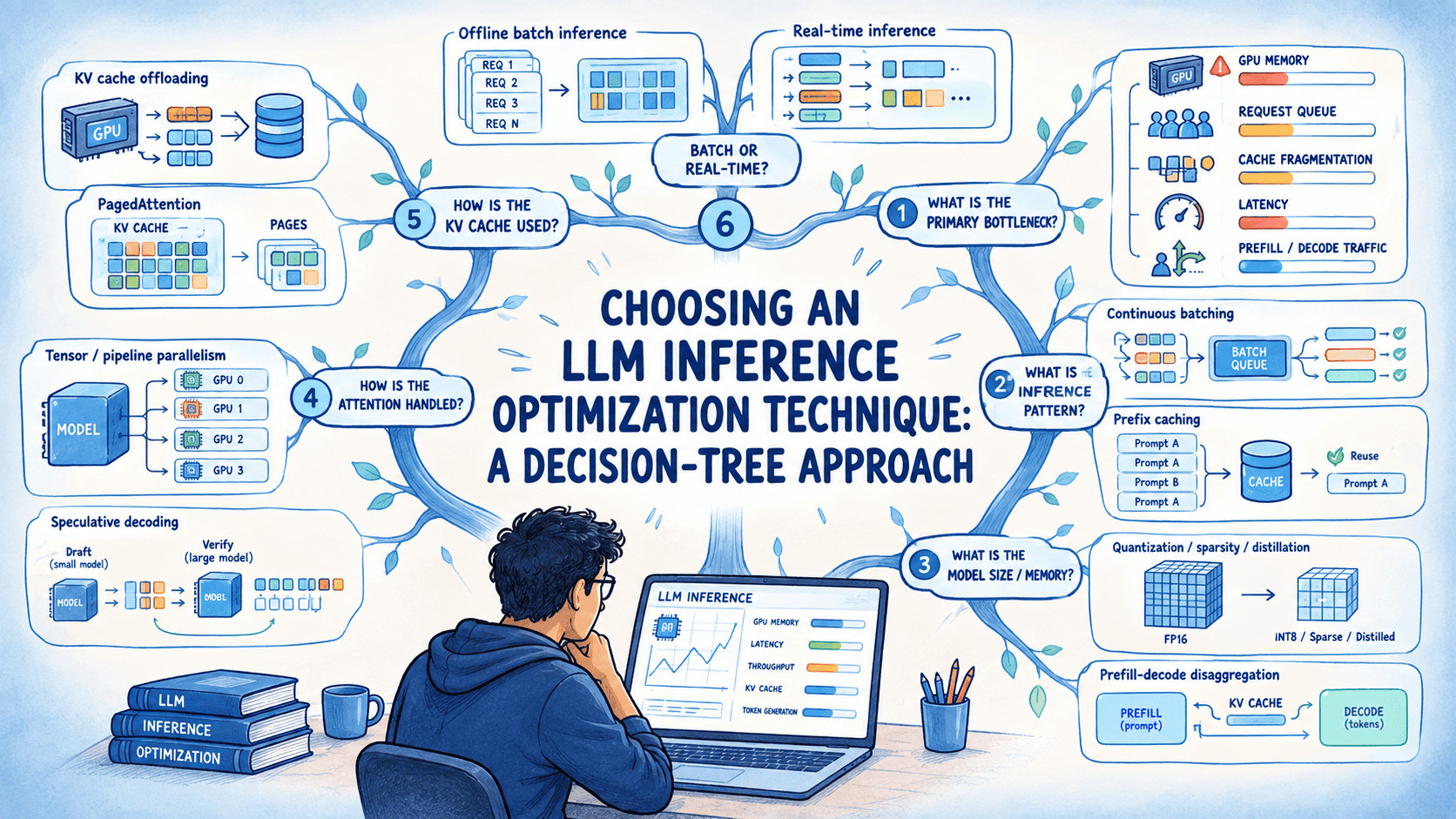
To avoid the trap of "optimization theater"—implementing complex solutions that provide negligible gains—engineers should utilize a systematic decision tree. This framework diagnostic approach prioritizes interventions based on the specific constraints of the workload.
1. Hardware-Model Alignment
The first step is a physical check: does the model fit comfortably within the target device’s VRAM? If the model occupies 90% or more of the available memory, the KV cache—which grows dynamically as a conversation progresses—has no room to expand. This causes "out-of-memory" (OOM) errors or extreme thrashing.
If the model is too large, operators must look at quantization (e.g., INT8 or FP8), sparsity techniques, or distillation. These techniques effectively shrink the model’s footprint. Data from recent industry benchmarks suggest that moving from FP16 to INT8 quantization can reduce memory usage by nearly 50% with minimal impact on perplexity, provided the calibration dataset is representative of the production workload.
2. Exploiting Prompt Redundancy
For applications involving RAG or complex agentic workflows, prompts often contain large, repeating blocks of text—such as long system instructions or extensive chat histories. If a significant percentage of traffic shares an identical prefix, prefix caching is the highest-leverage optimization available. By caching the KV state of the prompt’s prefix, the engine avoids recomputing hundreds of tokens per request. In production environments with high prompt-to-response ratios, this can reduce time-to-first-token (TTFT) by over 60%.
3. Managing Variable Output Lengths
Standard request batching, which waits for all sequences to reach a static length before finishing, is highly inefficient in production. A request requiring a one-word answer will be throttled by a request generating a full document. Continuous batching, or in-flight batching, solves this by allowing completed sequences to be swapped out in real-time. Modern serving engines now treat this as a baseline requirement, and failure to implement it represents a significant opportunity cost in GPU utilization.
4. Addressing KV Cache Fragmentation
Memory fragmentation is a silent performance killer. When engines allocate memory for the maximum possible sequence length, they often leave massive "holes" in GPU memory that cannot be utilized by other requests. PagedAttention, an innovation inspired by virtual memory management in operating systems, addresses this by partitioning the KV cache into small, non-contiguous blocks. This allows for near-zero memory waste and significantly higher batch capacities.
5. Prioritizing Per-Token Latency
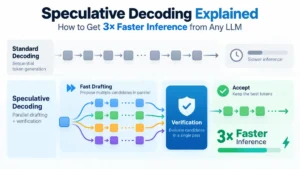
For user-facing chatbots, the "per-token" latency is more critical than total throughput. Speculative decoding acts as a performance accelerator by using a smaller, "draft" model to predict token sequences, which the larger "target" model then validates in parallel. If the draft model is accurate, the system can generate several tokens per single pass of the target model. While this introduces architectural complexity, the reduction in perceived latency is substantial for high-performance applications.
6. Disaggregation for High-Scale Traffic
In large-scale production, the prefill (prompt processing) and decode (token generation) stages often compete for the same GPU resources. Prefill is compute-heavy, while decode is memory-bandwidth heavy. By separating these into distinct hardware pools—prefill nodes and decode nodes—operators can independently scale the infrastructure to match the specific demands of their traffic patterns. This strategy, while complex to implement, is the gold standard for enterprise-grade LLM platforms.
Analytical Summary of Trade-offs
When selecting these techniques, it is essential to consider the "cost of complexity." Every optimization layer adds potential points of failure and monitoring overhead.
| Technique | Primary Benefit | Potential Downside |
|---|---|---|
| Quantization | Increased batch size/speed | Potential accuracy degradation |
| Prefix Caching | Reduced TTFT | Requires exact prefix matches |
| Continuous Batching | Higher throughput | Increased scheduling overhead |
| PagedAttention | Memory efficiency | Requires specific engine support |
| Speculative Decoding | Lower inter-token latency | Requires a high-quality draft model |
| Disaggregation | Optimized scaling | Significant network/routing complexity |
Implications for Future Deployment
The industry is currently moving toward a more granular understanding of these trade-offs. Recent data indicates that many enterprises are over-optimizing for raw throughput while under-optimizing for latency, leading to a "brittle" stack.
The consensus among infrastructure architects is that the future of LLM serving lies in "dynamic optimization"—systems that automatically switch between these techniques based on real-time telemetry. For example, a system might enable speculative decoding only during peak traffic hours to reduce latency, while reverting to standard inference during off-peak times to save on power and complexity.
Ultimately, the goal of any inference strategy should be to minimize the "wait time" of the GPU. Whether through smarter memory management, architectural disaggregation, or clever predictive techniques, the bottleneck is rarely the model itself, but rather the pipeline through which the model’s intelligence is delivered to the user. Engineers who master the interplay between these techniques will be the ones to successfully scale AI applications from the research lab to the global market.