The Evolution of RAG and the Visual Gap
The history of RAG development is marked by a relentless pursuit of improved accuracy. Initially, Large Language Models (LLMs) struggled with hallucinations, leading to the introduction of RAG, which grounds models in specific, verified documents. However, early iterations of these pipelines functioned primarily through linear text extraction. In a standard PDF parsing workflow, tables are often mangled into unreadable strings of characters, and images are discarded entirely.
Industry data suggests that in sectors such as finance, engineering, and healthcare, over 40% of mission-critical information is contained within visual elements rather than plain text. When an AI pipeline fails to interpret a graph illustrating a quarterly revenue trend or a diagram detailing a mechanical failure, the resulting output is inherently incomplete. This "visual gap" in document processing has spurred a shift toward multi-modal architectures that leverage advanced vision-language models (VLMs) to synthesize text and image data into a unified knowledge base.
Architecting the Multi-Modal Pipeline
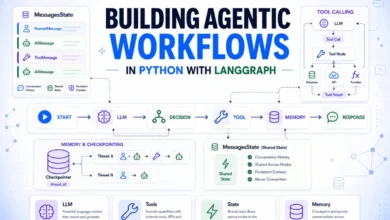
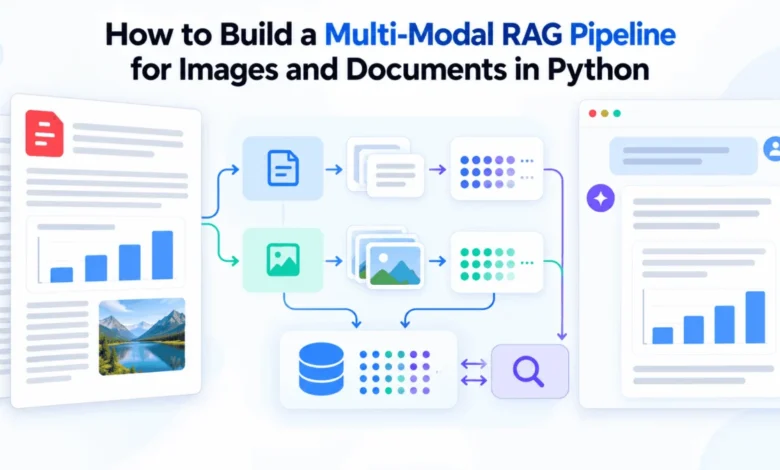
Transitioning from a text-only RAG pipeline to a multi-modal version requires a fundamental change in how data is ingested, indexed, and queried. The modern, API-driven approach to this challenge—often utilizing tools like LangChain, Unstructured, and OpenAI’s GPT-4o—follows a four-stage lifecycle: parsing, summarization, multi-vector storage, and multimodal querying.
Phase 1: Intelligent Parsing and Element Classification
The first stage involves granular decomposition of the document. Using the Unstructured library, developers can move beyond simple text scraping. The partition_pdf() function serves as the gatekeeper, intelligently identifying and categorizing document elements. By configuring the system to isolate "Image" blocks and "Table" structures, the pipeline preserves the integrity of the document’s layout. The importance of this phase cannot be overstated; by separating a paragraph from an embedded schematic, the system maintains the context of each element, which is vital for later retrieval.
Phase 2: Generating Searchable Metadata for Images
The most significant technical hurdle in multi-modal RAG is the fact that vector databases cannot natively "see" images in a way that allows for semantic similarity searches. To solve this, the pipeline must create a text-based proxy for each image. By passing images to a high-capacity model like GPT-4o, the system generates detailed, natural language descriptions of the visual content. These descriptions are embedded as vectors, allowing the search engine to match a user’s query (e.g., "Show me the Q3 profit margin trend") with a visual asset that was previously "seen" and summarized.
Phase 3: The Multi-Vector Storage Strategy
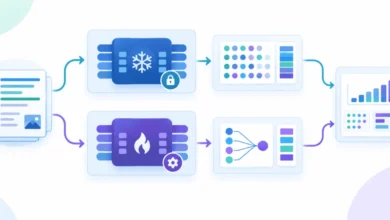
Standard RAG systems typically map a single chunk of text to a single vector. However, a Multi-Vector Retriever creates a more sophisticated architecture. It utilizes two distinct storage components: a vector store for the searchable embeddings (the text summaries of images and the raw text chunks) and a document store for the raw assets. A unique ID links the two, ensuring that when a user searches for information, the retrieval engine can pull both the contextual text and the high-resolution image file. This separation ensures that the system remains performant even as the volume of stored documents grows.
Phase 4: Integrated Retrieval and Reasoning
The final stage occurs at the moment of query. When a user submits a question, the retriever executes a similarity search across the combined space of text and image summaries. If the retriever identifies an image as a relevant source, the pipeline fetches the raw image file and prepares it for the LLM. The final prompt to the model contains both the retrieved text snippets and the base64-encoded image data. This allows GPT-4o to "reason" over the combined input, synthesizing a response that is grounded in both the written word and the visual data.
Technical Prerequisites and Implementation
For developers looking to implement this, the environment setup requires specific system dependencies. The use of poppler-utils is essential for handling the complexities of PDF rendering within the Unstructured framework. Following the installation of langchain, langchain-openai, and chromadb, developers must ensure their API keys are securely managed.
The implementation process involves the following technical sequence:
- Parsing: Using
partition_pdfwithinfer_table_structure=Trueto maintain the logical flow of data. - Encoding: Converting images to base64 strings to facilitate transmission to the OpenAI API for summary generation.
- Indexing: Creating UUIDs to map the relationship between the vector-indexed summaries and the raw documents.
- Querying: Implementing a routing function that distinguishes between text-based answers and image-based evidence, ensuring the LLM receives the correct data types.
Implications for Business and Research
The implications of this technology are profound. For a financial analyst, the ability to query an entire database of earnings reports and receive answers that include the specific charts from those documents transforms the speed and accuracy of market research. For engineers, it means the ability to query thousands of pages of technical documentation to find a specific wiring diagram without manually searching through index files.
Furthermore, this approach offers a scalable alternative to local, hardware-intensive models. By utilizing API-driven architectures, organizations can implement sophisticated document intelligence on standard hardware without the need for massive GPU clusters, provided they account for the costs associated with token usage for image analysis.
Future Outlook and Limitations
While the current multi-modal RAG pipeline represents a major leap forward, it is not without limitations. Cost management is a primary consideration, as every image indexed consumes tokens for the description generation process. Strategic filtering—such as ignoring images that are too small or lack informational density—is a necessary optimization step.
As the field matures, we are seeing the emergence of more advanced models like ColPali, which utilize vision-language models to embed entire document pages as images, potentially bypassing the need for manual parsing altogether. However, the current multi-vector retrieval approach remains the industry standard for its reliability, interpretability, and ease of integration into existing enterprise workflows. As document intelligence continues to evolve, the bridge between visual and textual data will become an increasingly standard component of the modern AI stack, fundamentally changing how we interact with, interpret, and learn from complex documents.