Google is replacing Gemini Gems with a modular Skills system to enhance AI workflow automation

Google has officially announced a significant structural shift in its artificial intelligence ecosystem, confirming that the customizable "Gems" feature within the Gemini app and Google Workspace is being deprecated in favor of a more sophisticated, modular framework known as "Skills." This transition, which marks a departure from static persona-based AI configurations, aims to provide users with a more flexible, reusable, and intelligent automation architecture. The rollout is scheduled to commence in early October 2025, with a staggered phase-out of the legacy Gems system extending well into 2027 for enterprise and educational sectors.
The Shift from Persona to Process
Since the introduction of Gemini Gems, users have utilized the feature to create custom AI assistants tailored to specific personas or narrow tasks—such as a personal tutor, a workout coach, or a coding assistant. While successful, Gems were largely monolithic; they functioned as isolated instances of the Gemini model with fixed instruction sets.
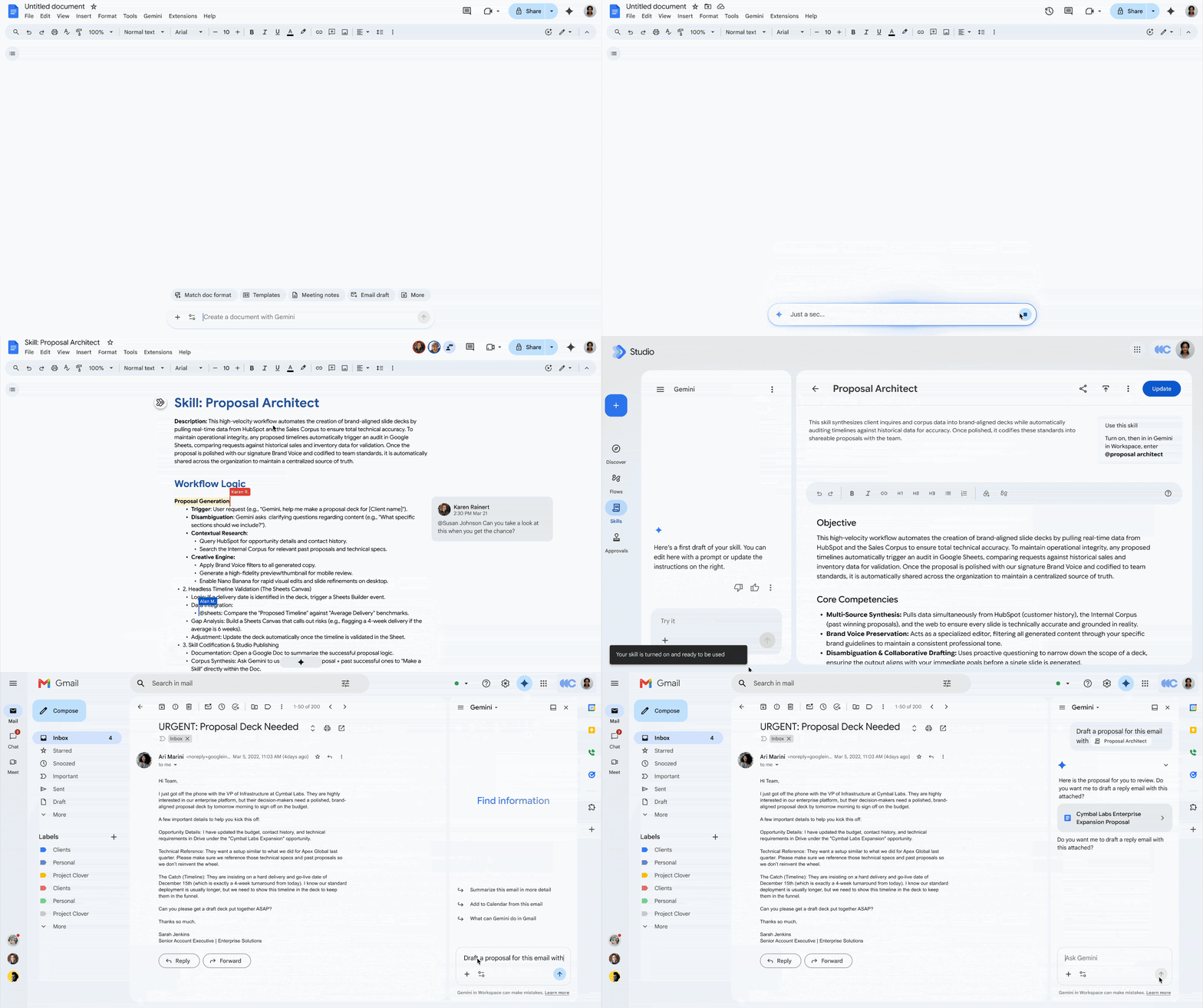
The introduction of Skills represents a paradigm shift toward modularity. According to Google’s technical documentation, a "Skill" is a discrete, reusable set of instructions, templates, and brand guidelines that can be invoked dynamically. Unlike Gems, which required users to switch to a specific "mode" or bot, Skills are designed to be context-aware. The Gemini model will now possess the capability to automatically detect when a specific, user-defined Skill is relevant to an incoming prompt, effectively "stacking" multiple Skills to process complex requests without manual intervention.
Deployment Timeline and Phased Rollout
Google has established a clear, multi-stage roadmap for this transition to ensure minimal disruption for both individual consumers and large-scale organizational users.
- October 5, 2025: Initial deployment of the Skills framework begins for Google Workspace customers.
- October 13, 2025: The Skills system becomes available to general users within the Gemini application.
- November 17, 2025: Gems are officially migrated into the "Settings" menu, where they will remain accessible as a legacy feature during the transition period.
- March 1, 2027: The absolute deadline for the discontinuation of Gems within Business and Enterprise-tier accounts.
- June 1, 2027: The final sunset date for Gems within Education-tier accounts.
During this transition, any remaining Gems that have not been manually updated or deleted by users will be automatically converted into draft Skills. This ensures that the proprietary instructions and prompt engineering invested by users are not lost, though they may require minor refinement to function optimally within the new modular architecture.
Technical Foundations: The Open SKILL.md Standard
A notable aspect of this update is Google’s commitment to interoperability. The company has announced that Skills are built upon the "SKILL.md" format, which utilizes Markdown. By adopting an open-standard approach, Google is signaling a move toward portability. While Skills created in one environment—such as the personal Gemini app—will not currently sync automatically with a Workspace environment for security and administrative reasons, the open nature of the format suggests a future where users could potentially export and import their AI configurations across different compatible platforms.
However, users should note that as of the current release, the lack of native synchronization between personal and workspace accounts remains a significant friction point. Organizations must manage their own library of Skills, and individuals must ensure their personal configurations are manually maintained across separate Google accounts.
Analysis: Implications for Productivity and Enterprise AI
The move to a Skill-based architecture serves several strategic purposes for Google. First, it directly addresses the enterprise demand for "agentic" workflows. By allowing companies to codify their brand voice, document templates, and internal processes into modular Skills, Google is positioning Gemini not just as a chatbot, but as a central operating system for corporate productivity.
Industry analysts suggest that the "stackable" nature of Skills solves one of the primary limitations of previous LLM interfaces: the need for constant context switching. By allowing the AI to pull from a library of pre-defined instructions—such as "Apply Corporate Style Guide" and "Format as Executive Summary" simultaneously—Google is reducing the cognitive load on the user.
Furthermore, the automation of Skill selection is a technical milestone. Previously, users had to "prime" their models by selecting a specific persona. The new system’s ability to recognize the applicability of a Skill suggests that Google is utilizing a more advanced retrieval-augmented generation (RAG) backend, where the AI can query the user’s library of Skills before generating a response.
Official Response and Support
In a briefing published on the Google Workspace updates blog, representatives highlighted that the primary driver for this transition is the need for "repeatable, high-fidelity outputs." By moving away from the "Gem" container, which was often treated as a novelty, to "Skills," which are positioned as business-critical assets, Google is attempting to elevate Gemini’s status in professional environments.

For educational institutions and businesses, the extended support timeline through 2027 is a clear indication that Google intends to manage this migration with significant caution. The grace period is designed to allow IT departments to audit their current Gemini usage and reconstruct their internal workflows using the more robust Skills framework.
Broader Industry Context
Google’s pivot arrives at a time of intense competition in the AI workspace integration market. With Microsoft’s Copilot and OpenAI’s custom GPTs vying for dominance, the "modularization" of AI behavior has become a critical battleground. By emphasizing open standards like SKILL.md, Google is attempting to differentiate itself by offering a more transparent and portable architecture compared to the often "black box" nature of competitors’ custom agent builders.
As of late 2025, the shift is expected to impact millions of users globally. While the learning curve for transitioning from Gems to Skills may be slight, the long-term utility of a modular, stackable, and context-aware system is expected to yield higher productivity gains. For power users, the ability to build a robust library of Skills that can be applied to any prompt represents a significant leap forward in personalizing AI to individual and organizational needs.
Future Outlook
The transition to Skills is not merely a rebranding exercise; it is a fundamental reconfiguration of how the Gemini model interacts with user-specific data. As the rollout progresses, the focus will likely shift to how effectively the model can manage "conflict resolution"—what happens when two stacked Skills have contradictory instructions?
Google has hinted that future updates will include a priority-based hierarchy for Skills, allowing users to define which instructions take precedence in the event of a conflict. For now, the focus remains on a stable migration. Users are encouraged to review their existing Gems to ensure that their core instructions are documented and ready for the shift to the modular format in the coming months.
With the first phase beginning in October 2025, the industry will be watching closely to see if the promised seamless integration of these Skills can truly deliver on the goal of making AI a more reliable and less manually intensive tool in the professional and personal toolkit. The shift underscores a broader trend in the AI sector: the move from "conversational AI" to "task-oriented automation," where the model’s value is measured not by how well it chats, but by how accurately and consistently it can execute complex, multi-step operations defined by the user.