MergeForge Introduces JetBrains-Style Three-Pane Merge Editor and Context-Aware AI to VS Code and Cursor

A new open-source extension, MergeForge, aims to revolutionize the way developers handle code conflicts within Visual Studio Code (VS Code) and Cursor. The tool introduces a sophisticated three-pane merge conflict resolver, reminiscent of the user-friendly interfaces found in JetBrains IDEs, and pairs it with an artificial intelligence assistant designed to understand repository context rather than merely processing isolated conflict markers. This development addresses a long-standing pain point for many developers who find VS Code’s default stacked merge editor cumbersome and inefficient.
The problem with traditional merge conflict resolution has been a recurring challenge in software development. When Git encounters conflicting changes between different branches, it flags these files, often presenting them in a default editor that requires developers to manually reconcile disparate code sections. In VS Code, this typically manifests as a stacked layout where "incoming" and "current" versions of the code are presented sequentially, with a separate pane for the resolved output. While functional, this interface often lacks the clarity and efficiency that developers have come to expect from more advanced integrated development environments.
For years, developers who have utilized IDEs like JetBrains’ WebStorm or IntelliJ IDEA have praised their integrated merge tools. These tools often provide a side-by-side or three-pane view that clearly delineates changes, highlights differences at a granular level (such as word-level diffs), and offers intuitive controls for accepting, rejecting, or blending changes. The absence of a comparable, robust solution in VS Code has led to a less streamlined workflow, particularly during complex rebasing operations or when merging significant feature branches. Developers often find themselves resorting to manual copy-pasting, hoping to avoid accidental data loss or the introduction of subtle bugs due to overlooking critical sections.

The advent of AI in software development has introduced new possibilities, but many early implementations of AI-powered merge resolution treated conflicts as mere text blocks. These tools would identify the Git conflict markers (<<<<<<<, =======, >>>>>>>) and attempt to offer solutions without a deeper understanding of the surrounding code, the project’s architecture, or the intent behind the conflicting changes. This approach often resulted in "confident guessing" rather than intelligent problem-solving, leaving developers to verify and correct the AI’s suggestions. The desire for an AI assistant that acts more like a knowledgeable teammate, capable of understanding the broader repository context, has been a driving force for innovation in this area.
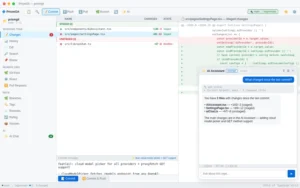
The solution, MergeForge, developed byognjenmarcheta, aims to bridge this gap. Available as an open-source extension for both VS Code and Cursor, it transforms conflicted files into a visually intuitive three-pane merge interface. The layout is designed for clarity: the "Left" pane displays the developer’s local version ("Yours"), the "Right" pane shows the incoming changes ("Theirs"), and the central "Result" pane, editable by the user, is initially populated from the merge base. This structure allows for a direct comparison and manipulation of the differing code segments.
Key features of MergeForge include:
JetBrains-Style Three-Pane Merge Editor
MergeForge replicates the highly regarded three-pane merge interface familiar to users of JetBrains IDEs. This includes synchronized scrolling across all three panes, visual connectors that link corresponding code chunks, and intuitive gutter controls for accepting, ignoring, or blending changes from either side. The result pane is fully editable, allowing developers to fine-tune the merged code. Word-level diffs are highlighted, making it easier to spot subtle alterations. The extension also supports full undo functionality via standard keyboard shortcuts (Cmd/Ctrl+Z), providing a safety net during the resolution process. Additional features include authorship attribution, allowing developers to quickly identify who last modified a particular section of code, and a history timeline that visualizes the commits leading to the conflict.

AI That Reads Your Repo, Not Just the Conflict Markers
A significant differentiator for MergeForge is its AI integration. Unlike tools that merely parse Git conflict markers, MergeForge’s AI is designed to access and understand the broader context of the repository. This includes the ability to read files, search code, inspect commit history, and look up symbols. Developers can use the AI to explain conflicts, resolve them directly into the result pane, or even attempt an automated "Fix all" function. The AI prioritizes safe, mechanical merges before resorting to the language model for more complex resolutions, focusing its AI capabilities primarily on the challenging "red chunks" of code.
The AI’s actions are transparent, with visible activity indicators (...) showing when the AI is performing operations such as opening files or searching code. This transparency allows developers to follow the AI’s thought process and ensures that no action is taken in a black-box manner. MergeForge supports various AI providers, including OpenAI, Anthropic, and local LLMs via Ollama. API keys are securely stored in VS Code’s secret storage, and all changes are staged with Git only after the developer explicitly clicks "Apply." If an AI-generated edit is unsatisfactory, it can be undone just like any manual change.
Authorship Chips, History Timeline, and a Real Merge Workflow
Beyond the core merge interface, MergeForge incorporates features that enhance the overall merge workflow. Authorship chips display the avatars or initials of the developers who last modified the conflicting code sections, providing immediate context about who introduced which changes. A "history timeline" view offers a two-lane representation of the commits that contributed to the current merge state, allowing developers to trace the evolution of the code.
The extension also includes a dedicated Conflicts dialog that provides progress updates, a status bar indicator for merge clusters, and a seamless loop to the next conflicted file after applying a resolution. For added robustness, MergeForge implements crash-safety snapshots, ensuring that work in progress is not lost in the event of an unexpected editor closure. It also correctly maps left and right panes during operations like rebasing and cherry-picking, which can sometimes complicate merge resolution.

Built with Care and Tests
MergeForge is developed in TypeScript, with a commitment to thorough testing and correctness. The project emphasizes that when Git merges cleanly, MergeForge aims to replicate that outcome precisely, ensuring byte-for-byte accuracy. This focus on fidelity is crucial for maintaining the integrity of the codebase. The development process includes a replay evaluation for the AI pipeline, enabling regression testing of prompt changes against real-world historical merges.
The project is open-source, licensed under the MIT license, and hosted on GitHub. Developers are encouraged to contribute, with resources available to facilitate this, including a development harness for testing the UI in a browser and scripts that can generate throwaway conflicted repositories for testing various conflict scenarios. This collaborative approach aims to foster a community around improving the developer experience of handling code merges.
The implications of MergeForge are significant for developers who frequently engage in collaborative coding environments. By providing a more intuitive and powerful tool for resolving merge conflicts, it has the potential to reduce the time spent on this often tedious task, minimize the introduction of errors, and improve overall developer productivity. The integration of a context-aware AI assistant further elevates its utility, moving beyond simple text manipulation to offer more intelligent and informed conflict resolution.
As the software development landscape continues to evolve, tools like MergeForge that streamline complex processes and leverage advanced technologies like AI are becoming increasingly vital. The extension’s focus on user experience, transparency, and developer empowerment positions it as a valuable addition to the toolkit of any developer using VS Code or Cursor. The open-source nature and active community engagement suggest a promising future for continued development and improvement.