The open-source artificial intelligence ecosystem has reached a significant milestone with the release of Inkling 2 Mini, developed by Thinking Machines Lab. Positioned as a formidable American
-made competitor to widely utilized international open-weight models such as Qwen3.8-27B, Inkling 2 Mini has rapidly drawn the attention of developers, researchers, and hobbyists alike. According to evaluations on the Artificial Analysis Intelligence Index, this new 26-billion-parameter model matches the performance benchmarks of its established peers while outperforming them across specialized domains including coding, multi-step agentic workflows, and tool-utilization tasks.
The arrival of Inkling 2 Mini addresses a persistent bottleneck in local artificial intelligence deployment: the compromise between elite performance and hardware accessibility. While top-tier models traditionally require expensive enterprise-grade clusters—often utilizing multiple high-end accelerators such as NVIDIA H100s or A100s—Inkling 2 Mini leverages an advanced Mixture-of-Experts (MoE) architecture coupled with an innovative internal looping mechanism. This design allows the model to compute complex logic and execute extended reasoning pathways without imposing prohibitive memory or power demands on the host machine.
Consequently, developers can deploy a 4-bit quantized version of the model on consumer-grade hardware, specifically a single NVIDIA RTX 3090 featuring 24GB of VRAM. This capability democratizes advanced AI engineering, enabling independent developers and small engineering teams to run sophisticated coding assistants and autonomous agents locally, completely independent of cloud-based APIs and associated subscription costs.
Architectural Innovations and Efficiency Benchmarks
The core engineering triumph of Inkling 2 Mini lies in its parameter distribution and computational routing. Traditional dense models require every parameter to fire during a token generation cycle, creating massive computational overhead. In contrast, the Mixture-of-Experts framework activates only a subset of neural pathways per token, preserving model capacity while drastically reducing active compute requirements.
Furthermore, Thinking Machines Lab integrated a unique looping mechanism that permits the model to iteratively refine its outputs before presenting them to the user. This iterative self-correction enhances performance on rigorous coding and logical reasoning benchmarks, allowing a 26-billion-parameter model to rival architectures nearly twice its size. When paired with speculative decoding techniques and optimized inference engines like llama.cpp, users running the model on local consumer hardware have reported generation speeds exceeding 50 tokens per second, making real-time interactive applications entirely viable.
Setting Up Unsloth Studio for Local Deployment
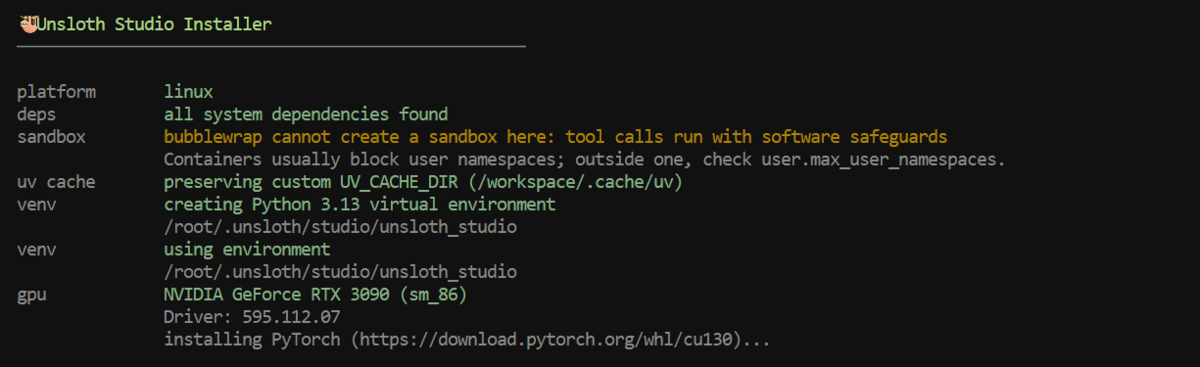
To bridge the gap between complex model weights and practical user deployment, platforms like Unsloth Studio provide streamlined local management interfaces. Unsloth Studio offers a unified web-based dashboard that automates the downloading, quantization selection, and execution of large language models, removing the traditional friction associated with manual Python virtual environment configurations and dependency management.
For engineers seeking to replicate this local deployment on an NVIDIA RTX 3090 running a Linux-based environment, the setup process begins at the terminal interface. The standard installation script automates environment detection and dependency resolution:
curl -fsSL https://unsloth.ai/install.sh | sh
During the installation prompt, users can defer the immediate startup of the server by selecting the negative option to permit directory configuration:
Start Unsloth Studio now? [Y/n] n
To maintain an organized workstation and prevent default system drives from filling up with massive model weights, environment variables should be designated to direct Hugging Face and system caches to an external directory with ample storage capacity:
Once the environment paths are established, the user restarts the shell and initiates the Unsloth Studio server, binding it to the local network interface:
exec bash
unsloth studio -H 127.0.0.1 -p 8080
Navigating to http://localhost:8080 in a web browser grants access to the administrative dashboard, where administrators establish security credentials before downloading model weights.
Model Loading and Functional Validation
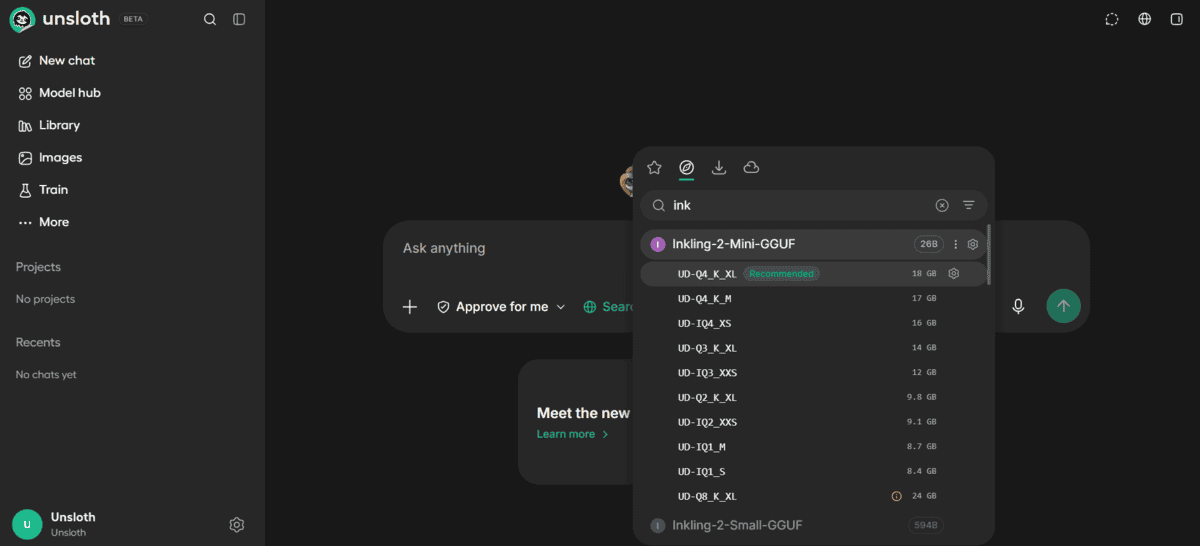
Within the Unsloth Studio interface, operators select the unsloth/Inkling-2-Mini-GGUF repository, specifically opting for the UD-Q4_K_XL quantization tier. This specific 4-bit quantization profile is mathematically balanced to fit comfortably within the 24GB VRAM ceiling of an RTX 3090 while retaining negligible degradation in reasoning capability.
Initial functional tests highlight the model’s versatility. When configured with web-search tools enabled, Inkling 2 Mini demonstrates strong retrieval-augmented generation (RAG) capabilities, synthesizing real-time information from external data sources to answer complex market analysis inquiries. Operating at an average throughput of approximately 52 tokens per second on a single consumer GPU, the system performs complex inference tasks with minimal latency.
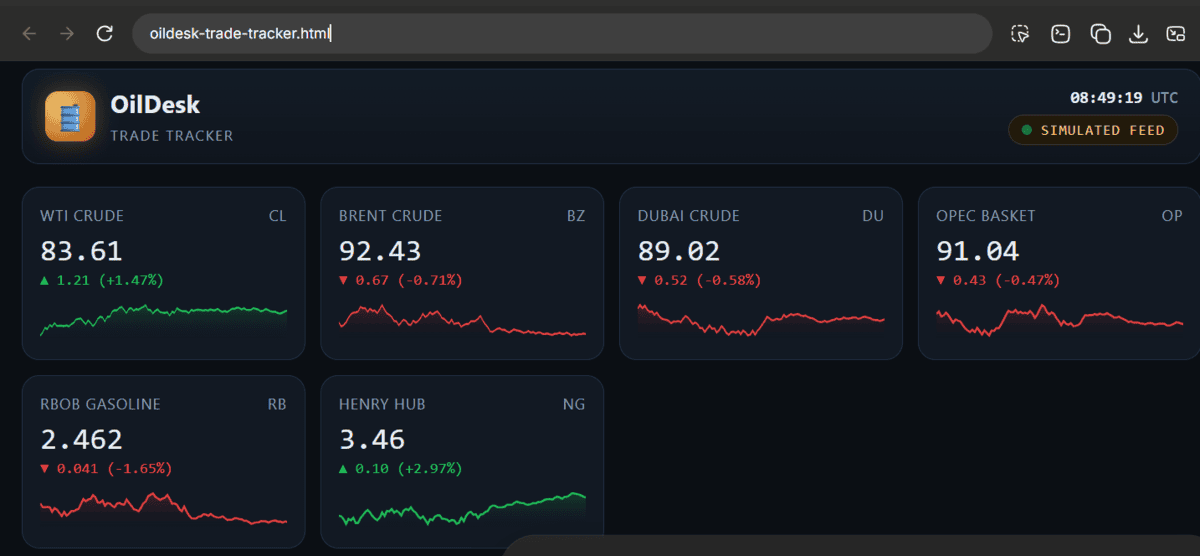
Beyond text-based analysis, the model proves adept at structural code generation. When tasked with producing a simulated oil market dashboard without auxiliary execution tools, the model constructs a functional, single-file HTML, CSS, and JavaScript application complete with dynamic visual indicators and animated price fluctuations. While operating on simulated data points, the visual fidelity and structural integrity of the generated frontend illustrate the model’s capacity for rapid prototyping.
Integrating with Autonomous Coding Agents
The true utility of local open-weight models becomes apparent when paired with terminal-based coding agents such as Pi. These frameworks allow the language model to act not merely as a conversational chatbot, but as an active software development partner capable of creating, modifying, and testing codebases directly within a developer’s local environment.
Installation of the Pi coding assistant follows a similar automated protocol via the command line:
curl -fsSL https://pi.dev/install.sh | sh
exec bash -l
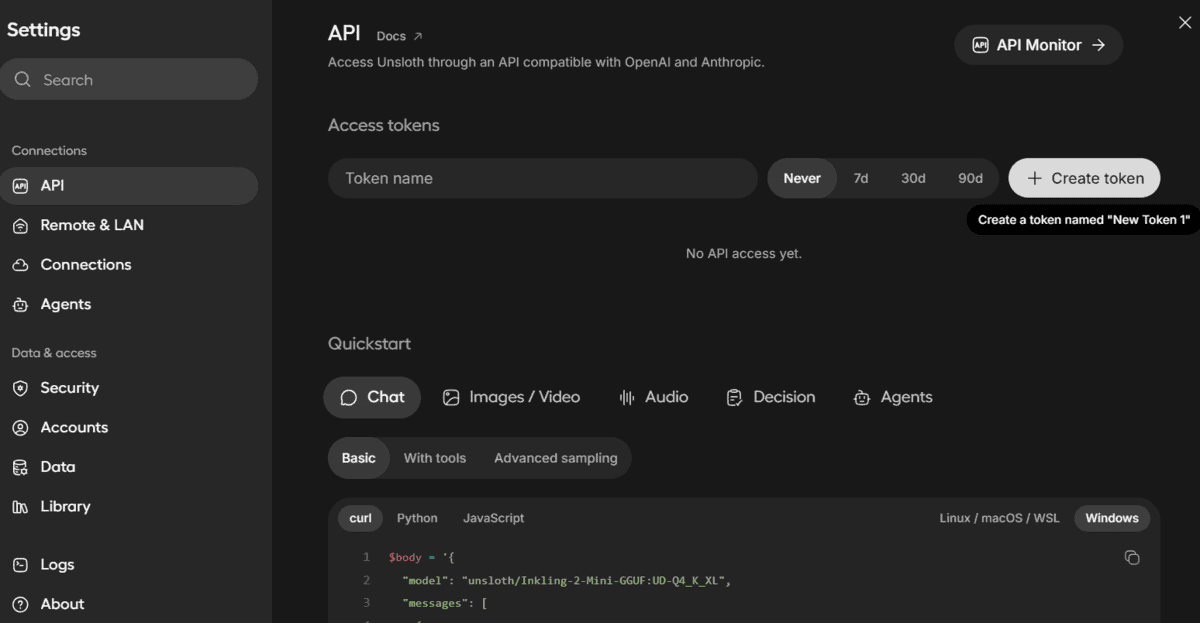
By retrieving the API connection parameters and authentication keys generated within Unsloth Studio, developers can bridge the local inference server with the coding assistant. Configuring the connection via environmental variables and execution flags links the Pi agent directly to the Inkling 2 Mini instance:
export UNSLOTH_STUDIO_URL="http://0.0.0.0:8080"
unsloth start pi --api-key YOUR_API_KEY --model unsloth/Inkling-2-Mini-GGUF:UD-Q4_K_XL
Practical Application: Building a 2D Endless Runner
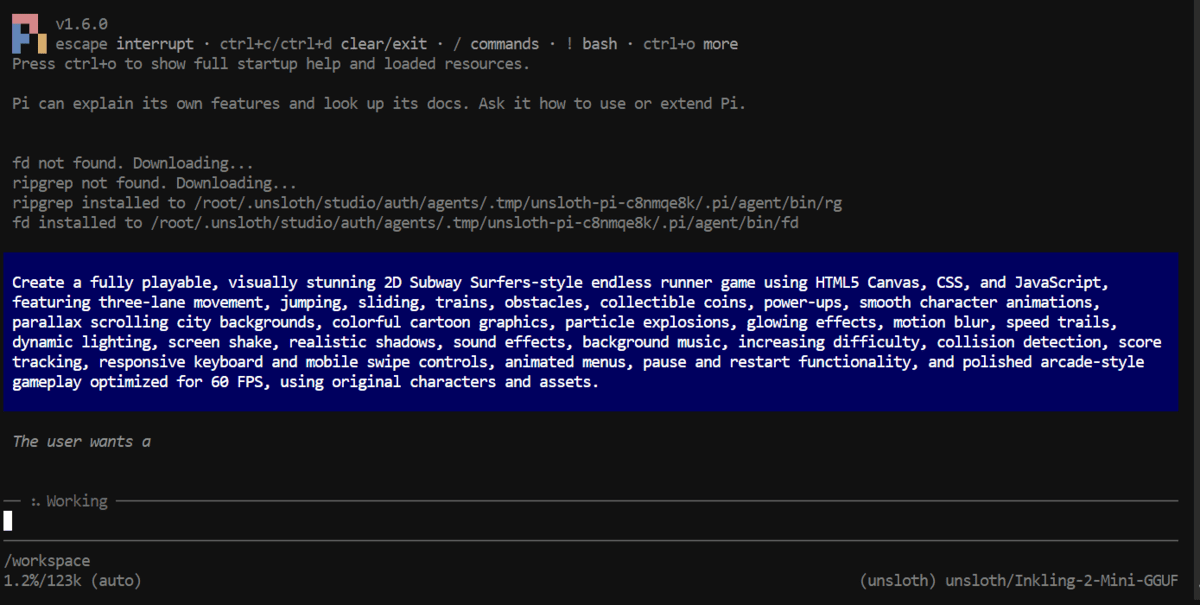
To rigorously evaluate the combined capability of Inkling 2 Mini and the Pi coding agent, developers can assign complex, multi-layered software engineering tasks. A notable test involves instructing the agent to construct a fully playable, arcade-style 2D endless-runner game inspired by modern mobile titles, featuring three-lane movement, obstacle collision detection, dynamic particle effects, and responsive keyboard controls:
"Create a fully playable, visually stunning 2D endless runner game using HTML5 Canvas, CSS, and JavaScript, featuring three-lane movement, jumping, sliding, obstacles, collectible coins, parallax scrolling backgrounds, particle explosions, collision detection, score tracking, responsive controls, and polished arcade-style gameplay optimized for 60 FPS."
Executing this prompt through the local pipeline yields a fully functioning web application within minutes. The resulting codebase incorporates complete game loops, canvas rendering logic, input event listeners, and state management systems. While initial iterations may exhibit minor spatial logic anomalies—such as lateral character traversal rather than forward progression—these edge cases can be rapidly resolved through iterative developer prompts.
The entire development lifecycle—from conceptualization and code generation to local browser testing—concludes in approximately ten minutes on a single workstation. Because the resulting application relies on standard web technologies, deployment to production environments such as Vercel or Netlify is immediate, eliminating the friction typical of traditional software deployment pipelines.
Broader Industry Implications and Open-Source Momentum
The rapid adoption and community optimization of Inkling 2 Mini underscore a broader shift within the artificial intelligence sector. Independent developers and open-source contributors are actively developing custom execution runtimes, specialized inference flags within llama.cpp, and tailored fine-tuning frameworks that push hardware performance limits even further. Reports of specialized setups achieving near-300 token-per-second generation speeds highlight the immense headroom available when open-weight models are paired with optimized local infrastructure.
This community-driven optimization contrasts sharply with the rigid, centralized control models enforced by commercial API providers. By maintaining full ownership of model weights, execution environments, and data pipelines, enterprises and individual developers insulate themselves against sudden pricing modifications, deprecation of legacy endpoints, and external privacy vulnerabilities.
Ultimately, models like Inkling 2 Mini, when supported by accessible deployment platforms like Unsloth Studio and versatile coding agents like Pi, signal a maturing local AI ecosystem. As optimization techniques improve and hardware efficiency increases, the capabilities once restricted to massive data center clusters are rapidly becoming standard tools on the modern developer’s desktop.