Dw-validation-utils: 12 DataWeave validation functions, sandbox-verified reference

Data validation remains one of the most critical yet boilerplate-heavy aspects of modern enterprise integration architecture. Within the MuleSoft ecosystem, developers frequently encounter the challenge of validating incoming payloads, ensuring field integrity, and enforcing structural constraints before downstream processing begins. To mitigate this repetitive engineering burden, software architect Shakar Bisetty has released a comprehensive, sandbox-verified toolkit titled dw-validation-utils. Designed specifically for DataWeave 2.x, this open-source utility library provides a standardized suite of 12 reusable validation functions aimed at streamlining field checks, pattern matching, date verification, and bulk payload evaluation.
The release arrives at a time when enterprise integration platforms handle increasingly complex, asynchronous data streams from diverse sources. Ensuring that payloads adhere to strict structural schemas before hitting core business logic is essential for preventing downstream failures, exceptions, and data corruption. Traditionally, MuleSoft developers have relied on a patchwork of native DataWeave conditional expressions, regular expression checks, or external JSON Schema validators within Mule flows. While effective, these custom implementations often lead to inconsistent error-handling patterns and difficult-to-maintain transformation scripts across enterprise projects.

Core Architecture and Function Signatures
The dw-validation-utils module addresses these inconsistencies by offering a unified API interface. Tested and verified on the DataWeave CLI 2.x runtime environment—specifically validated on version 2.12.2—the library covers a broad spectrum of validation requirements, ranging from basic scalar checks to complex bulk object evaluations.
The module exports twelve primary functions categorized into field-level validation, format verification, and aggregate payload analysis:
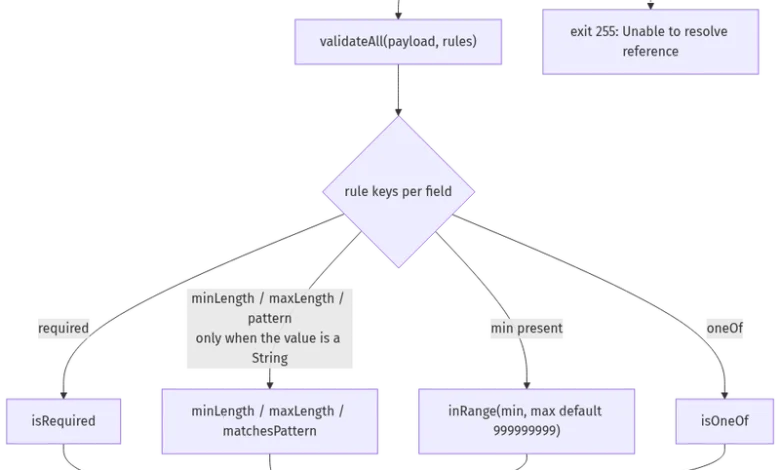
isRequired(val: Any, fieldName: String): Object— Evaluates whether a given value is present and non-empty. It returns a structured object indicating validity, the associated field name, and a descriptive error message if the check fails.minLength(s: String, min: Number, fieldName: String = "field"): Object— Ensures that string inputs meet or exceed a specified minimum length threshold.maxLength(s: String, max: Number, fieldName: String = "field"): Object— Validates that string inputs do not exceed a maximum length limit.inRange(n: Number, min: Number, max: Number, fieldName: String = "field"): Object— Confirms that numerical values fall inclusively within a specified lower and upper boundary.matchesPattern(s: String, regex: String, fieldName: String = "field"): Object— Evaluates strings against regular expression patterns to ensure format compliance.isValidDate(s: String, fmt: String, fieldName: String = "field"): Object— Verifies string representations of dates against expected structural formatting parameters, such asyyyy-MM-dd.isOneOf(val: Any, allowed: Array, fieldName: String = "field"): Object— Restricts scalar values to a predefined white-list array of allowed options.isUUID(s: String): Boolean— Evaluates whether a string conforms to Universal Unique Identifier standards.isURL(s: String): Boolean— Checks string values for valid Uniform Resource Locator syntax.isPhone(s: String): Boolean— Validates telephone number formats, including E.164 compliance standards.validateAll(obj: Object, rules: Object): Object— Processes a complete input payload against a defined dictionary of validation rules, aggregating errors into a single response object.hasRequiredFields(obj: Object, fields: Array<String>): Object— Scans an incoming object to ensure that all mandatory keys are present, returning a list of missing properties if any are absent.
Integration Workflow and Best Practices
Implementing the utility library within existing MuleSoft projects requires proper module importing and script structuring. Developers must declare the import statement import modules::ValidationUtils at the absolute top of their DataWeave transformation scripts. Failure to include this declaration results in runtime resolution errors, halting script execution with standard namespace lookup exceptions.

Once imported, functions can be invoked directly against individual payload elements or mapped systematically across complex JSON and XML structures. For instance, utilizing the validateAll function enables developers to execute comprehensive rule sets in a single pass, capturing all validation infractions simultaneously rather than failing fast on the first encountered error. This approach significantly enhances API user experience by providing comprehensive feedback on malformed client requests.
Industry observers note that structured validation libraries like dw-validation-utils align closely with modern API-led connectivity best practices. By shifting validation logic upstream into reusable DataWeave modules, organizations can enforce consistent data contracts across multiple API implementations without bloating XML configuration files or relying excessively on external caching and validation services.
Context and Broader Implications within the MuleSoft Ecosystem
The introduction of dw-validation-utils is part of a broader community-driven movement to codify and share battle-tested MuleSoft patterns. Shakar Bisetty’s broader repository, the MuleSoft Cookbook, encompasses over 104 DataWeave patterns and 8 Exchange modules backed by more than 208 MUnit automated tests. This repository serves as an open knowledge base for enterprise architects seeking to reduce boilerplate code and adhere to DRY (Don’t Repeat Yourself) principles within Anypoint Studio.

As enterprise integration logic grows more sophisticated, the demand for clean, modular, and testable transformation code has intensified. Native DataWeave capabilities have expanded significantly across recent releases, but community-authored utility packages continue to bridge the gap between core language features and practical enterprise architecture requirements. By standardizing validation responses into predictable objects containing explicit valid, field, and error keys, toolsets like dw-validation-utils simplify conditional routing and error payload generation within Mule flows.
Technical leads evaluating the adoption of community modules emphasize the importance of automated testing and version control. Because DataWeave modules are compiled directly into application runtime packages, incorporating versioned scripts from repositories into continuous integration pipelines ensures that downstream microservices maintain contract stability.
The complete documentation, source code, and practical implementation examples for dw-validation-utils are publicly accessible via the open-source MuleSoft Cookbook repository on GitHub, accompanied by video walkthroughs designed to assist developers in integrating the patterns into production-grade integration environments.